

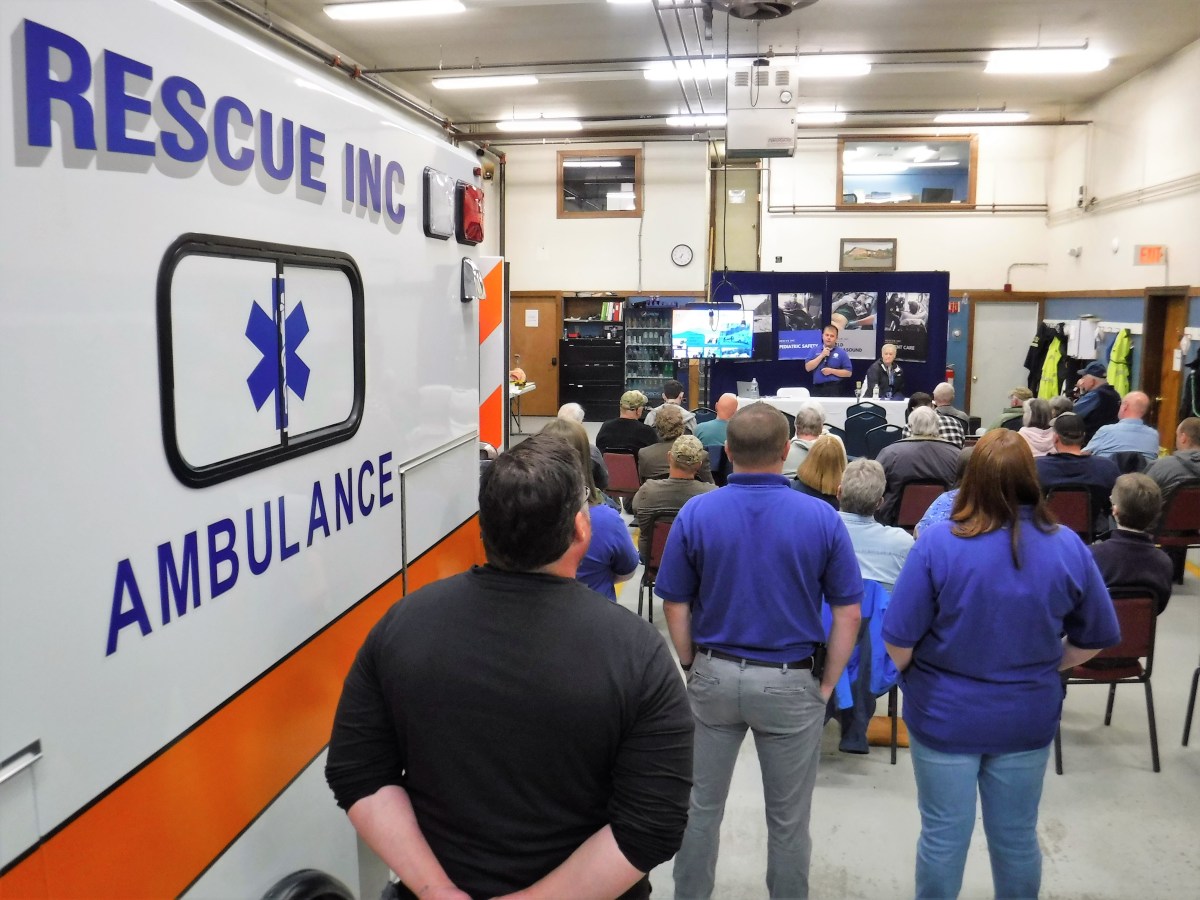
For years, emergency medical services in Vermont and in many rural parts of the country relied entirely on volunteers. But more recently, volunteerism has dwindled and providers throughout the state have transitioned to a different model.
“We at one point had 75 volunteers on a roster,” Colleen Ballard, executive director of Essex Rescue, said. She now counts 12, with two on leave.
As the volunteer pool shrank, Essex Rescue had two options: stop its services or start hiring paid staff. It opted for the latter.
Throughout Vermont, emergency providers have followed a pattern similar to that of Essex Rescue. Yet while the organizations have professionalized, their overarching structures and funding did not follow.
“EMS around the country is struggling. This is not just our area,” Ballard said. However, in Vermont, “our system has relied for much longer on volunteerism and we’ve been late to catch a train of recognizing that’s not going to be forever,” she added. “It has put us in this fragile state.”
The “fragile state” is starting to catch up with Vermont’s providers. EMS organizations across the state are not only financially strained as they need to pay their staff, but the staff — often still a mix of volunteers and paid personnel — is also facing a higher workload.
“With the increasing call volumes across the state, the decreasing number of volunteers, the challenges surrounding funding is putting stress on EMS services,” Bambi Dame, the state’s emergency medical services chief, which is part of the Department of Health, said in an interview with VTDigger.
Medical professionals warn that the state’s EMS system, once designed for volunteers and much lower call volumes, needs reforming.
“Unreliable levels of local, state, and federal support have pushed our fragile system and those who serve our communities to the point of crisis,” said a report recently submitted to the Legislature written by the Emergency Medical Services Advisory Committee.
“The heavy reliance on volunteers to staff EMS services, fill key EMS district positions, and coordinate regional EMS operations is an unsustainable model,” said another report by the Vermont Department of Health.
However, the department has limited insight into the scope of the problem of dwindling volunteerism. Although the number of licensed EMS practitioners is on the rise, there is no data that tracks the number of volunteers in the system, according to Dame, who prepared the report to the Legislature.
“Our system isn’t there yet,” Dame said. “We’re really working toward being able to have that data because we feel it’s an important data set to have to really understand our workforce.”
A lack of funding and support
To remain operational, Essex Rescue asked member towns to fund its increased budget last year, a request that was met with discontent.
“It wasn’t something that I really wanted to do,” Ballard said. “But if I didn’t, we would have survived only on our capital reserve account and when that was gone, we would have to close our doors.”
Nationwide, ambulance services rely on reimbursements from private health insurance companies and public programs such as Medicaid and Medicare. However, often emergency medical providers get paid only if they transport a patient. In a rural place like Vermont, with the nearest hospital sometimes more than 30 minutes away, responders often deliver on-site medical care, for which they are not always reimbursed.
According to Dame, among 911 responses in 2023 where transports were measured, about a quarter were “non-transports,” meaning that a person was not transported to a hospital and providers did not receive any compensation if the patient was a beneficiary of Medicare.
Even when reimbursements are made, they often do not cover the actual cost.
“Reimbursement for service is likely to be $600 for each call with most services expending more than $1000 in actual cost, capital, and labor for the service,” according to the report written by the Emergency Medical Services Advisory Committee.
In addition to the operation cost, EMS providers are also grappling with the cost of readiness.
There is a “gap in funding between paying for the service provided and being ready for the next call for service,” Bill Camarda, the executive director of Bennington Rescue, said in testimony to the Legislature on Tuesday. “It is very difficult in this environment to be able to pay a competitive wage for someone who is providing life-saving care,” he said.
While the outdated system has the attention of some politicians, both at the federal and state levels, there has been no legislation passed yet to improve the situation.
Last November, Vermont’s congressional delegation introduced a bill that would require Medicare to pay for EMS regardless of whether a person is transported to the hospital.
At the Statehouse, legislators are considering H.622, which would reimburse EMS organizations for Medicaid beneficiaries who were not transported to a hospital.
“We have an aging system,” Daniel Batsie, the deputy commissioner of public safety and former chief of EMS, said during his testimony in the House Committee on Government Operations and Military Affairs on Tuesday. “We are asking EMS agencies with these modern challenges to try to do it with the budget that worked in 1960 and that is not reasonable,” he added.
In addition to changing the funding, H.622 would attempt to reorganize Vermont’s EMS system to provide a clear point of oversight.
“It is the intent of the General Assembly to designate a central agency with responsibility for the coordination and integration of all State activities concerning emergency medical services,” the bill states, after recognizing EMS services as “essential.”
EMS practitioners such as Ballard stress that without adequate funding and support, consequences could be disastrous.
“We’re either going to get the support we need and they recognize that the service we provide is important and valuable and we grow on that, or they’re not (going to recognize that) and something catastrophic will come of it,” she said.
An increased pressure
As medical standards advance, the time commitments required to get licensed or certified have increased over the years too, which is one explanation for the dwindling number of volunteers. In addition, volunteers are often asked to fulfill several responsibilities on top of their emergency medical practices.
“Not only are we asking them to be highly qualified medical professionals, but we’re also asking them to fundraise the dollars they need to buy medications and supplies and equipment that they use every day responding to calls,” said Drew Hazelton, chief of operations of Brattleboro-based Rescue Inc. and a member of the Emergency Service Advisory Board.
“I think we may be at a point where we’re asking too much,” he said.
Mad River Valley Ambulance Service is one of the few Vermont ambulance services successfully run by volunteers — who have taken on a wide range of additional duties.
“I think we are the exception,” said Mark Giometti, EMT, treasurer, and part of the recruiting and retention committee at Mad River Valley Ambulance Service. “I think the overall system is in trouble.”
Giometti told VTDigger that the ambulance service’s workforce wants to remain a volunteer-run organization. But with an aging volunteer squad, Giometti also understands that, like other providers, the operation may someday need to move into a hybrid model of volunteers and paid staff.
“It is a little scary because we don’t always have a full-duty crew signed up,” said Patty Giometti, the organization’s press liaison, who is married to Mark. “When three of (the staff) came down with Covid at the same time, we were scrambling. We still handled our calls, but we constantly need to be recruiting.”
Despite a statewide staffing crisis, Vermont’s EMS system counts 3,277 licensed or certified EMS practitioners, which is an increase from previous years, Dame shared.
But the number of calls also rose alongside the increase in providers. In the past five years, there has been a 22% increase in calls, with a total of 124,740 in 2023, according to the report by the Emergency Services Advisory Board.
Adding to that, the increase of licensed or certified EMS practitioners has been mainly among first responders, firefighters and others who have completed the first tier of EMS training, due to a licensing campaign that was launched in 2022. While first responders are important, they can provide a more limited range of services than paramedics, Emergency Medical Technicians, or Advanced Emergency Medical Technicians. The report written by the Emergency Medical Services Advisory Committee found that the number of EMS providers declined by 14% as 390 providers did not renew their licenses.
According to Dame, Vermont has mainly seen a decline in AEMTs, who provide crucial medical care such as starting an IV. Their decline means that AEMTs working in Vermont have an increased workload on top of the higher call volume, a situation that providers say cannot be sustained.
“Because of the commitment of the providers, people are still getting the care that they need. But how long can that continue?” Hazelton asked. “Our system is in crisis.”
Correction: An earlier version of this story mischaracterized what kind of care Advanced Emergency Medical Technicians are allowed to provide.
