
Lamoille County Mental Health Services (LCMHS) has been providing peer support for many years now. This is groundbreaking work in the emerging climate of the mental health landscape. Peer support is first and foremost about the two R’s: Relationship and Recovery. As such, peer support is about two individuals, both with lived experience, coming together to find new ways of thinking about a problem or issue.
Peer support is not a clinical model of care. It is not about assigning roles to the relationship (like professional vs. patient), based on traditional psychiatric models, nor about disability or “labels.” Peer support is a system of giving and receiving help founded on the following principles: Respect, shared responsibility, and mutual agreement of what is helpful. Peer support is a fundamental principle of trauma-informed care.
There is broad support for the creation of more peer services for individuals receiving mental health care. It is an effective model with positive outcomes that empowers folx and promotes self-efficacy and hope. It also just happens to be more cost effective and sustainable than traditional forms of mental health support and reduces the need for costly and often traumatic interventions like hospitalization.
Vermont is currently working to establish a Certified Peer Support credential for individuals in recovery who have a desire to support those who may be facing similar experiences. There will be a specific training curriculum and process that folx can undergo to use their experiences to support others as a Certified Peer Support Specialist. While this program should be coming to fruition in VT in the next year or two, peer support is not new – it has been around for many years in other states and has been a key part of our culture here at LCMHS for some time.
Currently, there are nine peers in the Cadre program at LCMHS, all of whom have some type of lived mental health experience. Embodying the mission of LCMHS, peers come to work every day to make a difference in the lives of the folx they support. They work with individuals in groups or one-on-one and can address everything from transportation needs, to working in our Wellness Center, to shopping in the community, to beating anxiety and depression issues, to just holding space for another person and being a one-on-one support.
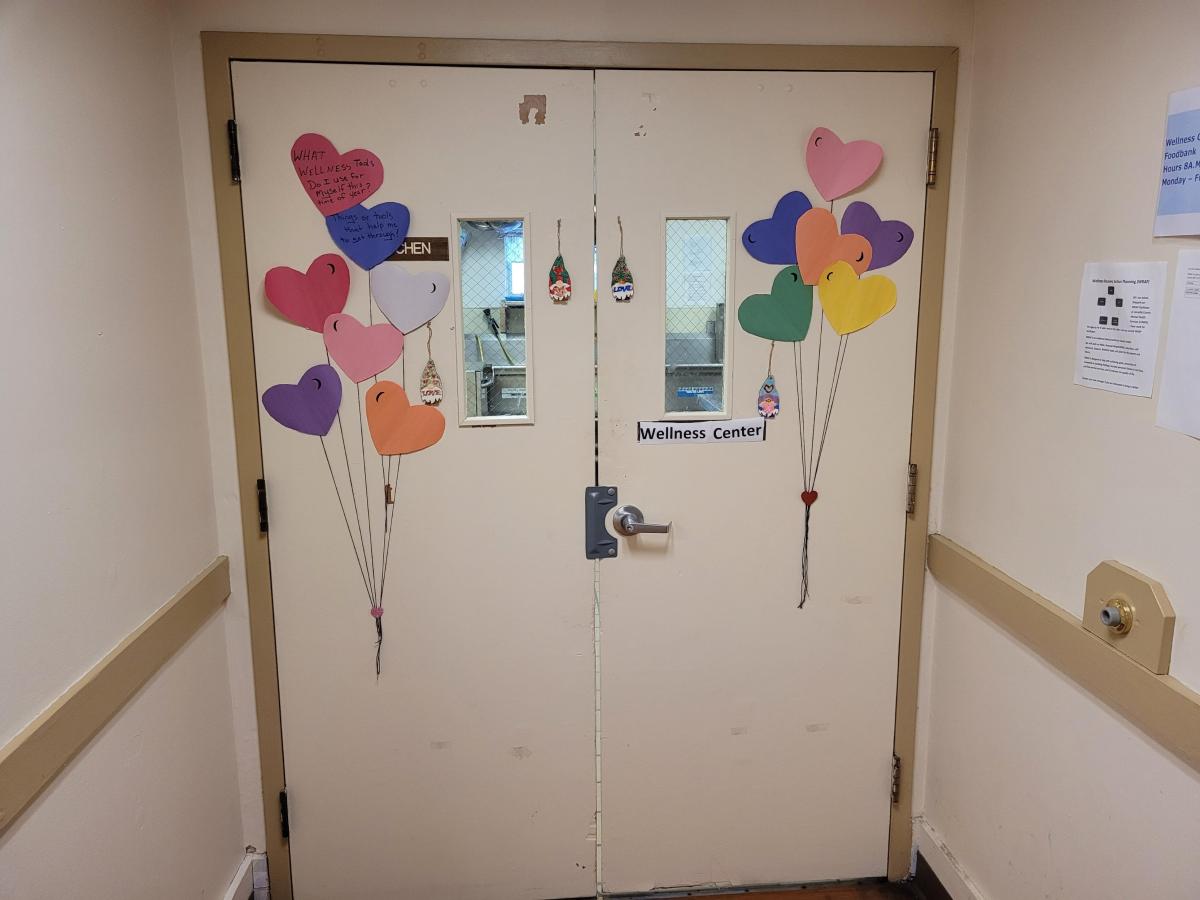
The doorway to our Wellness Center. The staff and participants decorate every month!
The fearless leader of the program, Megan, has been working at LCMHS for many years. She worked in direct service before she became the coordinator of our Wellness Center. When asked what she loves most about peer support Megan said she loves, “The opportunities that it gives the individuals we serve that need the support and also the support that it gives to our vulnerable populations.”
As far as growing peer support, Megan noted, “My hope is to grow more supports to offer to people we serve and have more opportunities for community integration.” When asked about challenges, Megan said, “The stigma that is present around our peer support staff and for the clients to be willing to accept more supports and get more involved in peer support services.”
Wellness Recovery Action Planning (WRAP) is an evidence-based practice that helps folx produce a plan for their ongoing wellness and what to do if things take a turn for the worst. Jolene at LCMHS has been leading the charge with integrating WRAP into the lives of the individuals involved in adult mental health care.
When asked about the impact of WRAP, Jolene had this to say – “WRAP is beneficial for our clients because it helps them produce a daily maintenance plan and their WRAP tools that they discover with that plan can help them before they go into a crisis. WRAP is also a peer support tool in that we share life stories that might mirror each other’s. The key concepts are hope, education, personal responsibility, self-advocacy, and support. We learn with each other too. One of the key pieces of WRAP is learning together.”
Jolene added, “I love my job. I love that I get to be with different people. I get to be with people at all different points in their life and I get to do different things with people every day. I get to do community support with people as well and I love that. I am in it for the consumers I work with. I also like listening to people when they tell their stories. It depends on what the person needs at that time. I have sat with people at home and in the hospital. Those are not things that you normally get to do at some jobs. Being a peer support gives me an opportunity to be there for someone when I’m needed.”
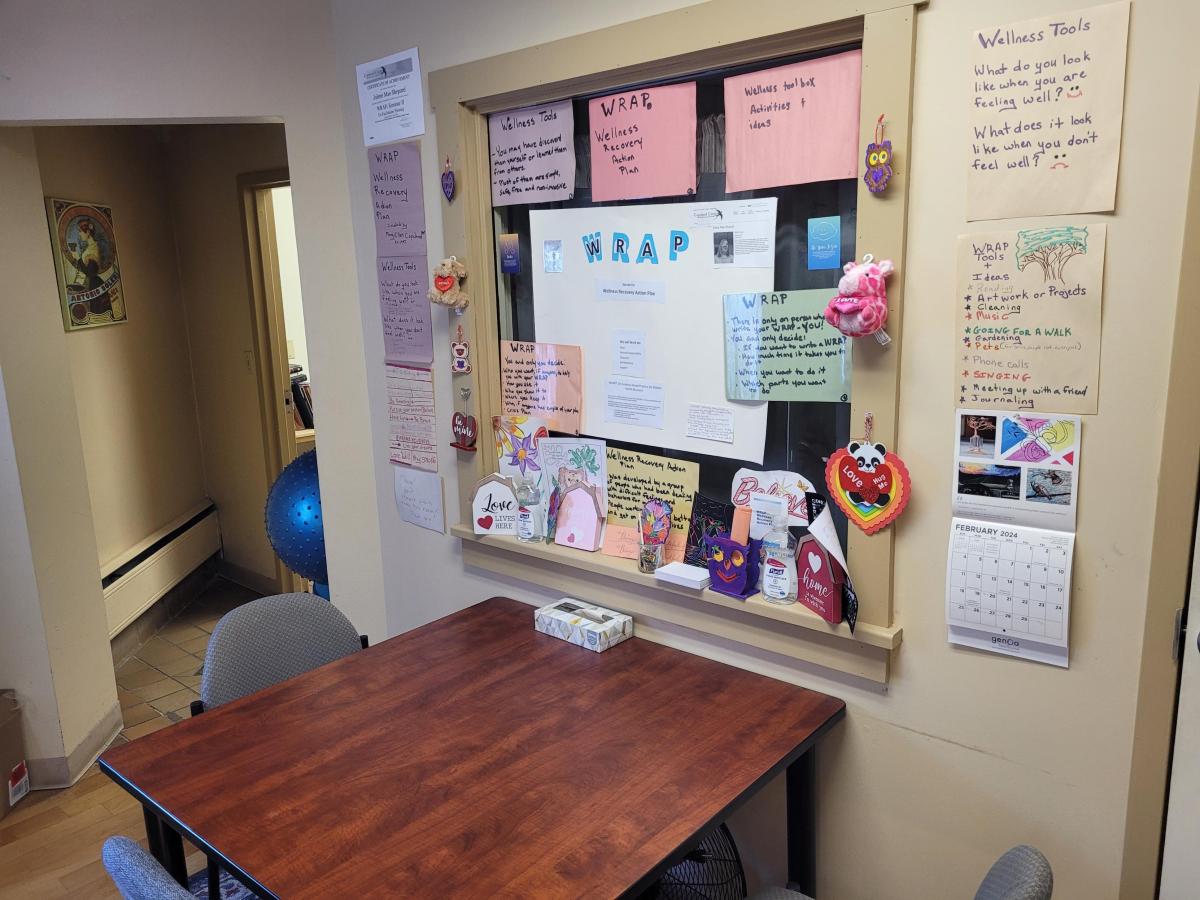
Our WRAP room!
Angela is one of the peer support staff at LCMHS. She was able to share her thoughts on the important work that she does – “Peer Support means being there for other people. It is not always that they are in a struggle, it is being there for them when sometimes they are doing well at the time to be able to continue to support them wherever they are at. Being able to listen and show compassion and support. And to try to support them with any goals that they might have. And to always hold the hope until they can hold it for themselves. I enjoy working one-on-one with people and doing groups. We do a BINGO group, we have a walking group, a baking group which helps people learn skills and how to work as a team. Art group is therapeutic and helps people to express their own individual creativity and is a warm and welcoming group of clients and peers.”
Brett, a participant at the Wellness Center said, “I get to meet new people and form relationships. The Wellness Center has given me the courage to move forward. I feel grateful that I can associate with people in a positive manner and go there and move forward with my positive wellbeing. I can use the resources to better myself. I have been in the agency for decades and I am happy in knowing that I can move forward in life and better myself. Coming here has really given me a new perspective on life. I have a great team. I have a case manager and a therapist, and I am happy that we’ve set up something like this (the Wellness Center) to help people move forward and create a better life for myself.”
Myles has been working in Peer Support for about nine years and wanted folx to know, “I love helping people. Keeping busy. The people are the most important thing…if I can do something for them.” When asked what his favorite thing about peer support is, he said, “being able to support somebody in their daily life. It makes me feel good. If I were not doing peer support, I would probably be at home doing nothing. I am retired, but it gives me income and I help people.”
For as far as we have come, stigma is still present and a factor in the lives of those who struggle. Peer support helps to shift that narrative and allows those in need of help to access it in a way that is supportive and free of judgement.
Lamoille County Mental Health Services is a nonprofit organization providing quality developmental and behavioral health to the Lamoille Valley area, enhancing independence and quality of life. A collaborative community with wellness at its core providing excellence in behavioral health and developmental services, that promotes wellness, independence and quality of life through access to person-centered integrated care in Lamoille Valley.
This article is part of a collaboration produced by members of Vermont Care Partners. Vermont Care Partners is a statewide network of sixteen non-profit, community-based agencies providing mental health, substance use and intellectual and developmental disability support

