

During the five years Jose Ignacio worked on a Vermont farm, he traveled only between his home and place of employment, too scared to go anywhere else for fear of being pulled over.
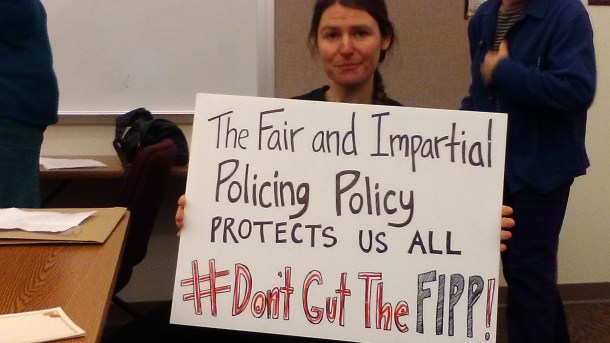
Ignacio, who now works in housing construction, was among four migrant workers who testified before the Vermont Criminal Justice Council on Feb. 7. Sharing stories of living in daily fear of being turned over to immigration authorities, they sought to impress upon the council the urgency of approving a revised fair and impartial policing policy.
“While we wait a lot of things can happen. Immigration can be called on us. Our families can be separated,” said another worker who identified himself as Eduardo. “And that is not just, that is not human.”
The proposed revisions aim to provide more protections for undocumented workers by closing what advocates have characterized as Trump-era loopholes added to the state’s policy in 2017.
The council was poised to vote on the revised policy at its monthly meeting last week. But, to the dismay of advocates and even several council members, Bill Sorrell, its chair, opened the meeting with a call to postpone the decision. He cited a recent letter from the Vermont Association of Chiefs of Police to the council, which, he said, “raised significant issues.”
The decision to delay the vote was overshadowed in the moment by a subsequent hot mic moment in which Mike Major, who represented the Vermont Police Association on the council, made a disparaging remark during Eduardo’s testimony, prompting an outcry and his on-the-spot resignation.
(Major apologized and then resigned from the council during the meeting and has since resigned from positions at the Bristol Police Department and the Chittenden County Sheriff’s Office.)
But in the aftermath of that event, advocates have pointed to Major’s comments as further evidence of the urgency of passing a stronger fair and impartial policing policy.
They’ve expressed dismay that the council chose to push back its vote, noting that the revision process dates back to 2019 and has involved law enforcement, state agencies and community members.
“This is a very disappointing development in what has been an extremely long and frustrating saga,” said Will Lambek of Migrant Justice, an advocacy group representing Vermont’s immigrant farmworkers.
The amended policy now under consideration, which was drafted by a subcommittee of the criminal justice council, would clarify the conditions under which local and state law enforcement may investigate suspected violations of federal immigration laws or contact immigration authorities. It states that seeking translation assistance from such figures, for example, is not an acceptable reason. It would also amend the definition of who constitutes a federal immigration authority, adding Homeland Security Investigations to the existing list.
The two-page letter from police chiefs listed 15 concerns, the first of which suggested the proposal was, in fact, an immigration policy and not a fair and impartial policing policy. The association asked that all immigration-related references be “stripped” from the document — a request some advocates said was ludicrous.
Doing so “would betray one of the most fundamental principles of Vermont’s Fair & Impartial Policing policy ensuring that local law enforcement refrain from discriminating against people based on their perceived immigration status,” said Falko Schilling, a lobbyist for the American Civil Liberties Union of Vermont, in a statement after the meeting.
Ann Schroeder, chair of the Windham County NAACP’s criminal justice committee, suggested the chiefs association had had ample opportunity to air its concerns earlier in the process. “This delay seems to me like it is a bias in favor of law enforcement. They had their chance in the (fair and impartial policing) subcommittee,” said Schroeder.
“I was there when they changed the policy because of Trump,” Schroeder continued. “I am extremely frustrated and my heart just breaks every day for what these undocumented people are going through.”
Amanda Garces, the chair of the council’s fair and impartial policing subcommittee, said the chiefs “seem to view immigration as peripheral to the concept of fair and impartial policing which prioritizes treating all individuals with equity and objectively, regardless of their backgrounds or immigration status.”
The state’s model fair and impartial policing policy was established in 2016 but was amended in December 2017 “to clarify the circumstances in which officers can consider personal characteristics or immigration status when making law enforcement decisions.”
According to a report from the subcommittee, those 2017 changes resulted in “the scaling back of certain safeguards for immigrant workers.”
Garces, who represents the Vermont Human Rights Commission on the subcommittee, said the new proposal “not only safeguards everyone’s safety and welfare but also provides law enforcement with a clear framework to follow.”
Ultimately, the council voted 17-1 to push the vote to its next meeting. Cassandra Burdyshaw, who represents the human rights commission on the council, was the lone “no” vote. Xusana Davis, executive director of the state Office of Racial Equity, and Karim Chapman, of the Life Intervention Team, abstained.
Erin Jacobsen, who represents the Office of the Attorney General on the council, said, “I fully hear, feel and agree with the frustration for how long this has gone on and I regret that all of the chiefs’ comments came so late in the game.”
But she argued that the opportunity to discuss the chiefs’ letter could well lead to a better outcome.
In an interview with VTDigger, Sorrell said the chiefs’ letter brings up “some very tricky legal issues that relate to this interplay between state and federal law” that require further discussion involving legal counsel.
“This is not going to go on the backburner — I make that commitment. If we can’t make it by next month then it will be the following month,” he said.
“We can’t just dodge tough issues and we can’t give a veto to a minority view on the council. We express our opinions, be respectful of differing opinions, and then we make our calls. That’s why the Legislature created this council with different voices,” Sorrell continued “So let’s not duck, let’s take on the tough ones.”
Correction: An earlier version of this story mischaracterized Ann Schroeder’s involvement with the fair and impartial policing subcommittee’s work.
