




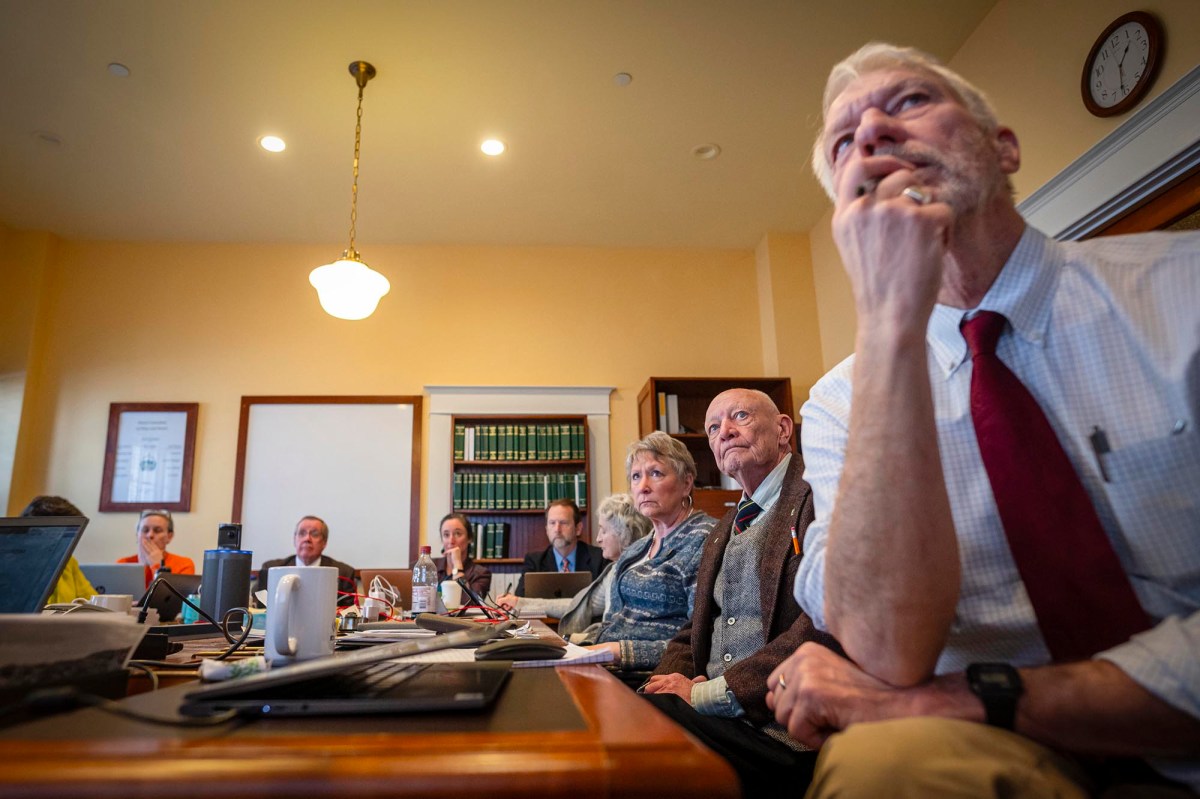
As state lawmakers consider whether to raise taxes on Vermont’s richest residents this year, they are seeking answers to a perennial question: Could higher taxes on the wealthy drive them out of the Green Mountain State?
Cristobal Young, a sociologist from Cornell University and author of the book “The Myth of Millionaire Tax Flight,” told members of Vermont’s House Committee on Ways & Means Thursday that such concerns are vastly overstated and often based on misleading anecdotal evidence.
“Millionaire tax flight does sometimes occur,” Young said. “It’s just that the magnitude is small, and it has very little impact on the stock of millionaires in the state.”
Vermont legislators are currently mulling over H.828, which would impose a 3% surcharge on income exceeding $500,000 annually. If passed, the law would impact just over 1% of Vermonters while bringing more than $70 million into state coffers, according to estimates from the Joint Fiscal Office.
Lawmakers have also proposed H.827, a bill that would tax unrealized capital gains on Vermonters with more than $10 million in net worth. The JFO has not yet presented a revenue estimate for that proposal.
“What the critics argue is that you can’t tax millionaires because if you do they’ll move away and you won’t get that tax revenue,” said Young.
According to Young, though, the ultra-wealthy traditionally haven’t migrated in droves following such tax hikes. Only 2.4% of U.S.-based millionaires move across state lines each year, roughly 15% of whom apparently do so for tax reasons. “So it’s like a small fraction of a small fraction,” Young said.
To Young, states should be less concerned with repelling the wealthy, who are usually older and have put down roots, than with attracting recent college graduates, who tend to be more mobile.
A smart tax system, he concluded, is one in which you “tax the late-career folks who aren’t really going anywhere and use it to invest in the things that attract and provide support and are appealing for future high-income earners.”
— Habib Sabet
In the know
Later on, the same committee heard arguments about how much a proposed ban on flavored tobacco sales could save and would cost.
Proponents of S.18, which would prohibit the sale of flavored tobacco products such as e-liquids and (at a later date) menthol cigarettes, said the bill will pay dividends by reducing the number of people hooked on nicotine, an addiction that often leads to costly health problems later in life.
Meg Riordan, representing the Campaign for Tobacco-Free Kids, told lawmakers that research suggests that long-term health care costs would be lower by $8,500 for every smoker who quits, while $16,000 would be saved for every youth that doesn’t start smoking.
But retailers testified that the bill would cut into the coffers of local businesses — and the state.
Erika Young, representing the Sandri Companies, a fuel retailer, said that the bill would cause its eight Vermont stores to lose a combined $1.06 million in revenue and about $122,000 in profit, which might require them to consider job cuts.
The testimony came a week after an updated estimate from the Joint Fiscal Office, which concluded that the state will lose between $7.2 and $13.5 million of tax revenue in the first full full year of a ban.
Brian Erkkila, who represented the tobacco company Swedish Match, pointed to Vermont’s current need for additional state funding for flood assistance, education and housing. “But a proposed flavor ban would only give the state less money to meet this growth in demands,” he said.
— Peter D’Auria
Officials from Gov. Phil Scott’s administration offered more details Thursday on their plans to set up temporary, emergency shelters for unhoused Vermonters exiting the state’s pandemic-era motel housing program.
In addition to standing up a congregate shelter at the Waterbury Armory, the Department for Children and Families is moving forward with plans for a family shelter at the former Austine School for the Deaf in Brattleboro, and is working on standing up three “emergency shelter apartments” in central Vermont with service provider Capstone Community Action, DCF commissioner Chris Winters told lawmakers at a Statehouse hearing Thursday.
— Carly Berlin
On the move
A debate that simmered in legislative committees for weeks boiled over on the Vermont Senate floor Thursday during that chamber’s vote on an amendment to the budget adjustment bill.
“I cannot support a continued degradation of public education,” Sen. Ruth Hardy, D-Addison, told her colleagues.

How did the annual budget adjustment vote lead to talk of the dismantling of public education? The source of the debate was a pot of money created through cannabis sales tax revenue meant to fund after-school and summer learning programs.
At issue was whether that money should go directly to public schools — as current law allows — or whether private and nonprofit programs should also be able to apply for funding, which, some senators argued, was the intention of lawmakers all along.
— Ethan Weinstein
After their lengthy debate on after-school funding, the Senate on Thursday advanced the Senate Appropriations Committee’s version of this year’s Budget Adjustment Act by a 21-8 vote.
Also of major interest in the bill are millions of dollars, as proposed by the House, to provide grants to municipalities battered by this summer’s floods.
According to Senate Appropriations Chair Jane Kitchel, D-Caledonia, the Senate’s version proposes $12.5 million in general fund dollars, half of which can be used to cover a broad range of municipal losses, and half is available to cover residential losses, to be distributed in the form of grants. From there, municipalities would have the freedom to decide how best to spend the money, Kitchel said.
The Senate is scheduled on Friday morning to debate a highly anticipated amendment to the BAA on the state’s emergency housing program. Should senators approve the budget adjustment on third reading, the spending plan will go into conference committee with the House to rectify the two chambers’ differences.
“We may need to do some tweaking,” Kitchel said.
— Sarah Mearhoff
Gov. Phil Scott signed S.160 into law on Wednesday, giving municipalities hit hard by the July 2023 flooding a break on some of the education property taxes they owe to the state.
— Erin Petenko
Visit our 2024 Bill tracker for the latest updates on major legislation we are following.
On the hill
Vermont’s two delegates to the U.S. Senate staked out opposite positions Wednesday on a key procedural vote to advance a bipartisan measure marrying new border restrictions with additional aid for Ukraine and Israel.
Sen. Bernie Sanders, I-Vt., joined four Democrats and most of the Republican caucus in opposing the measure, while Sen. Peter Welch, D-Vt., joined four Republicans and most Democrats in voting for it. The motion to advance the legislation, which required 60 votes, ultimately failed by a vote of 50-49.
— Paul Heintz
Bad vibes
If I may be so bold: The vibes were OFF in the Senate today. First of all, thanks to a furnace on the fritz, the room was, in my estimation, 500 degrees. Throughout a more than three-hour-long session, senators were fanning themselves with sheets of paper, and even — gasp! — drinking water on the floor.
Interrupting her marathon BAA presentation to take a sip, Kitchel said, “I feel like a camel in the desert.”
Such a heated debate (literally and metaphorically) can garner quite the crowd of observers in the gallery. Indeed, Thursday’s did, and lobbyists and House members in attendance were, it appeared, unaware of or unbothered by the Senate’s strict rules against electronics. Various cell phones chimed their familiar ding, ding, dings, drawing the vitriol of Senate Secretary John Bloomer, who raced up to the gallery to scold the crowd.
Lt. Gov. Dave Zuckerman took to passing a flurry of notes to members in the room as well as observers in the gallery. The poor pages scuttled the notes to and fro, up and down the stairs in the heat. One got a nosebleed.
At one point, when I took my leave from the chamber to have a snack outside (because I’m a rule follower) Rep. Mary-Katherine Stone, D/P-Burlington, pondered to me: Was all of this chaotic energy due to the House’s afternoon vote on H.666?
— Sarah Mearhoff
What we’re reading
Vermont’s biggest municipalities set March votes on nearly $60 million in capital projects, VTDigger
Burlington Mayor, CityPlace developers want to add hotels to project and reduce housing, VTDigger
