

BURLINGTON — In the next two months, city officials hope to push through a broad revamp of residential zoning that would allow for denser housing development throughout Vermont’s largest municipality.
The city’s planning department pitched the latest version of the so-called “neighborhood code” to the City Council at its meeting on Monday night. And while some councilors expressed concerns about the draft ordinance, all but one agreed to advance the plan, with the hope of passing it before a new council and mayor take the helm in April.
Mayor Miro Weinberger, who is not running for reelection, called the rezoning effort “probably the most significant action we will have taken in my time here to really try to do something meaningful about the housing crisis.”
He and most of the council want to take action soon — before significant turnover occurs in City Hall. In addition to electing a new mayor for the first time in 12 years, residents on Town Meeting Day will vote for councilors in eight races.
“It will be dramatically interrupted if we wait and hand this work off to a new group of people that is likely to include numerous new individuals,” Weinberger said. “And there’s a real risk that all this work is wasted and comes to naught if we do that.”
Typically, the council refers new ordinance proposals to its ordinance committee for study. On Monday night, it skirted that step, instead warning the neighborhood code proposal for a public hearing, expected to be held in late February.
Weinberger kicked off the neighborhood code project over two years ago when he released a housing action plan that called for finding ways to allow for more residential buildings. It called for a focus on what city planners call the “missing middle,” by allowing for the creation of more duplex, triplex and other multi-unit buildings in areas long restricted to single-family residences.
Working closely with the planning department, a joint committee made up of members of the council’s ordinance committee and the Planning Commission met nine times, gathering input from each of the city’s distinct neighborhoods on how to proceed.
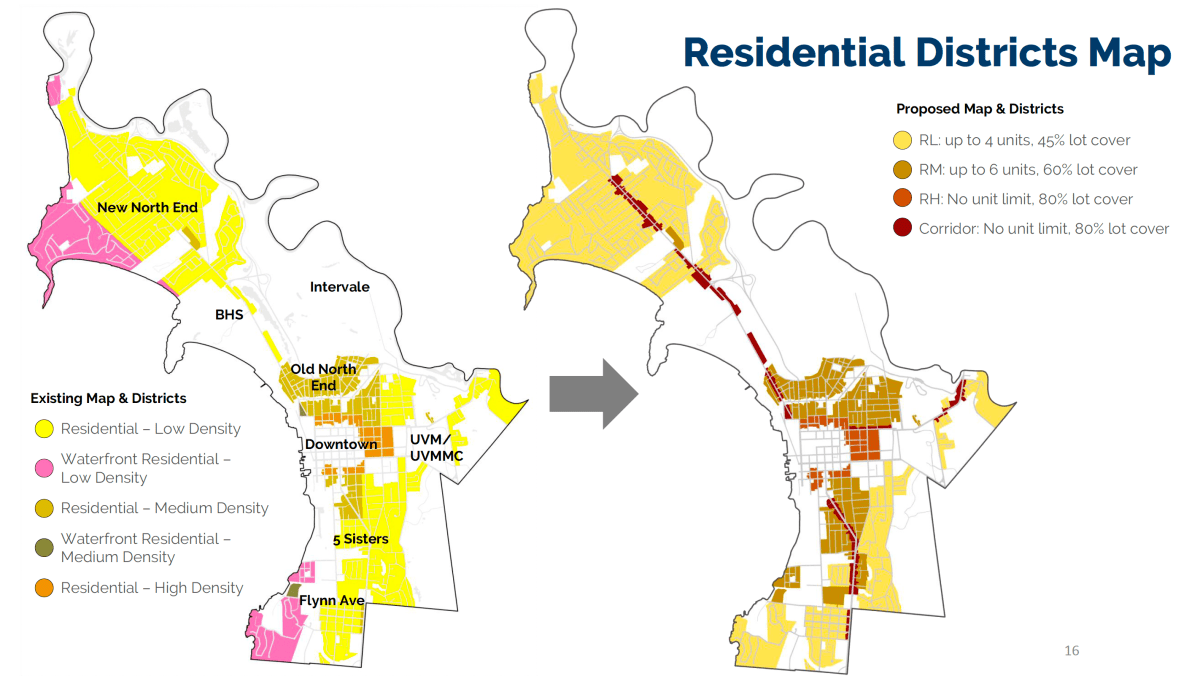
The latest version of the neighborhood code proposal, as presented on Monday, effectively would upzone all residential areas of the city, but distinctions remain, depending on the neighborhood.
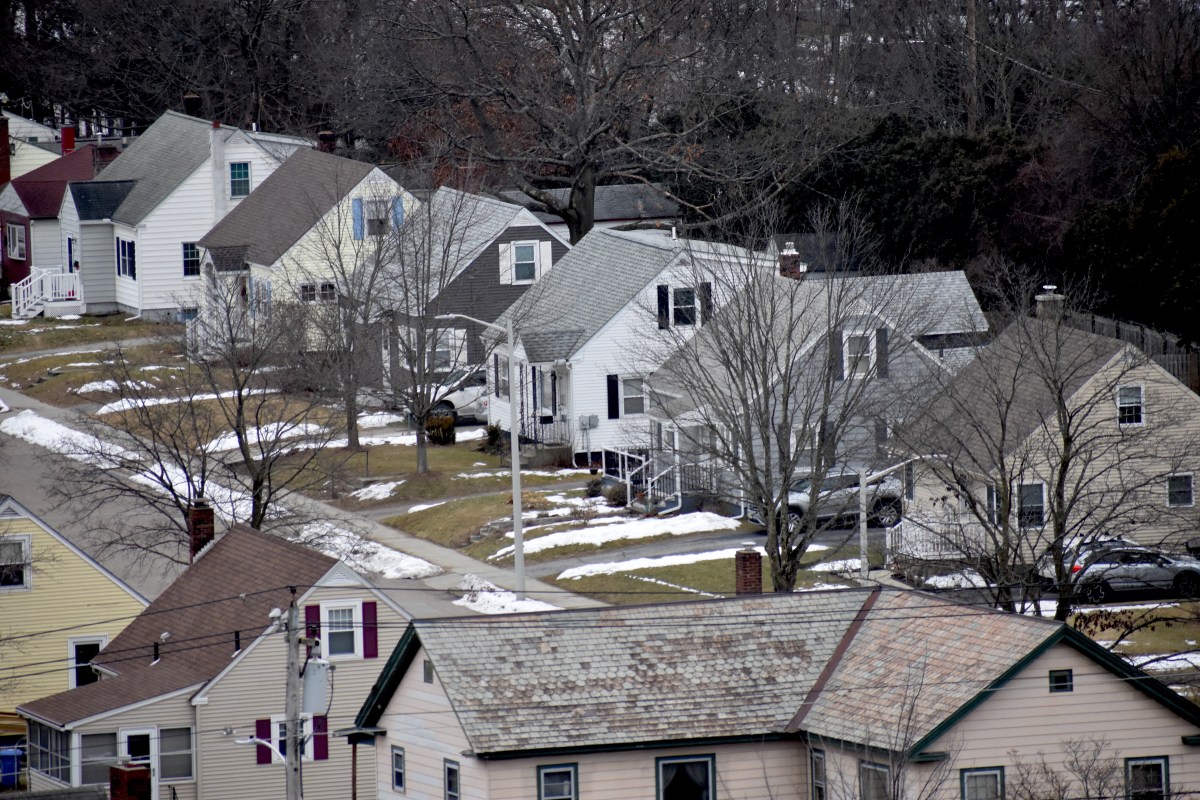
Areas of the city such as the New North End and portions of the South End, historically made up of mostly single-family lots at low density, will remain in a low-density district, but lot coverage limits in that district would increase from 35% to 45%. Other tweaks would allow for smaller lot sizes and secondary buildings on lots.
The plan designates other residential zones as medium-density (which would allow 60% lot coverage), high (up to 80% coverage), and a residential corridor (up to 80% coverage). It would also allow more commercial uses on common thoroughfares such as North Avenue and Shelburne Road.
After Burlington’s rezoning work had already kicked off, the Legislature took action on the issue. Last June, Gov. Phil Scott signed into law the HOME Act, which removed state barriers to denser residential construction and mandated allowing larger units such as duplexes (as well as tri- and four-plexes if served by municipal water and sewer).
Meagan Tuttle, director of Burlington’s planning department, noted in her presentation to the council on Monday night that the city’s proposed zoning updates satisfy the new state requirements.
All but one city councilor, Tim Doherty, D-East District, voted to advance the proposal. Doherty said the council should take more time to study the proposed ordinance.
Some of the councilors who voted to proceed with the plan said it would need further tweaks before final approval. Councilor Melo Grant, P-Central District, said she was troubled that the plan would preserve low-density zoning in particular areas of the city.
“I’m very disappointed. This screams equity issues to me. This screams that people that live in certain areas — they’re being protected in a way that I’m not comfortable with,” Grant said. Grant and Councilor Joe Magee, P-Ward 3, both said later that medium-density zoning should be the “floor” in all areas of the city.
Andy Montroll, chair of the planning commission, said the joint committee was split on whether to use the medium-density standard as a starting point, but in the end, the committee received data that suggested the building opportunities were limited in the areas that would remain low density.
Tuttle noted during the presentation that the updates proposed on Monday were only the beginning, addressing what she called the “core issues.” In further phases, the city will consider other housing options such as “cottage courts,” which are lots featuring a number of smaller, stand-alone units.
Members of the public will have an opportunity to weigh in when the council schedules a public hearing on the proposal, expected to be held on Feb. 26. The planning department also intends to hold another informational meeting prior to that hearing.
The public debate had already started at Monday’s meeting.
Burlington resident Michael Long said he thought the proposal increased density “beyond reason.”
“Neighborhood code protects the suburban template and directs the most severe and negative impacts at the under-pressure neighborhoods that can least tolerate them,” he said.
Bob Duncan, an architect who lives in Burlington, recalled speaking out back in 1974, when the city was debating zoning that restricted density.
“I didn’t understand why it was so restrictive then. I spoke at meetings then asking for it to be liberalized and less restrictive,” he said on Monday. Speaking again on the issue, 50 years later, he said, “It’s been a long time coming and it’s time to move it forward.”
