


In old German mythology, the sun and the moon were married. A solar eclipse — when the moon passes completely in front of the sun, blocking most of its light — was seen as the moon being drawn to his bride.
Hazel Wilkins, a recent graduate of the University of Vermont, knows all about the science of solar eclipses. Yet she drew on stories like the German one to describe her viewing of a partial solar eclipse in 2017 as an almost spiritual experience.
“Seeing (an eclipse) for the first time really opened my eyes to the possibility of connections — not only in the astronomical world, but really in our own lives,” she said.

Wilkins is the regional lead trainer of a group of academic researchers, citizen scientists and local space enthusiasts who are planning to study the sun in detail when it is covered by the moon for about three minutes on April 8.
The roughly once-in-a-century opportunity to view a total solar eclipse in Vermont is not just a chance to conduct astronomical research close to home, it’s also a chance to deepen the public’s connection to science, and for scientists to experience the topics they study firsthand.
Wilkins was a high school student in 2017 when she viewed the partial eclipse in Long Island. It helped inspire her to pursue astronomy as a future career.
“It has really sparked this huge passion of mine to really figure out the science that was going on behind all of these phenomena that are going on in the sky,” she said.
A total eclipse of the heart of researchers
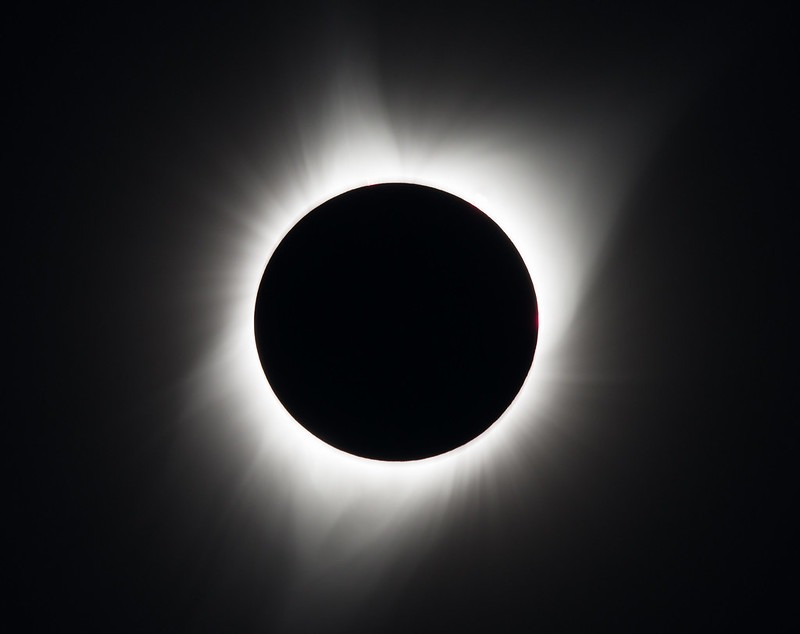
A total solar eclipse occurs when the moon aligns perfectly between the earth and the sun, blocking all of the sun’s rays and bringing on a brief dusk-like darkness, according to NASA. In clear conditions, the sun’s corona, or outer fringe of light, will peek out behind the moon, creating an orb of darkness surrounded by a glow.
Total solar eclipses occur roughly once every 18 months somewhere in the world, but they are rare for any one location. John Perry, an astrophysics professor at the University of Vermont, said the last time any part of Vermont experienced a total solar eclipse was in 1932.
“If you wait in one place and wait for a total solar eclipse to come to your location, you’ll wait about 360 years,” he said.
Only the top half of the state will experience a total solar eclipse on April 8. The “path of totality” will streak diagonally across the state, beginning in Burlington that afternoon and continuing northeast into the Northeast Kingdom, according to the University of Vermont’s eclipse website.
The southern part of the state will experience a partial solar eclipse, where the moon will not completely cover the sun, but will create a crescent shape viewable with proper solar safety equipment. (It is only safe to view the eclipse without safety equipment during the moments of full totality.)
Path of the 2024 solar eclipse through Vermont
Actually seeing the eclipse in Vermont, however, is not a sure bet. Vermont is typically 80% cloudy on April 8, according to the National Weather Service. So there’s a good chance the state will be cloudy. But even in poor weather, the darkness of totality will be noticeable, Perry said.
The likelihood of cloudy conditions hasn’t prevented space-loving Vermonters from planning for the possibility of a clear view. The University of Vermont has slated a series of events leading up to the eclipse for students and faculty, from lectures to trivia nights to a space career fair.
Justin Dulyanunt, president of the university’s Space Club, said the club was planning to set up viewing stations around campus on the day of the event. Perry is scheduled to give a talk in March about the history of scientific discoveries made during eclipses.
And that research continues into today. Wilkins is part of a nationwide project led by the Southwest Research Institute to collect data on the sun during the eclipse.
Because the moon blocks the sun’s brightest rays during an eclipse, scientists can observe the sun’s corona in more detail — like turning off a bright light to see a weaker glow more clearly.
Wilkins said 35 teams across the path of totality will use solar telescopes to capture a lengthy view of the inner corona of the sun. She is receiving applications from Vermonters who want to join her group of citizen scientists who will be trained on how to capture that data.

“We have applicants who are just in high school that are applying, all the way to really experienced astronomers with astronomical societies that are upwards of 50-plus years old,” she said. “It’s really great because we just love seeing the interest for just astronomy in general across all ages.”
After the event, the project also aims to donate the equipment used by the teams to local groups to allow community members to use it, according to Wilkins. As an original founder of the UVM Space Club, she sees it as a continuation of a long-held goal to bring more awareness of astronomy to others.
“I feel really just happy and privileged … that post graduation I'm able to kind of still be pursuing this goal of expanding the astronomical field and knowledge all throughout Vermont,” she said.
