
Consider what it would be like to move to a different country, one where the customs, traditions, and language are all unfamiliar. And what if the systems and services you’re so well acquainted with at home–things like medical providers and social services that you may not use often but when you need them, you really need them–what if they operate differently in your new country, and it isn’t clear what services are available or how to access them?
This simple thought exercise will help you understand, to a small degree, what members of Vermont’s resettled communities experience when they need help. The language barrier, combined with unfamiliar services and ways of accessing them, means that people who are new to Vermont are less likely to seek assistance from agencies like Howard Center, even though their needs can be great.
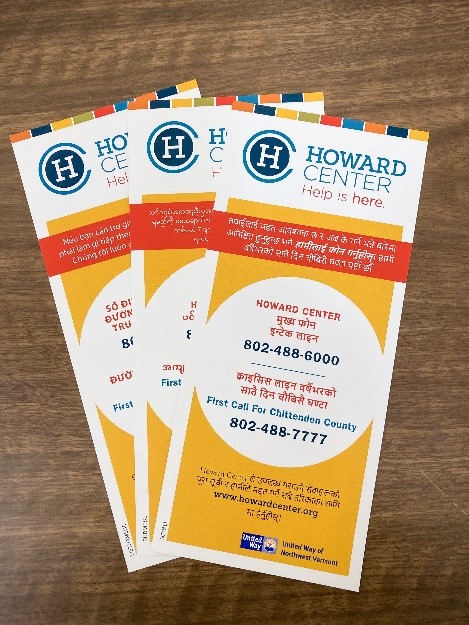
Many years ago, Howard Center recognized a need to make services more accessible for our resettled community. Overcoming language challenges was a clear priority so Howard Center began to use interpreters by phone or in person, enabling much easier communication between people with limited English skills and Howard Center staff. The agency also had a long list of publications and forms translated into the most commonly spoken languages in Vermont. Despte the success of the interpreter services and translated documents, these additions weren’t enough.
“Interpretation services are vital, but we found that having someone to interpret is only half of what we need,” shared Julia Paradiso, director of Howard Center’s Cultural Liaison program.
“Interpreters give exact wording and we often use clinical terms or idioms that, even when correctly interpreted, are unfamiliar to people that are non-English speakers. We needed someone who could help our resettled community make sense of the interpretation, and more importantly, be able to interpret services and how to receive care at Howard Center.”
Paradiso explained that the translation and interpretation issue are just some factors that led Howard Center to launch a Cultural Liaison program two years ago. “Yes, we needed to improve communication when receiving services, and we also needed to build connections in our resettled community so they are aware of the services Howard Center provides and are comfortable seeking help. What we really needed was staff that had lived experience in our resettled community and the knowledge of and ability to navigate Howard Center services,” said Paradiso.
In 2020, a large COVID outbreak in the Bhutanese Nepali population in Winooski accelerated movement toward the creation of a Cultural Liaison program. It was determined that members of the community were not aware of how to mitigate the spread of COVID because there was no connection to the greater community supporting and informing them. A group of concerned human service providers and community members met, and out of those meetings funding for services was established for our resettled population.
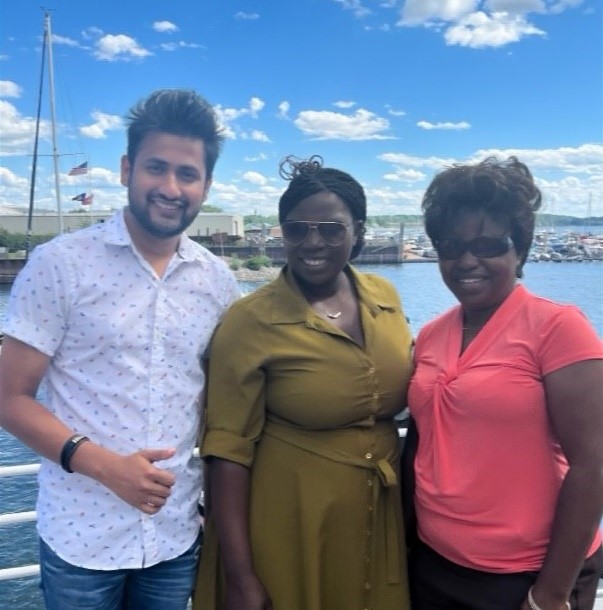
Thus, was born Howard Center’s Cultural Liaison program, a team of three individuals who are themselves from different resettled communities. Initially funded by the Vermont Department of Mental Health with grant money from the CDC, the team’s main purpose is to engage, build trust, and acts as ambassadors for Howard Center services in Vermont’s resettled communities.
Team members are not from every resettled community Howard Center serves, but they have similar lived experience which is vital to engagement. The team strives to demystify and destigmatize services and bring resettled community members into services, so they do not end up in crisis. Rather than being language interpreters, they are interpreters of Howard Center services. The small team has already increased community partnerships and served nearly 100 resettled families from 13 different countries, providing over 1200 services across all ages.
“We started the team two years ago, but it took time to hire, so we’ve really only been fully staffed for about a year and a half,” said Paradiso. “It’s amazing to see how much the team has accomplished in the short time it’s been up and running. It really speaks to the extent of the needs we’re trying to address.”
The team not only helps individual resettled families, but also assists Howard Center staff to become more knowledgeable about issues of acculturation, providing staff with a better understanding of how to serve individuals from the resettled community. The team has been vital to many Howard Center programs, consulting with staff throughout the agency to improve understanding of different cultures, leading to better outcomes.
Paradiso explained the program will continue to evolve with the needs of the community and build relationships with individuals and families, and with organizations representing the resettled community. Most recently, she noted, was the team’s work providing Mental Health First Aid training, a statewide program supported by Vermont Care Partner agencies across the state, to members of the community.
“We’re excited about what the program is and can become, and what it can mean for our resettled communities in Vermont,” said Paradiso. “Thinking about what people have gone through to get here and how hard it must be to find their way in Vermont, our Cultural Liaison team helps. We meet people in a way that acknowledges their language, cultures, and traditions. And that is a great start.”
ABOUT HOWARD CENTER: Howard Center has a long and rich history as a trusted provider in the community. With a legacy spanning more than 150 years, we have been providing progressive, compassionate, high-quality care and supports to those in need. Today, we offer an array of exemplary mental health, substance use, and developmental services across the lifespan. As Vermont’s largest social service organization, our 1,600 staff help more than 19,000 people each year in over 60 locations throughout Vermont in collaboration with hundreds of community partners. Howard Center’s 24/7/365 crisis service, First Call for Chittenden County, is available to meet the needs of Chittenden County children, adults, and families in crisis by calling 802-488-7777. www.howardcenter.org. Help is here. A United Way of Northwest Vermont Funded Agency.
This article is part of a collaboration produced by members of Vermont Care Partners. Vermont Care Partners is a statewide network of sixteen non-profit, community-based agencies providing mental health, substance use and intellectual and developmental disability support.

