




So, here’s what happens:
A person owns some land. Some guys with logging equipment knock on the door and offer to do some work for them. “We happen to be in the neighborhood,” they might say. “We have a little free time — want any timber harvesting done?”
The landowner agrees, either through a shabbily written contract or a spoken agreement, to sell the seemingly well-meaning loggers some of the fruits of their land.
But the loggers take more than the agreement stipulated. They leave the land destroyed. Sometimes, the landowners approach the loggers while they’re still at work, pointing out apparent contract violations, only to be threatened. In most cases, the landowner doesn’t see a dime.
Rep. Marc Mihaly, D-East Calais, told members of the House Agriculture, Food Resiliency, and Forestry Committee earlier this month that this scenario has played out in the northeast part of the state. It’s been happening for decades, and in 2016, lawmakers passed a law that made timber trespass a crime.
To add insult to injury, several landowners who have experienced timber theft in Vermont have taken the nefarious loggers to court — and won — some in the realm of tens of thousands of dollars.
“These people have been sued successfully and fined,” Mihaly said. “And here’s the problem: (the loggers) don’t pay the fine. They don’t pay the judgments.”
In many states, failure to pay would send the bad loggers to jail, he said. In Vermont, the state refers the fine to a collection agency, which sends an ignorable letter.
Mihaly has introduced a bill, H.614, that would address loggers with unpaid fines, giving them a choice: They could either work for a legitimate logger or be assigned a $50,000 bond by the Attorney General’s office. Absent these conditions, continuing to log would be considered a crime of land improvement fraud. This year, some loggers are signing on to the bill, arguing that the bad loggers are hurting the industry’s reputation.
Danielle Fitzko, commissioner of the Department of Forest, Parks and Recreation seemed tepidly on board during testimony on Wednesday, wanting to ensure that the state’s time, energy and resources weren’t solely allocated toward an issue that involves only a few bad actors when the broader logging industry is suffering economically. So far, it seems committee members want to make the bill a priority this session.
While learning about the issue, Mihaly met with representatives of the Attorney General’s office, the Department of Forest, Parks and Recreation, victims of timber trespass and representatives of the logging industry.
“It’s really amazing,” he said. “When you’re in the room, everybody’s pissed. Everybody’s frustrated at the inability to get at these guys.”
— Emma Cotton
In the know
Despite last year’s hand-wringing over an anticipated downturn of Vermont’s economy, one year later, state economists on Thursday were notably optimistic about where the state’s finances currently stand.
“We have no recession in the forecast,” economic adviser Jeff Carr told a panel of high-ranking lawmakers Thursday.
“Thank you for saying that so bluntly,” House Ways and Means Chair Emilie Kornheiser, D-Brattleboro, replied.
Until Thursday, lawmakers had been bracing for sour news in economists’ annual revenue forecast. In recent years, “epic, unprecedented, off-the-charts” influxes of federal cash — in the words of Carr last year — bolstered state revenues. Lawmakers knew those reserves were due to dry up, and they fretted that the state’s come-down would be harsh.
But according to Carr and fellow economist Tom Kavet’s report, Vermont’s economy over the past year has “exhibited surprising economic resilience.”
Unemployment rates remain low, inflation persists but has slowed, and the stock market is performing well, Carr and Kavet wrote in a report delivered to the state’s Emergency Board — a panel composed of the Legislature’s key money committee chairs and the governor — on Thursday.
Read more soon at VTDigger.org.
— Sarah Mearhoff
When temperatures plummet across Vermont, and traditional shelters are full, the state eases eligibility requirements for its motel housing program to get unhoused Vermonters out of the cold and into a room.
But this winter, many motels participating in the program — which acts as a safety net to the safety net — are regularly full, or very nearly so, said Miranda Gray, deputy commissioner of the Department for Children and Families’ economic services division, in an interview.
Currently, the department is turning away around 60 households a day because of lack of space, Gray said, though that number could count the same household more than once if they call multiple days in a row.
— Carly Berlin
Gov. Phil Scott’s administration announced that a voluntary paid family and medical leave program will now be available to private employers in Vermont.
The program, administered by The Hartford, a Connecticut insurance giant, has offered paid family and medical leave to state employees since July 2023.

Starting Feb. 15, all private employers in the state with at least two or more employees will be eligible to purchase the insurance, called Vermont Family and Medical Leave Insurance. Benefits will take effect July 1.
— Peter D’Auria
The cities of Montpelier and Barre unanimously passed a joint resolution this week supporting the flood omnibus bill H.723, a $85 million piece of legislation with a smorgasbord of funding and legal changes geared toward central Vermont’s specific experiences with the July 2023 flood.
Lawmakers from both of the “Twin Cities” announced the bill at a rally earlier this month, but it’s made slow progress since then. The House Committee on Environment and Energy hasn’t put it on its agenda yet, although other flood-related bills are in the mix.
Meanwhile, Barre and Montpelier city managers testified at the Senate Committee on Finance on Jan. 9 to tell lawmakers just how, well, screwed they will be on their budget shortfalls this year. Montpelier City Manager Bill Fraser said that between lost revenue and rebuilding costs, the city faces more than $3 million in direct financial exposure.
— Erin Petenko
The Senate Committee on Transportation rejoiced on Thursday morning as the Vermont Agency of Transportation arrived to give testimony on an ever-fascinating topic: stuckage.
That is, the problem of big trucks getting stuck while attempting to pass through Smugglers’ Notch on Route 108.
Five trucks have been stuck in the notch over the last three years, Josh Schultz, operations and safety bureau director with the agency told committee members. That represents a 40% decrease, which he attributed to increased signage, social media blasts and articles from the Vermont press (you’re welcome).
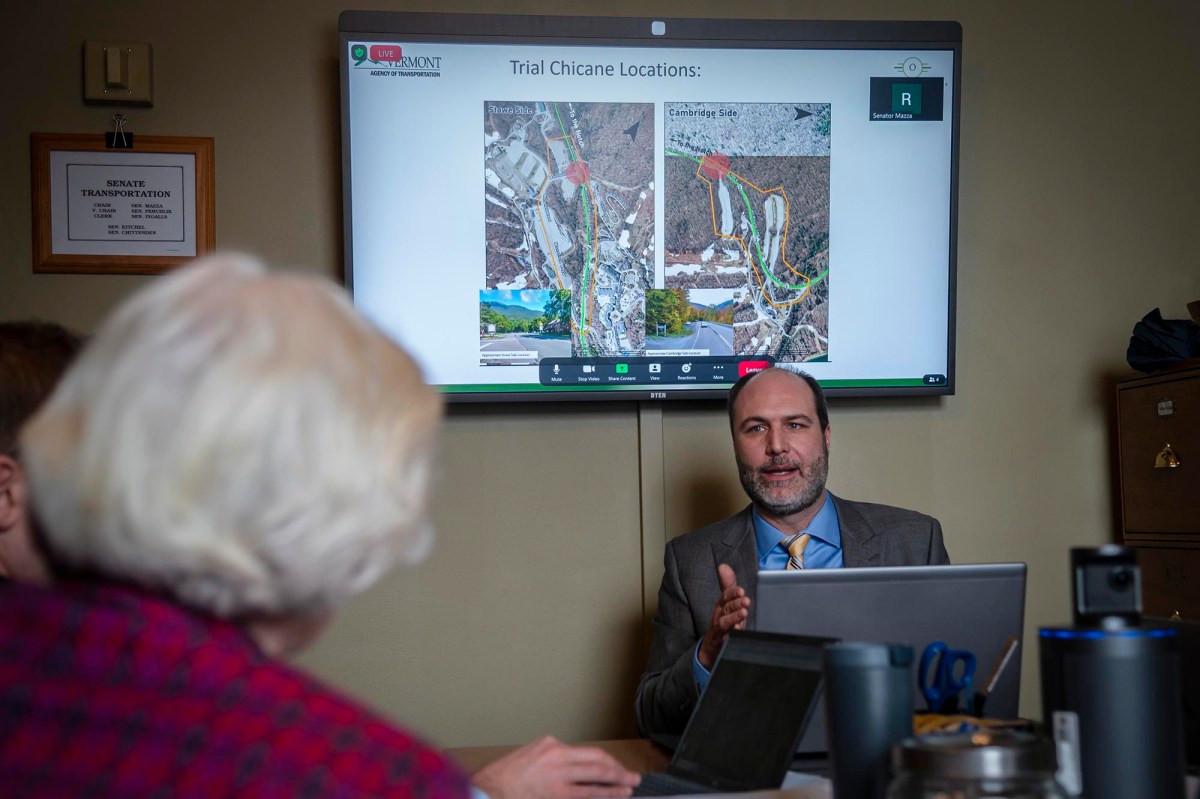
While it’s looking less likely that Google and other GPS systems will update their apps with instructions for big trucks to stay away from the Notch, the agency is moving forward with a different solution. It plans to install chicanes, physical barriers designed to artificially narrow a road, which would catch trucks before they head uphill and give them a spot to turn around.
After years of truck stuckages, which shut down the road for hours and require careful, expensive work to reverse, the agency seems pleased to have settled on a solution.
“We’re really excited about this,” Schultz said.
— Emma Cotton
Junk mail
Anyone who has ever worked in the news industry (or spent any substantial amount of time talking to someone in the biz (so sorry if that’s the case)) knows that the modern reporter’s inbox is positively swamped with random PR pitches. Sometimes, checking off unreads to delete, you will mumble to yourself, “Do you seriously get paid more than me to write this nonsense?”
There are actually some real-world trends behind this phenomenon: According to 2019 data from the Bureau of Labor Statistics, PR professionals outnumber journalists working in the U.S. six-to-one.
This is troubling because the steady decline of reporters in the U.S. — namely, local reporters — has a highly documented and, frankly, bleak correlation to a decline in government accountability, the fueling of political divisions and the preponderance of underserved “news desert” communities.
So with all of that said, we here at Final Reading are piloting a new, semi-regular section of this newsletter where we nominate the most absurd PR pitches we’ve received recently.
Today’s nomination: “REVEALED: The most popular fictional lawyer in Vermont, according to a new study.” Hint: These “studies” are, more often than not, “revealing” some random search terms on Google Analytics.
According to Georgia-based personal injury law firm Bader Scott, Vermont’s most-searched lawyer character is supposedly Saul Goodman of “Breaking Bad” and “Better Call Saul” fame. One could say it’s actually pretty meta that Vermont’s favorite fake lawyer is a fake lawyer in canon, as well. Cool!
— Sarah Mearhoff
What we’re reading
As Town Meetings prepare to return to the floor, some Covid-19 changes remain, VTDigger
Animal welfare groups sue state over new hunting and trapping rules, VTDigger
No joke: Feds are banning humorous electronic messages on highways, Associated Press
Correction: A previous version of this story used the incorrect bill number for the flood-response legislation supported by the city councils of Barre and Montpelier.
