


In 2022, Erin Kellar was diagnosed with Type 1 diabetes.
Kellar had enrolled in Vermont’s Medicaid health insurance program as a graduate student, and was able to stay in the program while she began her career as a therapist.
Medicaid helped pay for treatment for her diabetes, which requires rapid-acting insulin, long-acting insulin and a glucose meter. She also requires thyroid medication and treatment for other autoimmune conditions.
But last year, the state determined that her income — about $40,000 a year — made her ineligible for the program. Since then, she’s paid out-of-pocket for a Blue Cross Blue Shield of Vermont plan — one that eats up roughly a quarter of her total income.
“I’m constantly fearful of, are they going to raise the costs? And I’m powerless to it,” Kellar said. Without insurance, she said, “I would die.”

Kellar is one of thousands of Vermonters who have lost coverage through Medicaid, a state-run government program that provides health insurance to low-income Americans, since last spring.
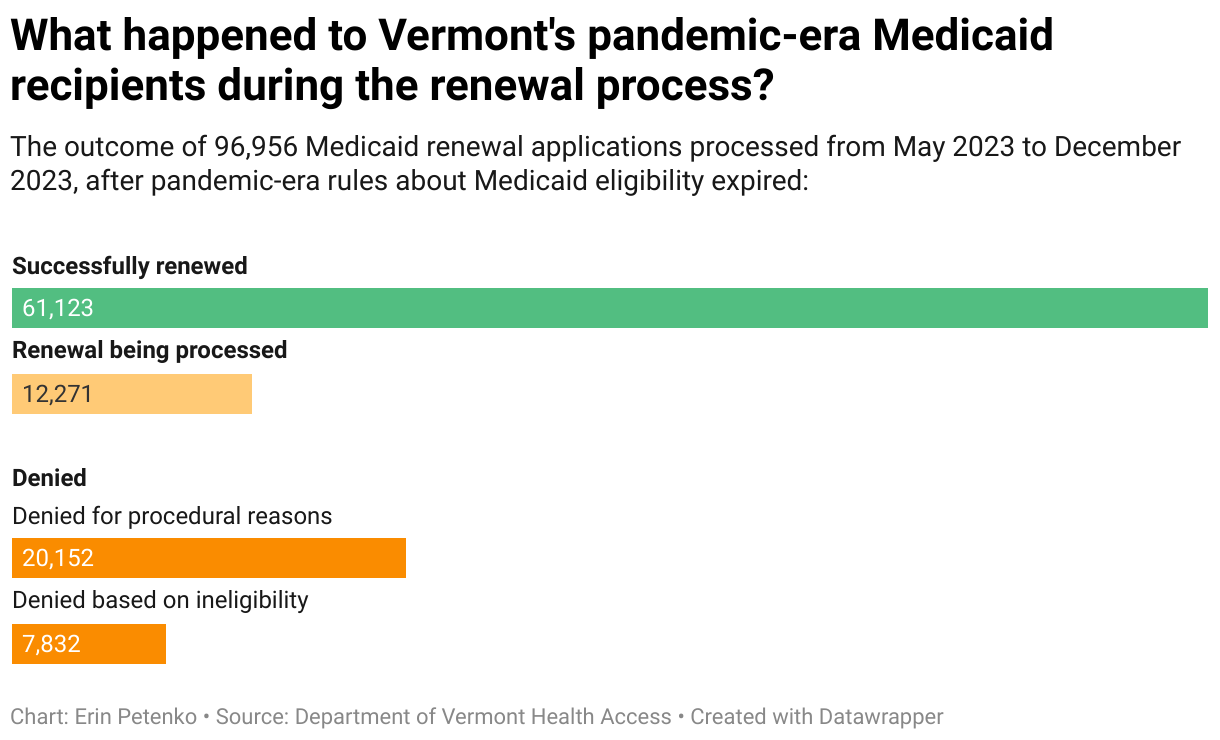
Between April and December of last year, 27,984 Vermonters have lost Medicaid coverage, according to data reports submitted to the federal government by the Department of Vermont Health Access. The losses come as millions of Americans are being disenrolled after pandemic-era protections come to an end.
Usually, states undergo an annual process in which they check whether residents enrolled in Medicaid fit the household income requirements for the program, and remove those who don’t.
But in 2020, Congress offered states money to keep Medicaid patients enrolled in the program, meaning that millions of people were able to maintain their health insurance during the Covid-19 pandemic.
After that provision expired last spring, states began trimming Medicaid rolls for the first time since 2019. Nationwide, nearly 14 million people have lost Medicaid coverage during this process, according to the health policy think tank KFF.
‘People shouldn’t have to choose’
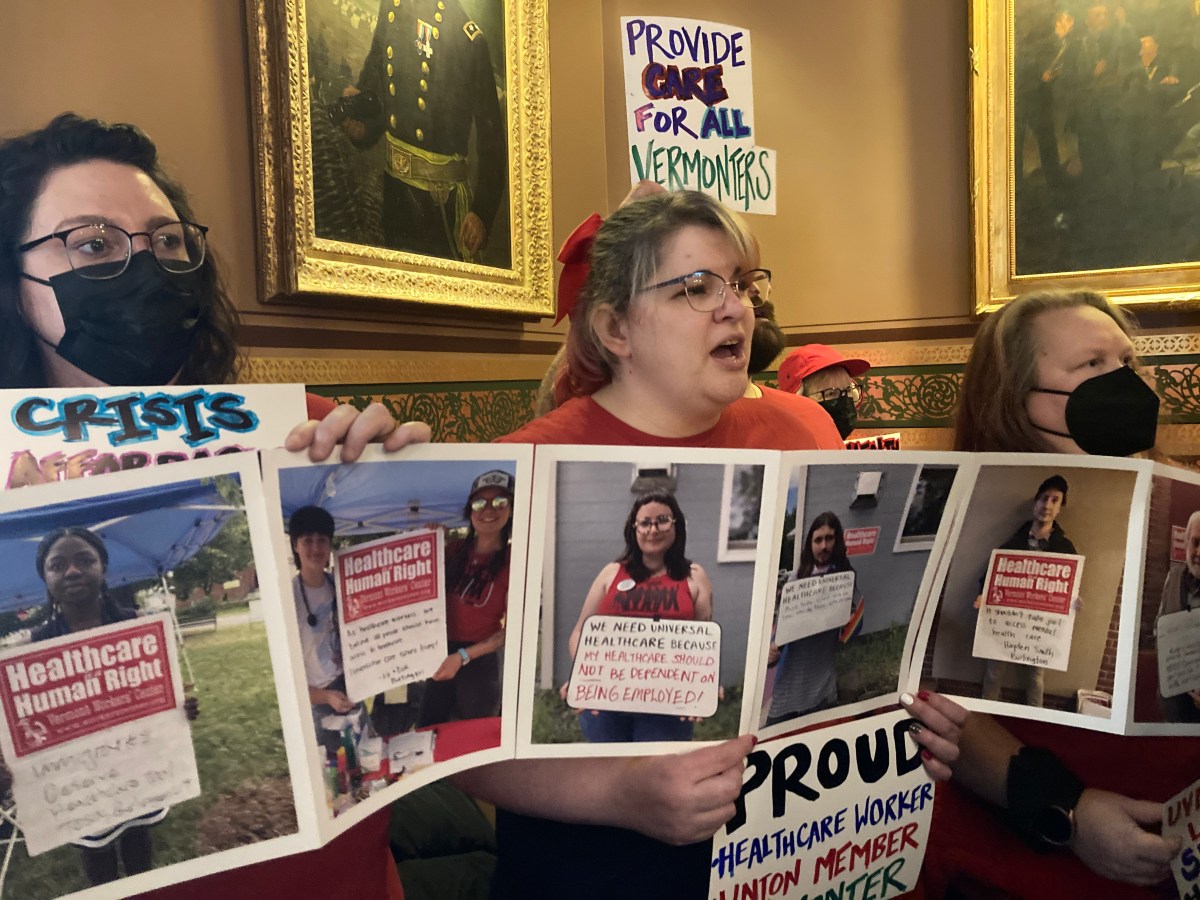
As Vermonters grapple with burgeoning health care costs, advocates, including Kellar, have urged lawmakers and Gov. Phil Scott’s administration to stop removing Vermonters from Medicaid.
On Friday — the same day as a raucous Statehouse rally against the Medicaid removals — Vermont lawmakers announced a sweeping proposal to expand Medicaid access in the state.
Currently, Vermont adults who make up to 133% of the federal poverty level are eligible for Medicaid. Children are eligible if their families makes up to 312% of the poverty level, and pregnant people with incomes up to 208% of the poverty level are eligible.
If passed, the bill, H.721, would gradually raise the limit for adults to 312% of the federal poverty level by 2030. Currently, the federal poverty level for one person is $15,060 and $31,200 for a family of four.
The bill would also expand the state’s publicly funded health care program for children — called Dr. Dynasaur — to cover all Vermonters up to 26 years of age and pregnant people. Today Vermonters up to age 19 are eligible.
It would also direct the Department of Vermont Health Access to increase Medicaid reimbursement rates to providers for health care services.
“We really need to start looking at what Vermonters pay for health care and how we can make it more affordable and accessible,” Rep. Lori Houghton, D-Essex Junction, chair of the House Committee on Health Care and a sponsor of the bill, said in a committee meeting Friday.
“We found through the pandemic that Medicaid works for a lot of people,” she said. “We know Medicaid is a well run program in Vermont. And so I drafted this bill to expand Medicaid in several different areas, as well as increase provider reimbursement rates.”
‘Procedural reasons’
Of the roughly 14 million Americans who lost Medicaid coverage in the past year, roughly 70% were disenrolled for “procedural reasons,” according to KFF — meaning they did not meet a deadline or incorrectly completed a renewal application.
In Vermont, 20,152 of the 27,984 people removed were done so for such administrative reasons. It’s not clear how many of those people might actually be ineligible for Medicaid coverage.
Alex McCracken, a spokesperson for the Department of Vermont Health Access, which administers the state’s Medicaid program, said that those procedural disenrollments could be due to a number of factors.
“That could be a whole host of things, from document deficiencies, invalid paperwork or information errors, to logistical issues of not receiving the application or not receiving it by the deadline,” McCracken said.
Vermont’s rate of procedural disenrollments — about 70% — is in line with most other states. A handful of states, however, have managed to bring that rate down. In Maine, for example, only about a quarter of disenrollments are due to procedural reasons, and in Illinois, only 13% were removed for those reasons — the lowest rate in the country, according to KFF.
In Vermont, the health access department informs Medicaid enrollees by mail ahead of their renewal deadline, and reaches out via phone or email if possible, McCracken said. Officials try to provide Vermonters with resources to help them complete their applications correctly and within deadlines, and the state offers an appeal process for those who believe they were disenrolled incorrectly.
The state’s process is about halfway through, and so far, roughly a quarter of Vermonters processed have been disenrolled. McCracken said that it’s not clear when exactly the state will finish processing everyone.
“It’s the mission of the department to provide access to high quality, affordable health care to every Vermonter that we can,” McCracken said. “And we take that mission very seriously.”
Correct: An earlier version of this story incorrectly identified the chamber in which H.721 originated.
