


One of Vermont’s most prolific investigators, working for the state’s top law enforcement agency, is a chubby dropout who doesn’t always listen to his commands.
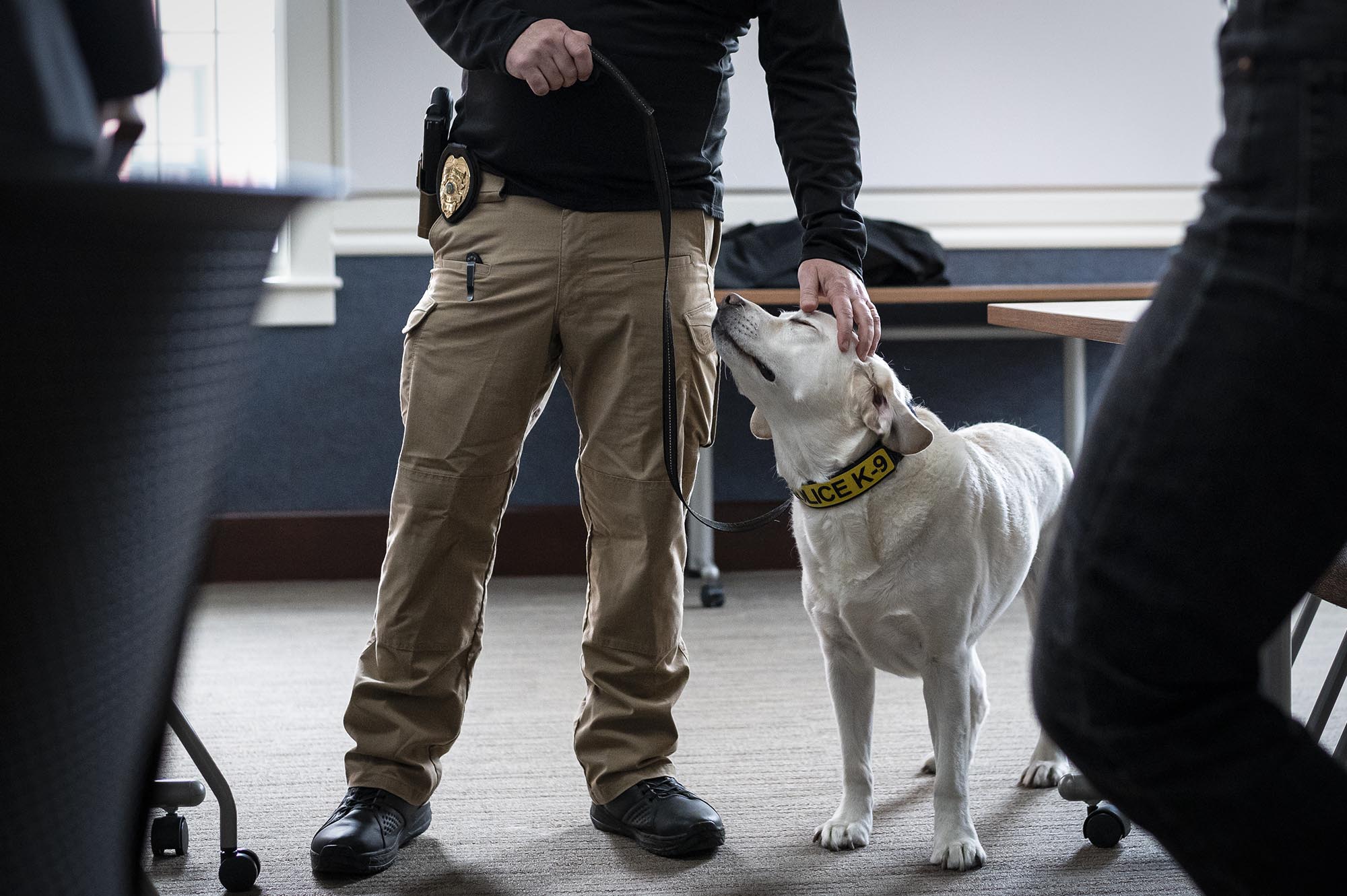
Meet Mojo, an 8-year-old English yellow lab working for the attorney general’s office. He is one of only a few dozen K-9s in the country trained to sniff and detect electronic storage devices.
For the specialized team within the attorney general’s office that investigates allegations involving child sex abuse material, Mojo’s skills are invaluable. Taken on raids of homes where investigators suspect there is such material, Mojo can quickly sniff out devices like hard drives, flash drives or SD cards — often leading officers straight to the evidence they need to make an arrest.
Mojo, one could say, is an employee of Vermont’s Internet Crimes Against Children Task Force, or ICAC, a subdivision within the attorney general’s office that investigates suspected cases of the production, possession or distribution of child sex abuse material. Every state has a similar division within its law enforcement, and Vermont’s is relatively small, consisting of five full-time investigators.
But despite the size of the task force, and Vermont’s small population, its officers are busy. According to ICAC Commander Matthew Raymond, officers last fiscal year investigated nearly 800 cyber tips filtered through the National Center for Missing & Exploited Children.

When Raymond first accepted his position with ICAC in 2010, he said he “foolishly” thought to himself at the time, “Won’t I work myself out of a job? … How many could there be in Vermont?”
With years of hindsight, Raymond’s 2010-era optimism now appears to him as almost naive. He and his officers are carrying out search warrants on suspects in the state on a weekly basis, he estimates. There are some electronic files that have been spread so widely that officers know their hash value — an identifying number on a file, like its DNA — by heart. They don’t even have to open the file to know which picture or video it is.
It’s difficult to say whether sexual exploitation of children — both the acts themselves and the spread of sex abuse materials — has actually increased dramatically in recent years, or if the perceived rise is due to better detection of what is circulating.
“The workload has flooded,” Raymond told VTDigger. “And I think a lot of it is the availability of it online, obviously, but the other part is just, I think platforms are getting much better at controlling their own environment and finding and rooting that stuff out.”
‘Seek’
When Mojo dons his K-9 vest, he knows it’s time to work — and eat.
Mojo learned his unique skill in Indiana, trained by Todd Jordan, a professional dog trainer who has developed an elite squad of K-9s now searching for electronic storage devices on behalf of law enforcement agencies throughout the country.
Mojo was among Jordan’s early proteges, according to Raymond, who is Mojo’s handler and full-time companion. The pair is in sync: When Jordan trains the dogs, he has their eventual handlers come to Indiana so he can match up optimal pairs. The soft-spoken, stoic Raymond makes for a perfect foil to Mojo’s goofy demeanor.

Mojo had a rough start to his career: He was initially being trained as a seeing eye dog, but according to Raymond, “He was that one puppy that just wasn’t like the others.”
“He would just injure a person with sight difficulties if he smelled a hotdog cart across the street,” Raymond said, miming Mojo taking off across a street. “He’d be like, ‘We can make it!’”
But it’s that keen nose and insatiable appetite that makes him so successful at his job. Mojo can smell the off-gassing that electronic storage devices emit — undetectable to humans — and is trained to lead officers to its source. His performance is entirely food motivated.
On a brisk day in December, Raymond treated VTDigger to a demonstration of Mojo’s abilities at Vermont’s State Office Building in Waterbury. When it was time to get to work, he fastened a K-9 working dog vest onto Mojo’s stout frame, remarking that it felt a little snug. Then Raymond adorned himself with a waist bag containing kibble.
“Seek,” Raymond commanded Mojo as the hound feverishly sniffed around the conference room.
When Mojo finds an electronic device, he boops his snout where it’s hidden, then signals to Raymond where it is in vertical space: if it’s low to the ground, he lays down. Mid-height, and Mojo sits. If it’s high up, he can jump on furniture to communicate that. When he locates the device, he happily accepts kibble as his reward.
In their demo to VTDigger this month, Mojo located three storage devices stashed throughout the room — one under a trash can and two hidden between the seats of stacking chairs — in under two minutes.
Not only is Mojo talented — he is insistent. It pays off.
In one raid that Raymond recounted, Mojo was incredibly preoccupied with the bathroom trash can in the house. Initially, Raymond figured that Mojo was just trying to trick him into offering a treat. Raymond tried to move on.
But Mojo wouldn’t. Eventually, Raymond lost grip of Mojo’s leash. Mojo ran back to the trash can and, as Raymond tells the story, kept smacking his face against the bin. Raymond took a closer look and said he found a camera hidden inside, allegedly for filming children in the bathroom.
The camera and the micro SD card it contained were a revelation: On it, investigators say, they found video footage of the suspect setting up the camera. It solidified their case.
‘The miracle of the dog’
Part of what makes Mojo so effective is that he cannot grasp the profound sadness of his work. He is blissfully unaware of the contents of the material he smells, and the immense harm that content has inflicted on some of society’s most vulnerable victims.
“He associates electronics with eating,” Raymond said. “It’s fun for him because it’s a game, right?”
For the human officers working in the unit, though, it’s anything but. To investigate sexual crimes against children is “a pretty dark place to live in,” Raymond said. Mojo provides the team some light.
Raid or not, Mojo comes to the office every day and moseys along from cubicle to cubicle, greeting the officers. They take turns playing with him, Raymond said, and keep dog toys at their desks. On Zoom calls, colleagues ask Raymond to shift his camera so they can say hi to their four-legged colleague.
Mojo has effectively become the unit’s emotional support dog — an added benefit beyond his training abilities that Raymond did not expect when he brought Mojo home from Indiana.
And his capacity to bring solace is not exclusive to those within the unit. When the unit carries out search warrants of houses, Raymond said, it is not uncommon for both the victim or victims and the perpetrator to be home. The children, in this scenario, “don’t know what’s going on. Their life is changing,” Raymond said.


What they do know is that there are uniformed strangers searching through their homes, potentially taking their caregivers into custody. Then, officers often have to conduct a forensic interview with the victims. “The transition can be rough and hard and take a lot of time,” Raymond said.
That’s where Mojo can help, in what Raymond refers to as “the miracle of the dog.” After making sure the children are not afraid of dogs, he will introduce Mojo, who is “great with kids.” They will start to play, “and then instantly, I’m okay because I brought Mojo into the picture,” Raymond said.
“Then Mojo can go with the kids to meet the forensic interviewer and then they’re like, ‘Oh, you’re friends with Mojo. You’re good,’” Raymond said. “We didn’t get him for that purpose, but it turns out it’s pretty amazing.”
Mojo’s golden years
Cradle Mojo’s giant, boxy head in your hands and gaze at his kind face. You may detect some white on his snout.
At eight years young — nearly 60 in dog years — Mojo is approaching the sunset of his career. According to Raymond, it is standard practice to retire a working K-9 around 10 years old, when they can start collecting their social security and pension benefits. (That’s a joke; dogs don’t get pensions.)
Mojo is still performing impeccably, and he may be able to work for a bit longer than the norm. But even so, ICAC is preparing for his retirement: This spring, they’re set to receive a new match-made puppy from Indiana. Ideally, Mojo will overlap with his successor so the unit is never without a K-9 coworker, and the puppy can learn the ropes alongside the more seasoned Mojo.
“Obviously, we want them fresh and ready to go,” Raymond said of Mojo and his soon-to-come sidekick. What a dog like Mojo finds can save a child from further trauma.
“Content, if they miss that, it can be a child victim.”
