

This story by Aaron Calvin and Tommy Gardner was first published in the News & Citizen on Nov. 16.
Towns still recovering from July’s catastrophic flooding were hit again this week by heavy rain, resulting in damage that was reminiscent, if not quite as severe, as the devastating summer storm.
Lamoille County received over 2 inches of rain in a storm that began Sunday and continued into Monday, causing the Lamoille, Gihon and Little rivers to flood their banks early Tuesday morning.
Johnson, perhaps the hardest hit Lamoille County community in July, saw over 3 inches of rain, which pushed the Lamoille River into the major flood stage with a height of 17.58 feet, its fourth highest level on record, according to the National Weather Service. The river also entered a major flood stage at one point in the Jeffersonville area of Cambridge.
The rain, along with a snowmelt caused by rapidly warming temperatures, created a pattern of flooding reminiscent of the historically destructive flooding that hit the area less than six months ago. The damage this time was mostly measured by the level of water in basements, not by how high floodwaters reached into a home or business’s first floor.
Johnson saw low-lying areas near Willow Crossing Farm and River Road East inundated with water, but not the same level of widespread destruction recorded this summer, partially because many of the properties damaged in that flood are still unoccupied, according to Johnson selectboard chair Beth Foy.
As in July, Stowe was spared serious damage as the waters of the Little River and West Branch mostly stayed within their banks, although village lowlands saw some flooding.
The north end of Jeffersonville was flooded, and several areas of Route 15 between Cambridge and Johnson remained impassable for much of Tuesday. The water stopped just short of the Varnum Memorial Library, which suffered minor basement flooding, and it spared the Cambridge Community Center.
The Wrong Way Bridge in Cambridge village became impassable and water from the Lamoille surrounded the same cluster of homes at its eastern edge but did not reach Cambridge Village Market.
There was also a prevailing sense of dread as the extent of the flooding became clear Tuesday morning, a renewal of the trauma still held by those who suffered during the summer’s deluge.
As Cambridge village resident Pearl Dennis looked out at the water surrounding her porch, a frigid replay of the last big storm, she remarked, “The worst part about flooding is you can’t do much but sit there and watch the water rise.”
No dam problems
Morristown weathered the July storm better than Lamoille River towns upstream and downstream, and it was spared this time around too, with just a few roads shut down Monday — parts of Elmore Mountain, Stancliff, Goeltz and Duhamel roads, as well as Route 15 east of Garfield Road were all closed for part of the day.
The upper parts of Oxbow Riverfront Park were also spared, although the lower field was flooded.
The village utility also fared better.

Scott Johnstone, manager of Morrisville Water & Light, was not about to allow an encore performance of last July, when the state forced the utility to implement a do-not-drink notice for its customers after its primary drinking water well was overrun by the Lamoille River.
Even though a forensic investigation determined the well-intentioned prohibition was likely unnecessary because the drinking water reservoir had shut off the pumps before the well got inundated, Johnstone wasn’t taking any chances.
“We talked later yesterday afternoon and were like, “Let’s shut all the pumps down, so no one can possibly suggest that any water from the floods got into the reservoir,’” he said Tuesday, noting the drinking water reservoir holds four to five days’ worth of water. “So, we turned them back on this morning when we knew there was no way the water was getting into the well.”
Johnstone said the Morrisville village hydroelectric dam was able to create power, but he put off opening the Green River Reservoir Dam during the height of the storm, mainly to make sure downstream communities like Johnson didn’t get even more water than they already received.
“We wanted to hold back everything we could,” he said Tuesday, saying the utility would likely start generating at the Green River dam later that afternoon. “I’m guessing there’s so much water, we’ll probably generate up there for a couple of weeks.”
‘One more bad storm’
In Wolcott, Devon Woods and her family — her husband, their 3-year-old daughter and three household pets — had to evacuate their home on the North Wolcott Road after the nearby Wild Branch River gobbled up roughly 20-30 feet of their backyard, leaving their 120-year-old house just a few feet away from the river.
“We are terrified. We don’t feel safe to stay here,” Woods said Tuesday. “We are avoiding being on that side of the house because we are afraid of it going into the river.”
Woods said they bought the house six months ago, shortly before the July flood. That incident was frightening enough, and she said the town road crews did some culvert work “here and there,” but that wasn’t adequate. She said a “delicate spot” in a nearby bend of the river ought to have been bolstered, and Monday’s flooding took advantage of the riverbank’s weakness.
Woods is frustrated with the town and the state, especially since, as of Tuesday, there had not been a state of emergency declared that could open avenues for financial aid. She said her family is fortunate because they have a friend with an excavator who might be able to help, but she’s not sure where they’ll be able to find enough material, or how to afford it.
Tuesday, Woods and her family were packing up to spend the holidays with family in Connecticut. The North Wolcott Road property is the couple’s first home, and already it’s had two close calls.
Monday was closer.
“It’s like, one more bad storm and your house is gone,” Woods said.
Soggy slopes
The flooding in Stowe on Monday was, for the most part, a colder copy of what occurred in July, with the low-lying area in the village next to the West Branch of the Little River becoming completely inundated, and parts of Moscow near the Little River getting flooded.
“Absolutely frightening,” Monique LaJeunesse of Little River HotGlass Studio wrote in an email titled, “The not so Little River,” in which she shared a photo of the white-capped rapids in central Moscow.
The big difference between July and this week was the impact on Stowe Mountain Resort, which had been enjoying a string of Monday morning storms that brought snow, not rain, to the slopes.
All that snow helped the resort weather the storm, and there were some brave souls skiing and riding on Monday, although most lifts, including the gondola and Fourrunner Quad, were closed for the day because of high winds.
The daily snow reports tell the damp details: on Sunday morning, there were 73 trails open and 38 inches of natural snow near the stake, located at 3,900 feet; on Tuesday, the resort started the day with 29 trails open and 29 inches at the stake.
“The amount of natural snow we’ve had, on top of the man-made snow that we started the season with, really got us through it,” resort spokesperson Joe Healy said, adding Stowe was more fortunate than Vail’s sister resorts in Vermont — the weather forced Okemo and Mount Snow to close.
Even as Healy was speaking Tuesday, the air had dropped to seasonably sub-freezing temperatures and snow began to fall lightly in the village, more earnestly at higher elevations. He said the mountain operations crews would be firing up the snowmaking guns as much as possible to complement any natural accumulation and he expressed optimism there would be plenty of coverage in time for the holiday stretch, largely thanks to the previous three Mondays.
“There’s a lot of excitement right now because of the way the season has gone so far,” he said.
Cambridge
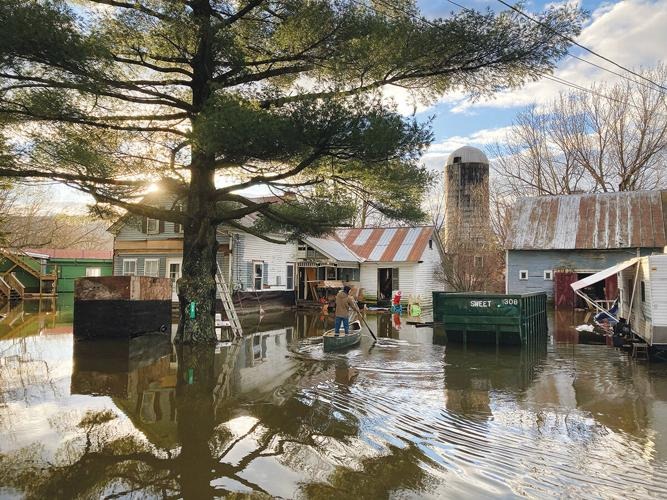
Pearl Dennis and her partner, Erik Holcomb, looked out from their house Tuesday morning at the flooded Wrong Way Bridge. She had popped over to Cambridge Village Market to grab water, coffee and breakfast sandwiches for the two as they watched their neighbor paddle himself back toward his property in a canoe.
Holcomb was pumping water out of his basement that morning, where a brand-new heating, ventilation and air conditioning system was installed after the July flood. They counted themselves lucky that water stayed out of their first floor, where they’re still working to replace the kitchen and install insulation. Holcomb said he grew impatient with the slow pace of Efficiency Vermont and began the process himself.
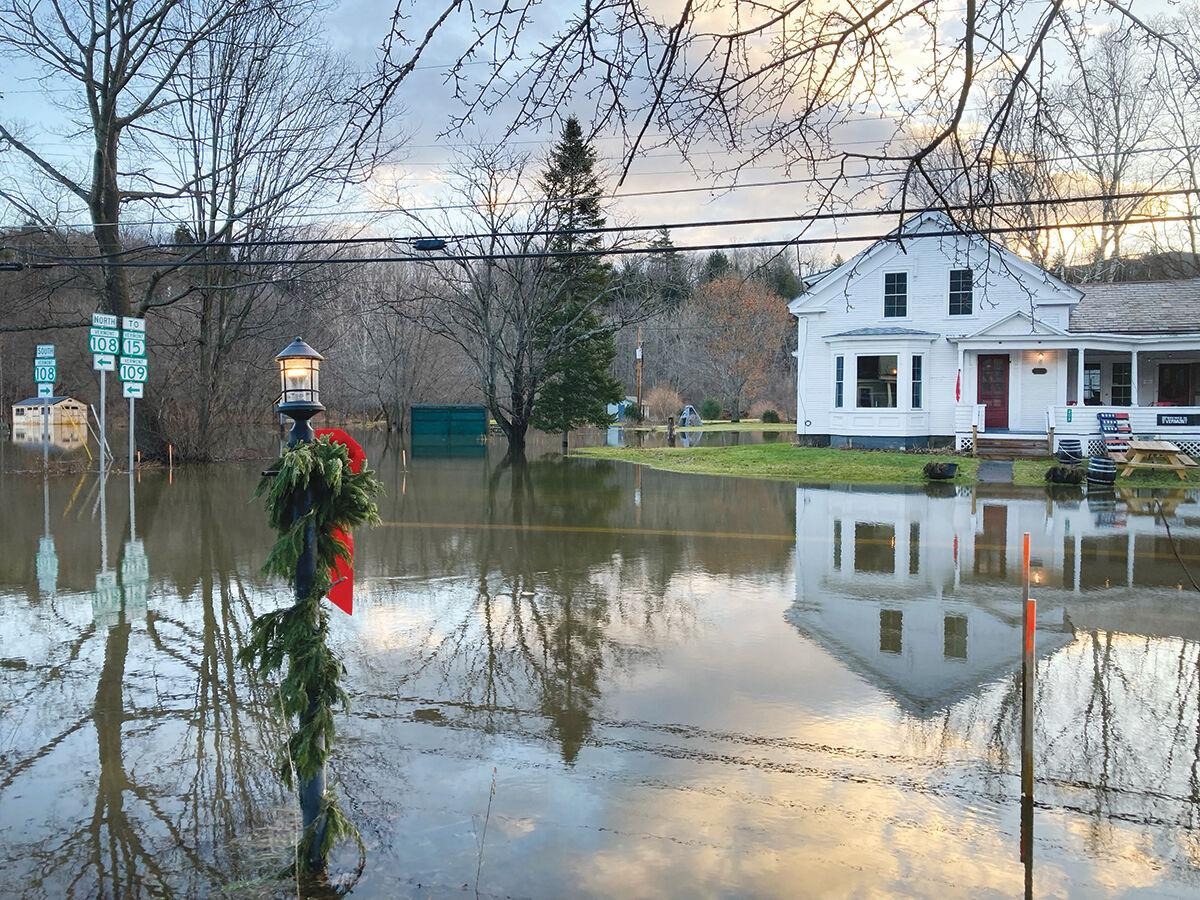
While neighbors in the increasingly flood-prone east end of the village have begun the process of seeking a buyout from the state or federal government, Holcomb and Dennis have insisted on staying put. They’ve considered raising the house but found little support for the idea from the state.
In the flooded north end of Jeffersonville, Jeremy Harriman was also pumping water out of his basement. After the flood in July, he said his family received a lot of assistance from friends, family, the Cambridge Fire Department and the federal government.
In less than six months, the Federal Emergency Management Agency helped him move his furnace and hot-water heater out of the basement to the first level to save him the expense of replacing them when the next flood hit.
Now that it had, he was relieved.
“Not ideal, but a lot better than what it would have been if we put it all back down there,” Harriman said.
Cambridge administrator Jonathan DeLaBruere said no municipal property was damaged, and most of the road closures due to flooding were on the state-owned highway. However, the ever-vulnerable greenway, which connects the town with the nearby Lamoille Valley Rail Trail, once again flooded after its recent restoration, the second such post-flood repair since 2019.
Johnson
Railroad Street, devastated in July, emerged Tuesday morning with no standing water on the road. One tenant on the street, who returned to his previous apartment after being displaced in July, said the water didn’t quite make it to his building.
On Monday evening, the Johnson Selectboard, Johnson Village Board of Trustees and others involved in emergency response authorized emergency spending to allow the town’s road crew to get supplies for treating damaged or closed roads.
The group ultimately decided against going door to door to warn residents in flood prone areas.
There were a few casualties. The Johnson Post Office, which just reopened in the former Sterling Market building, took on a few inches of water but Foy said it would likely reopen soon.
The recently reopened Johnson Health Center escaped unscathed, but Jenna’s House — the central community center of the holistic opioid treatment program known as Jenna’s Promise — took on water in its basement offices, as did the program’s sober home, Rae of Hope, according to its communications director Gregory Tatro.
Many of the structures closest to the Lamoille and Gihon rivers that were flooded in July are either empty awaiting a buyout or uninhabited.
“It wasn’t a significant structural flood event,” Foy said. “The rivers kept rising, but they rose slowly, and they weren’t receding quickly, which was different. We had a lot of water in July, but it felt like it receded more quickly.”
Strange weather
According to independent Vermont weather analyst Matt Sutkoski, the storm, initially predicted to be a moderate weather event, dumped a lot of precipitation over a long period of time despite the speed at which it was moving.
According to Sutkoski, Vermont lucked out. A slower storm and a deeper snowpack could have spelled disaster on a greater scale.
“We were caught in that south-to-north stream of deep moisture in advance of the storm and with the storm, it could have been worse,” he said. “If it had been moving slower it would have lasted longer and made it an even worse mess.”
As Sutkoski also pointed out, climate change in general is making storms stronger and more variable, with a warmer atmosphere able to hold more water.
University of Vermont climatologist Lesley-Ann Dupigny-Giroux said that what’s being seen now are the effects of an El Niño winter as climate change progresses, where warm atmospheric winds interact with the warming Atlantic to create oscillating temperatures and variable weather. She urged a greater consideration of complex conditions that have led to increased flooding in Vermont.
“It’s not just how much rain is falling, not just how fast the snowpack is melting, but it’s also how long it rained, because at some point, it will no longer be able to absorb that moisture coming in,” she said.
Dupigny-Giroux also stressed that residents and towns shouldn’t lose sight of the broader ecosystem of climate disasters in recent floods.
“I think we need to take an all-hazards approach to what we’re experiencing,” she said. “If we think back this year, 2023, we had frost that affected farmers in the spring, and then we were looking at droughts, which also affected farmers, and that was going on up until a couple of days before the July floods.”
She urged towns, which may be in the process of updating local hazard mitigation plans, “to try and make sure that we are looking at all of the various things that could affect our towns and municipalities.”
