

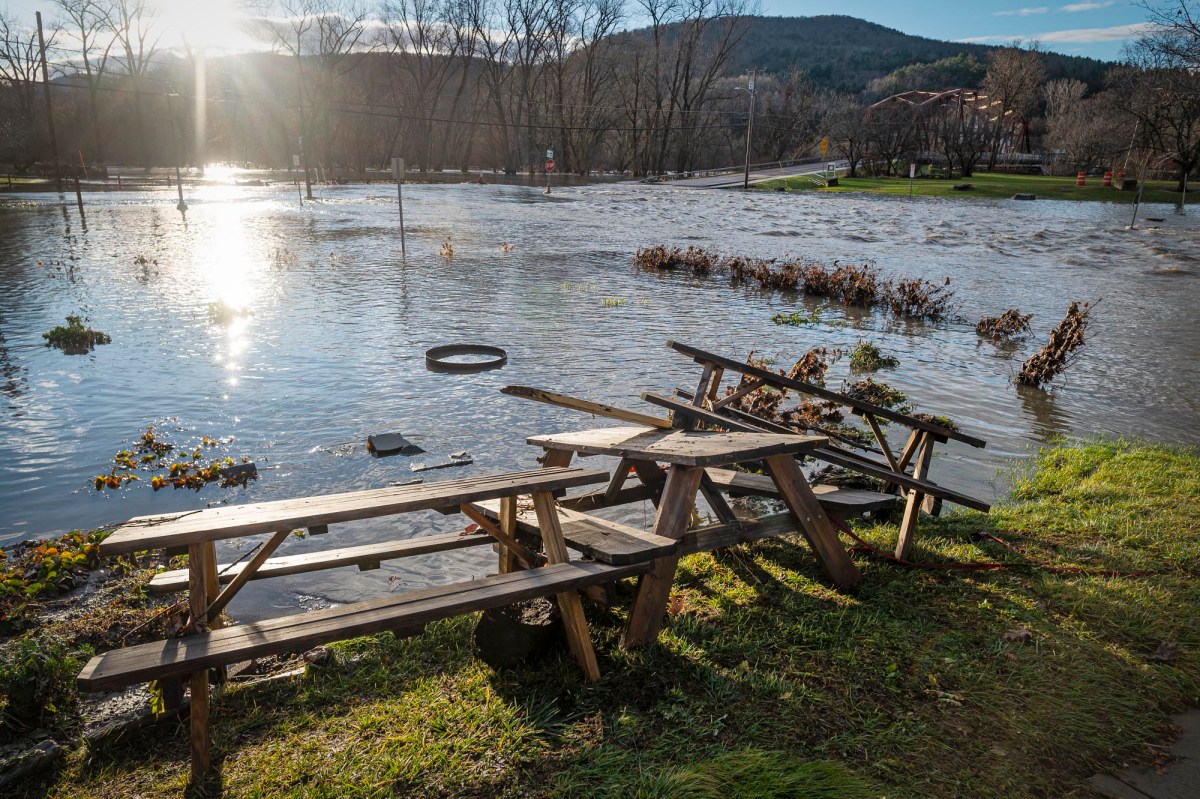
Vermont officials on Wednesday said they had mostly dismantled the emergency response to Monday’s flooding as rivers receded below flood levels, though they said resources remain on hand to help those who need them.
The state is now beginning to calculate the damage to determine whether Vermont will be eligible for federal disaster relief money. To that end, officials have encouraged Vermonters with damage to their homes and businesses to report it to vermont211.org, or for those without internet access to report it over the phone.
Most town officials contacted by VTDigger on Tuesday and Wednesday said their communities were largely spared, other than flooded basements, temporary road closures and wastewater plant problems that led to some combined sewage overflows.
One exception was the Moretown Elementary School, the largest public building in the state to experience flooding this week. The school saw several inches of water in its classrooms, but the greatest damage resulted from three feet of water in its boiler room. School officials are “cautiously optimistic” that the damage will be repaired before the end of next week’s holiday break, according to the school’s website. Until the break, students are expected to take field trips and travel to Harwood Union Middle and High School to watch movies instead of having class in the flooded building.
At a press conference Wednesday in Berlin — state officials’ third flood-focused press event in three days — Gov. Phil Scott described the thresholds that would need to be met for the state to receive a federal disaster declaration, which would come with additional resources.
“There are two levels: public assistance to help with infrastructure, and individual assistance, which is a much higher bar to clear,” he said.
By 7 a.m. on Wednesday, the state had received 20 calls to 2-1-1, and officials were still sorting through the information by late morning, according to Eric Forand, director of Vermont Emergency Management. It’s important for state officials to know the extent of the damage, even if Vermont doesn’t qualify for federal assistance, Scott said.
By Wednesday morning, all rivers had receded below flood level, though “Vermonters should remain vigilant,” Forand said at the press conference.
“River levels are still higher than normal, and most have extremely strong currents,” he said. “Everyone is encouraged to stay clear of these potentially dangerous areas.”
The state activated nine swiftwater teams at the height of the storm, and those teams completed a total of 12 rescues. They had demobilized by Tuesday afternoon, though they remain available in case of emergency, Forand said. The State Emergency Operations Center, which handles requests for assistance from towns, remains activated.
An American Red Cross emergency shelter in Barre has closed, along with all warming shelters, but any Vermonter who needs shelter or food can call 2-1-1.
When Joe Flynn, secretary of the Agency of Transportation, provided an update at Wednesday’s press conference, he spoke first of road damage from the July floods. The last state road to remain closed after that event — Route 107 in Stockbridge — had just reopened on Friday, he said.
Two state roads remain fully closed as a result of Monday’s rain, Flynn said. Those are US 302 from Barre Town to Orange and VT-73 in Sudbury from Brandon to Willow Brook. In Stowe, Route 108 near Spruce Peak at Stowe Mountain Resort is partially closed. There are no issues with air or rail travel, according to Flynn.
The Lamoille Valley Rail Trail, which was heavily damaged in the July floods, was minorly damaged this week but should be fixed within a few days, Flynn said.
The transportation agency has spoken with 75% of the towns in the state, 33 of which have indicated “some degree of damage” to roads. There are 37 “damage sites” on the federal highway network in the state, Flynn said, but only one is significant: U.S. Route 2 in St. Johnsbury, where there was a landslide.
“When I say damage sites, I want to put that into perspective,” Flynn said. “It’s not all like it was in July.”
At Tuesday’s press conference, Scott said that state officials would “learn something from this storm.” The extent of the flooding caught many officials by surprise, as evidenced by the 120 schools that closed early on Monday after starting the day as normal.
Asked on Wednesday about lessons learned, Scott said his takeaway is that “what we’ve done is working, but we need to do more of it.”
“We want to make sure that we address all the issues, that we’re not missing anything,” he said. “The communication aspect is so important. It reinforces the importance of (the press) and communicating our perspective and the perspective of those victims as well.”
