

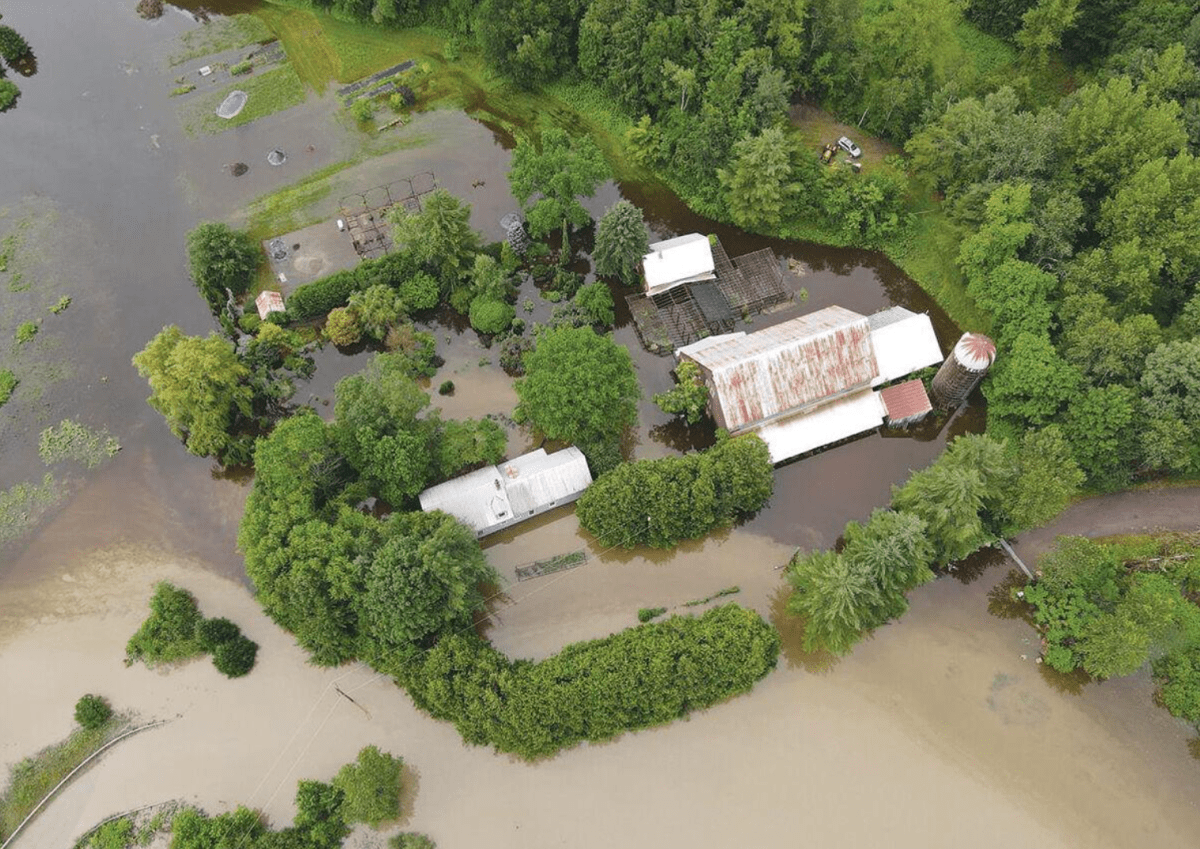
This story by Tommy Gardner was first published in the News & Citizen on Dec. 7.
The Vermont Department of Fish & Wildlife plans to buy a riverside property in Morristown that has frequently flooded over the past four decades.
The land, a 22.4-acre parcel on Duhamel Road that is the site of the former Cady’s Falls Nursery, has flooded seven times since the current owners, Don and Lela Avery, acquired it in 1979.
The most recent was in July, when much of the state saw catastrophic flooding. The flood inundated the Averys’ house and barn with four feet of water, leaving behind sediment and debris.
“It was the seventh time it’s had a 100-year flood,” Don Avery said at a selectboard meeting Monday, a chuckle-inducing comment that underscores how climate change is altering the expectations of properties located near water bodies.
The property sits at the confluence of Kenfield Brook and the Lamoille River. Will Eldridge, an aquatic habitat biologist with the state, said Kenfield Brook is an important stream for the department, from a fish habitat standpoint, with high numbers of brook, brown and rainbow trout.
Eldridge said the department already owns the streambank between the Avery’s property and the brook and the river, along with some larger adjacent parcels.
“There are a wide variety of uses for this property that would be protected in perpetuity through state ownership,” Eldridge said.
That includes public paddling and fishing access to the Lamoille River and numerous recreational uses on Kenfield Brook, including a popular swimming hole, Terrill Gorge, a short hike upstream from Duhamel Road — the more widely used access trail to the gorge is off Stagecoach Road.
Hunting, fishing and trapping would be allowed on the property — as is the case with any property fish and wildlife takes over — but Eldridge said there would not be any new access roads to foster those kinds of activities. Selectboard chair Judy Bickford worried about the proximity to the town gravel pit further down Duhamel Road, and wondered if road crews there might become “unintended targets.”
Board member Richard Craig said, however, that hunting is already allowed in the area.
Eldridge said his department is still seeking funds from the Vermont Emergency Management Flood Resilience Community Fund, and it will take about a year for the state to complete the buyout process, which includes drawing up deed restrictions on future development.
The Agency of Natural Resources makes annual payments in lieu of taxes to towns where the state owns property. Eldridge estimated those annual payments would be $1,422, starting next year.
Jason Kelley, Morristown’s first assistant fire chief, asked if the fire department could have the buildings that are no longer needed for training purposes.
There is a historic barn on the property that cannot simply be torn or burned down, but Eldridge said fish and wildlife crews will work with state historic preservation officials to find another location to rebuild it.
“We do have experience with this, with some of our other acquisitions, where we’ve bought farms that have been retired and had to dismantle the structures and move them elsewhere,” he said.
