


This article by Tommy Gardner first appeared in the Stowe Reporter on Nov. 30, 2023
The family of a former Stowe Mountain Resort zip line tour guide who was killed two years ago on the course is suing the resort and various equipment manufacturers.
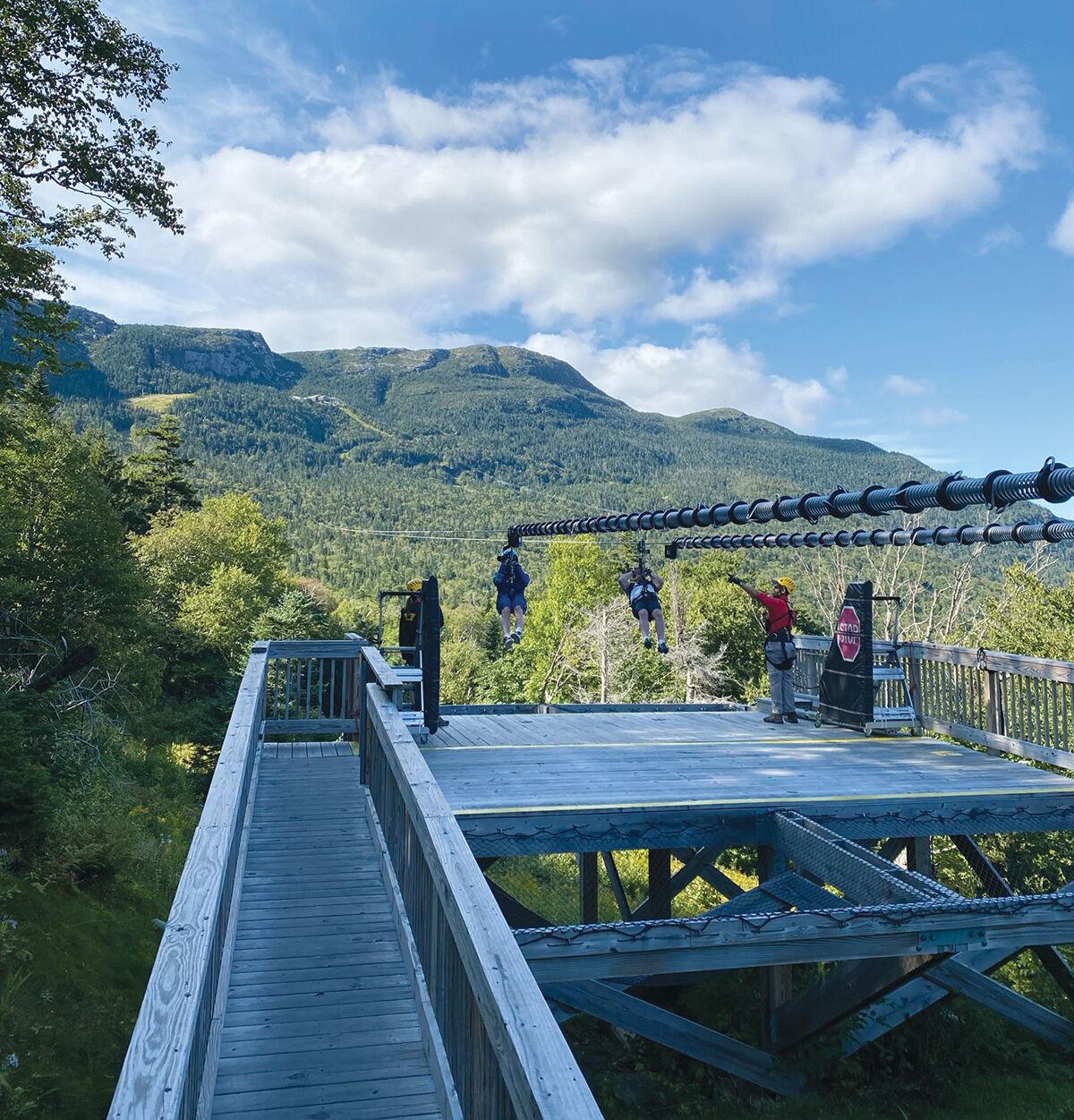
Scott Lewis was killed Sept. 23, 2021, when he was riding on a 3,500-foot section of resort’s ZipTour ride and his equipment failed, according to an investigation. He was 53 years old and had worked as a zip line guide at Stowe since the thrill ride opened in 2015.
Lewis’s former wife and executor of his estate, Molly Lewis, has filed a wrongful death lawsuit against Stowe parent company Vail Resorts, along with four companies involved in the construction of the zip line course — Terra-Nova, Zip Install, Petzl and Precisioneering. Last week, the case was moved to U.S. District Court since the companies are headquartered in four different states.
The lawsuit, originally filed Sept. 22 in Vermont Superior Court in Hyde Park, alleges that Vail encouraged its zip line employees to race each other to see who could achieve the fastest speeds down the mountain, while intentionally deciding against replacing the $26 piece of equipment — a canvas lanyard — that investigators determined caused the crash, despite the manufacturer’s recommendation that those lanyards be replaced every year.
The Vermont Occupational Safety and Health Administration, after an investigation, determined the lanyard was four years old and showing signs of wear after being through nearly three full seasons of intensive use. VOSHA fined the resort $27,000.
Since Lewis was an employee, that was the only fine levied.
“He is now deceased because the defendants created, and fostered, a recipe for disaster,” the lawsuit, filed by attorney Lisa Snow Wade, states, before laying out several factors in that alleged disaster:
“A zip line course that was unsafely steep; a zip line trolley (the mechanical device that moves along the zip line cable and connects to the rider’s harness) that failed to slow Scott’s speed either because of catastrophic failure or because it was not engineered to handle the speeds achieved by riders on that course but sold to Stowe Mountain Resort anyway with knowledge it would be used on that course; a defectively-designed and/or manufactured harness/lanyard assembly that catastrophically ripped at high speed, catapulting Scott at high speed into the cable bollard base several yards away; and an employer that encouraged its employees to engage in high speed zip line runs to promote itself to adventure seekers, all while deliberately failing to properly inspect and maintain the equipment it supplied to its employees for use on the zipline to save money, knowing full-well that its deliberate workplace safety failures created a workplace hazard, as VOSHA put it, ‘likely to cause death or serious physical harm to employees.’”
This week, Vail filed a motion to dismiss the case, arguing that Lewis’s family is only entitled to worker’s compensation. The motion, filed by attorney Ritchie Berger, states that “it is undisputed” that Lewis’s death occurred while he was working, and the resort has been paying and will continue to pay his family — Lewis left behind three teenage sons as well as Molly Lewis, who his obituary referred to as “his close friend.”
However, Berger argued that “work-connected injuries” trigger Vermont’s exclusivity law when it comes to workers’ compensation.
“The Estate’s complaint does not allege facts that would demonstrate Stowe acted with a specific intent to injure Mr. Lewis. Rather, even broadly reading the complaint it asserts at most that Stowe was negligent in developing appropriate workplace policies, as well as relying on other Defendants for their expertise in designing and constructing the zip line and determining that the equipment was safe,” this week’s motion to dismiss states.
In addition to suing Vail for wrongful death, Lewis’s family is suing four other companies involved in the zip line operations.
The suit alleges negligence against Terra-Nova LLC, the Utah-based company that designed the course; Zip Install LLC, which installed the course; and Petzl America, which made the lanyards, carabiners and other equipment. Terra-Nova is also accused of “strict liability.”
The suit also alleges negligence against Precisioneering, the company responsible for conducting annual safety inspections of the zip line course and the equipment.
The companies, in their answers to the complaint, denied all allegations, with Petzl’s lawyers denying the company made any component used in the Stowe course and Precisioneering’s lawyers denied it was hired to inspect any personal safety equipment.
The lawsuit also calls for punitive damages against Vail and Precisioneering, arguing that both company’s actions “demonstrate a conscious disregard for the rights and safety of Scott Lewis and other employees and members of the public using the ZipTour zip.”
Risky business
According to court documents, Lewis had been a guide on the zip line course for seven years, predating Vail’s purchase of the resort operations. However, it is unclear whether any amount of experience could have prevented the equipment failure that caused his death.
The VOSHA investigation determined that the lanyard could have spared Lewis’s life if it hadn’t snapped, but the lawsuit also alleges his trolley braking mechanism had failed when it reached the terminal brake at the bottom of the zipline, which caused the inertial impact that snapped the lanyards (the lawsuit references two lanyards, not one).
The lawsuit alleges that the resort fostered a culture of competition among its tour guides, to see who could reach the fastest speeds on the course, “because it enhanced Vail’s image as supplying greater thrills for its customers, intentionally putting its employees at risk.” It also alleges that Vail invited Stowe police officers to use their own radar detectors to record the riders.
Some employees, including Lewis, wore GPS trackers to record their fastest speeds. The VOSHA investigation revealed that Lewis’s tracker clocked him at a top speed of 82 mph. However, the lawsuit claims that Lewis’s tracker showed him going even faster on the first two spans of the three-leg ZipTour — 112 mph on the first span and 99 mph on the second. He was traveling 76 mph when he crashed.
