

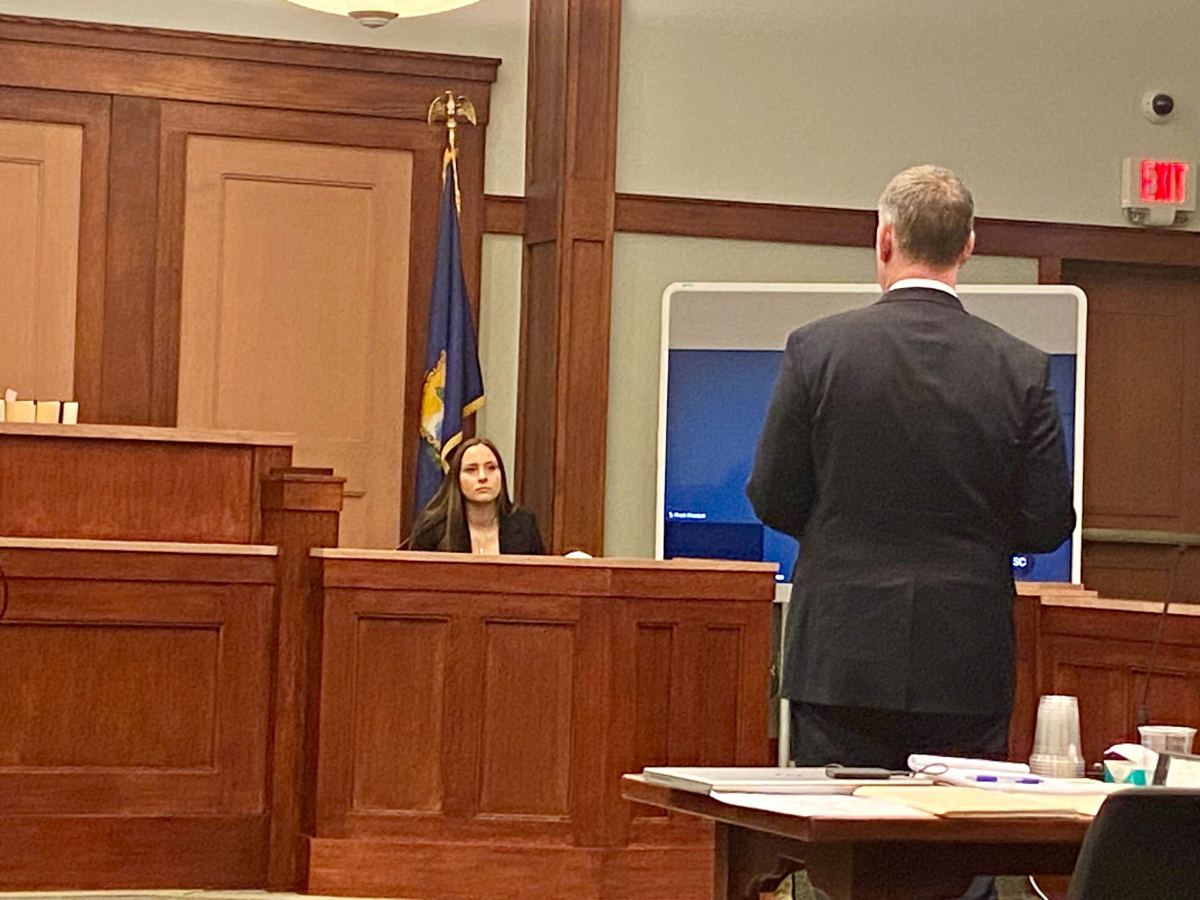
RUTLAND — The defense team for a woman accused of fatally medicating an infant at her Rutland day care in 2019 told a jury Monday what it has long asserted: Prosecutors don’t have evidence that Stacey Vaillancourt provided the drug that killed the 6-month-old girl.
“The evidence is going to show that the state, through its investigation, has never recovered any medication from Stacey Vaillancourt to contain diphenhydramine,” the lead defense attorney, Robert McClallen, said during opening statements in Vaillancourt’s trial at the Rutland Superior criminal court on Monday morning.
“The state has to prove that Stacey gave it and the state has to prove how it was given,” McClallen said.
Vaillancourt, 58, is being tried on two felony charges, manslaughter and child cruelty, resulting in the death of Harper Rose Briar. The baby died on Jan. 24, 2019, her third day of going to Vaillancourt’s in-home day care.
The child’s autopsy showed she died of intoxication from diphenhydramine, an antihistamine that has sedative effects. The prosecution alleges Vaillancourt provided the drug to sedate the infant.
The baby’s mother, Marissa Briar, testified Monday that she’d told Vaillancourt on the child’s first day at the home day care that “Harper wasn’t a great sleeper.” At that point, Briar said, her daughter slept for three to four hours at night and napped for only 10 to 45 minutes during the day. The infant would only fall asleep while being held or rocked.
At the end of the child’s second day with Vaillancourt, Briar said, her daughter appeared more tired than usual. Around 3 p.m. the following day, on her way to pick up the child, Briar saw a text message from Vaillancourt, saying the child was sick and was being taken to the local hospital.

When Briar next saw her daughter, at the Rutland Regional Medical Center, the baby was pale and being given CPR. She was declared dead shortly after 4 p.m. that day.
“The forensic pathology and toxicology essentially solved this case,” the lead prosecutor, Rutland County State’s Attorney Ian Sullivan, said in his opening statement.
He told the jury that, when Harper died, she’d had no significant health problems and her body showed no external signs of trauma. But lab tests on her stomach contents, blood and urine detected high levels of diphenhydramine.

“She was far too young to give it to herself. Someone else had to give it to her,” Sullivan told the group of 15 men and women, including three alternates, who were shown video clips of Harper’s capacity for movement at around six months old.
“The defendant was the only adult with access to Harper from the time she was dropped off until right about when the ambulance crews arrived. She is the only one,” the prosecutor said. Vaillancourt, he said, had washed the baby’s things after she was taken to the hospital.
McClallen, the defense attorney, disagreed that the autopsy and lab tests solved the case. On the contrary, he said, they couldn’t answer several important questions: What type of medicine that contained diphenhydramine was given to the infant? Was the baby given one dose of diphenhydramine or several doses? When was the dose or dosages given, and at what amount?
If a series of doses were given, McClallen said, then someone else could have given the child the medication. “Listen not only to what’s being said but what’s being omitted,” he told jurors.
Last year, McClallen sought to get Vaillancourt’s charges thrown out. He’d argued before the court that the state’s case was based on circumstantial evidence and also raised the possibility that another person could have given the medication.

But Judge Cortland Corsones said in May he was not persuaded by the defendant’s arguments. “There is ample evidence that (Harper) was alive and breathing, well into the afternoon on January 24,” Corsones wrote, adding that there was enough evidence for the case to go to trial by jury.
Vaillancourt’s trial is scheduled to run until Friday. It’s unclear if she will take the stand, given that it’s her right not to testify. McClallen, who is representing her alongside Mike McClallen, declined to comment on the witnesses the defense team intends to call.

If convicted of the charges, Vaillancourt faces up to 25 years in prison.
McClallen earlier said Vaillancourt had run the day care for 25 years but stopped operating it following the infant’s death. She has been free on a $25,000 bond since she was formally charged in court in March 2019.
