


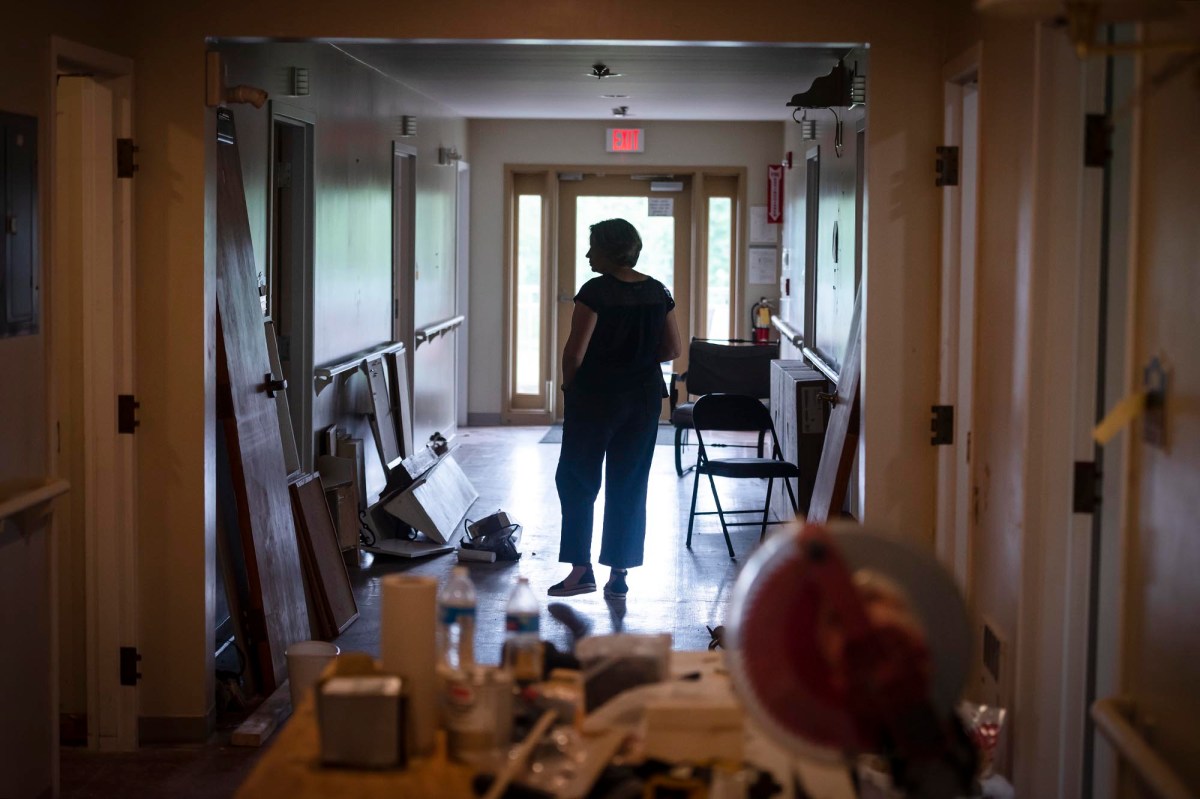
When Agape Ministries, a Derby-based nonprofit, bought a former nursing home in July 2022, the group imagined a hub for health services, education and respite for more than 30 Ukrainian refugees.
Relying on personal finances and the generosity of donors to quickly raise hundreds of thousands of dollars, Agape’s leaders planned extensive renovations to create their Northeast Kingdom haven, attracting media attention throughout the state.
But not long after the refugees arrived, some started to grumble about the Derby facility and the care they received there. And behind the scenes, local, state and federal authorities scrambled to figure out what was going on inside the home — and how they might intervene.
At one point, government officials stood up a plan for relocating refugees in case they had to shut the place down. At another time, they discussed how to “stop the flow” of refugees to sponsors who were then passing them on to Agape.
Agape’s leader, Theresa Cianciolo, maintains that the organization did nothing wrong. She has dismissed officials’ concerns and chalked up refugees’ complaints to miscommunication. If it could do anything differently, she said, the group would have put more resources into hiring translators, and slowed down the speed at which it brought Ukrainians stateside.
The precise nature of the state’s concerns — and whether they were validated — remains unclear. Officials declined to elaborate on heavily redacted emails VTDigger obtained through a public records request.
But a year after the group first welcomed Ukrainians to the Northeast Kingdom, the House of Mercy, as it was dubbed, had emptied. Refugees who lived there had moved to Massachusetts, Pennsylvania or even back to Europe. Others had started lives for themselves in Vermont.
The project quietly disintegrated. At the end of October, the House of Mercy was put on the market for $1.2 million, 60% more than Agape bought it for hardly more than a year ago, land records show. The contents of the group’s website were erased.
The Cianciolos said last week that Agape would be “downsizing to a smaller home” amid serious health challenges facing Theresa Cianciolo and several board members, according to emails sent by her husband and co-president, Scott Cianciolo.
The change would return Agape to “the ministry we were before our Ukraine friends came to live with us,” including working with adults and children with special needs, he wrote.
“All of our Ukrainians have moved out and started on their own lives, successfully.”
The community rallies
Scott and Theresa Cianciolo, the godly couple at the helm of Agape Ministries, punctuate sentences with “amen.” The pair has run the Christian nonprofit, which previously focused on hosting camps for people with developmental disabilities, since founding it in 2004. The organization, tax records show, garnered meager revenue in years past — less than $50,000 annually between 2010 and 2021, the most recent year for which records are publicly available.
The Cianciolos, who lived in the Northeast Kingdom town of Albany, adopted young twins from Ukraine in 2014. The twins, who have Down syndrome, sparked the couple’s interest in the country. Theresa began traveling to Ukraine with increasing frequency, working at universities to teach about special education and work with disabled children, she has said.
So in February 2022, when Russian forces began their attack on the country that had become like a second home, the Cianciolos knew their work would pivot. Agape began to implement a far more ambitious vision.
The 10,000-square-foot former Derby Green nursing home fit the bill: large enough to take in entire families who had lost their homeland to war. After a frenzied fundraising campaign, Agape purchased the building for $750,000, land records show, and the Cianciolos began renovating it to serve as a home for themselves and refugees.
The plan, it seemed at the time, required rapid movement.
Agape sought to bring Ukrainians to the U.S. through the Biden administration’s “Uniting for Ukraine” program. Announced in March 2022, the program initially intended to bring 100,000 Ukrainians and others fleeing the Russian war to the United States and allowed U.S. residents with the demonstrated financial means to sponsor Ukrainians stateside for two years.
Ultimately, the limit was increased, and by April, more than 280,000 Ukrainians had entered the U.S. through the program, according to reporting from The New York Times.
But in those early months, the Cianciolos said, it appeared that Agape needed to stand up its facility quickly before the program hit its limit.
Quietly preparing for the worst
From the outside, the House of Mercy seemed to live up to its name, and Vermonters flocked to help the growing nonprofit.
Premier Coach, a charter bus service out of Milton, helped donate a handicap-accessible van to Agape. Kwasnik Family Dental in Berlin signed up to provide free dental care. Later in the year, Highland Center for the Arts in Greensboro hosted a sold-out benefit concert for Agape.
In June, the first Ukrainian family arrived. The Shapovalovs and the Cianciolos had previously struck up a friendship in Ukraine, and when war broke out, the American couple acted as the Shapovalovs’ sponsors, bringing the family of eight to Vermont.

In August, Agape began to welcome more Ukrainians, though the specific number has changed in Theresa’s telling, fluctuating from the 30s to the 40s. In an interview this summer, she said Agape had helped 44 refugees, including some sponsored by the Cianciolos themselves and many sponsored by others. Not all of them had stayed in Derby, she said.
As the project came together at a remarkable clip, records maintained by the state show that concerns began to arise almost as quickly.
Through a public records request, VTDigger obtained a cache of heavily redacted emails kept by the Agency of Human Services regarding Agape Ministries.
Those messages show that the state has been aware of concerns regarding the House of Mercy since at least September 2022. Through the turn of the year, additional local, state and federal partners entered the conversation, and officials began to prepare for the possibility of shutting down Agape Ministries.
In September, according to the documents, Elizabeth Anderson, assistant attorney general and director of the state’s Medicaid fraud and residential abuse unit, reached out to Tracy Dolan, who leads Vermont’s refugee office, asking to discuss the Ukrainian refugee resettlement program. Later emails show state officials bringing Anderson into conversations about Agape.
Dolan shared with the state Attorney General’s Office a history of interactions between the Vermont Department of Health’s Newport branch and Agape Ministries from June through September 2022. The version provided to VTDigger was largely redacted, and the Attorney General’s Office said it could not provide any additional information about whether it had investigated Agape, but said its Medicaid fraud unit did not currently have any “pending matters” regarding the organization.
A meeting was scheduled for Sept. 27, in Anderson’s words, to “brainstorm the situation in Newport.” Dolan, Agency of Human Services officials and state health officials were invited.
Throughout September, according to the documents, Dolan also carried on a correspondence about Agape with Virginia Merriam, a detective within the Attorney General’s Office’s Medicaid fraud and residential abuse unit. Dolan wrote to Merriam indicating that she’d spoken with Department of Health employees, including the department’s emergency preparedness director, letting them know that they should do some “quiet preparation among state government in the event that we would need to resettle a group of refugees,” with a focus on housing.
“I have asked that they do this quietly,” Dolan wrote. “They will plan a table top emergency response exercise early next week.”
As days passed, Dolan requested more information.
“When Medicaid closes a facility, what is the notification process or is there one within state gov’t? Also, is there a time lag?” she asked. “For example, if the facility in Derby was deemed in adequate (sic), who would get notified within AHS so that we could assist with relocating the Ukrainians?”
A response from the Attorney General’s Office was, in substance, completely redacted.
‘Stop the flow’
In December 2022, the emails show, discussions within state and federal agencies seem to have been most active.
Trissie Cassanova, a human trafficking consultant for the Vermont Department for Children and Families, penned a message to more than 15 people across various government entities.
“I am reaching out to all of you in order to coordinate (a multi-disciplinary team) meeting regarding Ukrainian Refugees who are living at Agape. The purpose of this meeting would be to share information, determine which agencies can be a lead and develop next steps.”
Among those invited to the Dec. 7 meeting: members of Homeland Security Investigations, a leader from the state’s Medicaid fraud unit, a northern Vermont human trafficking case manager, a DCF child safety manager, and representatives from Vermont State Police and United States Citizen and Immigration Services. A subsequent email from Dolan that recapped the meeting for leaders at the Agency of Human Services indicated that representatives from a local school and the Orleans County sheriff also attended.

Much of Dolan’s email is redacted. But the challenge, as she saw it, was clear: “It is difficult to stop the flow of Ukrainians to the area,” Dolan wrote, “as it is likely that sponsors from other areas (eg. out of state) are filling in the paperwork and then transferring them to Agape Ministries.”
Officials intended to collect basic information about some of the Ukrainian children, then work backward to identify the sponsors, according to Dolan’s email.
Why the circuitous route? Under the terms of Biden’s Uniting for Ukraine program, individuals who sponsored Ukrainian refugees could then pass them off to other organizations.
Dolan’s email indicated that, based on sponsors’ ZIP codes, that was likely the case with some of the Ukrainians living at Agape. Theresa confirmed as much in an interview with VTDigger.
Dolan wrote that she didn’t know how many people were living with Agape — she’d heard anywhere from 17 to 30 — and noted that she heard on Vermont Public that the group was expecting nine more families.
She said by identifying the sponsors who were transferring Ukrainians to Agape, officials could “then presumably stop the flow of Ukrainians to those sponsors.”
However, she wrote, “I don’t know if they will be successful.”
‘We just don’t want anyone else to suffer’
In the months after the December meeting, the records obtained by VTDigger show more and more time passed between emails among government officials who had raised concerns about Agape. Dolan corresponded with the Vermont Chronic Care Initiative, which helps Vermonters on Medicaid with complex case management, in January 2023, hoping to get a nurse to visit the House of Mercy. The next record of communication is dated March 14.
Then, in late April, a Department of Health official circulated a link to a public blog post credited to Olena Levchuk, a Ukrainian refugee who lived at the House of Mercy and was decrying conditions at the home. (The post has since been edited.) Allie Perline, the refugee health coordinator at the Agency of Human Services, wrote back, saying “several community partners” had already shared it.
“This ongoing situation is definitely on our radar,” Perline wrote.
Levchuk, who speaks Ukrainian and minimal English, lived in the Agape house from the end of August 2022 to April 2023. In her post, which she wrote with translation help, she described her experience at the House of Mercy, specifically what she felt was inadequate medical care for her son and “strange” rules within the house.
In a May interview, speaking through a translator, Levchuk said that her son, who has cerebral palsy, requires specialized medical care. She said she came to stay with Agape because she believed he would receive the best care for his needs.
But Levchuk said when she arrived in Derby, she began to understand how isolated the Northeast Kingdom was. She accused Theresa of acting “two-faced” and fueling a culture of “manipulative bullying.”
Months into her stay, Levchuk said, she discovered that Agape was receiving money from the state to pay her rent.
That came as a surprise, according to Levchuk, who said she thought she had been living in Derby for free. Had she known housing assistance was available, she would have considered using that money to try to live elsewhere, she said.
Levchuk’s post ignited public speculation about Agape Ministries and the House of Mercy. The organization defended itself online, replying in a comment on Levchuk’s post to deny her claims. Theresa also posted on Facebook in response, doubling down on Agape’s good work.
As the blog post circulated within state government and the Kingdom community, more Ukrainians began to negatively share their experiences living at the House of Mercy.
Among them was the Shapovalov family. As friends of the Cianciolos, the Shapovalovs said in an interview that they initially wanted to help the couple fulfill their vision for the House of Mercy. They threw themselves into the renovation work upon arriving in Derby and promoted the project to fellow Ukrainians.
But last winter, months into living at and helping to run the House of Mercy, the families’ friendship disintegrated. In a May interview, the Shapovalovs said they began to feel they were helping to promote a dishonest project for the Cianciolos, claiming the couple had overstated the total number of refugees staying in Derby and those with disabilities.
“We hope this information will stop them and prevent them from doing this in the future,” said Dmytro Shapovalov, the family’s patriarch. “We just don’t want anyone else to suffer.”
Medical credentials
The Shapovalovs said they felt particularly deceived by Theresa’s claims of medical experience. Oleksandra Shapovalova, the family’s matriarch, said many of the families who came to the House of Mercy did so because they trusted Theresa’s medical expertise.
Theresa, identified on her Facebook as Agape’s “clinical director,” has often cited her extensive background working with children with a variety of disabilities. She has referred to herself as a doctor of neuropsychiatry in interviews, and her Facebook profile, on which she is active weekly, is under the name “DrTheresa Cianciolo.”
Before the House of Mercy opened, Theresa told VTDigger that the facility planned to welcome people with a range of medical needs, from severe cerebral palsy to autism spectrum disorder and a rare neurological disease called Rett Syndrome.
In an August 2022 interview, Theresa highlighted Agape’s “nursing team of RNs and APRNs.” She called herself a “professor for special needs” who wrote “the first diagnostic criteria for pediatricians” in Ukraine.
Describing why a specific family whose child had a rare genetic neurological disorder wanted to come to Derby, Theresa said “we will make (his life) a little longer, and we will make him more comfortable. He won’t have seizure after seizure after seizure, we’ll control some of those.” She also described some of the medical resources available at the House of Mercy for the people with medical needs she expected to arrive, such as a hospital bed and hoyer lift.
This summer, asked about her medical credentials, Theresa said she had never claimed to be a medical doctor. Rather, she said she was a “doctor of counseling and neuropsych,” as well as an “advanced EMT.”
Later in the interview, when asked where she obtained her doctorate in neuropsychology, she said her doctorate was in religious counseling, and she’d received the degree from Patriot Bible College. The institution is an unaccredited Baptist college, which issues only religious degrees.
Theresa disputed the Shapovalovs’ statement — that her supposed medical experience had persuaded refugees to come to the House of Mercy.
“Our home was never going to be a medical facility,” she said. “Could we treat a headache? Yeah. … We never told anybody we could provide care here.”
‘Growing outrage’
In May 2023, a Department of Health employee in Newport wrote to Dolan about concerns regarding Agape, adding that “there’s growing outrage in our network of community partners working with these families,” referring to the Ukrainians living at the House of Mercy.
In her response, Dolan acknowledged she was aware of many of the concerns.
“Mostly they appear to fall into the category of ‘sponsor’ breakdown where a landlord is not providing high quality housing or a sponsor is not living up to what they promised,” she said.
The U.S. Committee for Refugees and Immigrants — the primary nonprofit organization that works with northern Vermont’s refugees — had helped some people find housing so they could leave Agape, Dolan wrote, and some Ukrainians had received money to assist with moving and rent.
“It certainly appears to be an unfortunate situation and we have repeatedly asked USCRI and Agape to reach out to encourage folks to enroll in USCRI and learn more about possibly benefits or assistance,” she wrote.
In an email to Dolan last September, Matt Thompson, USCRI’s coordinator of programs, wrote that “So far, the sponsor has not affirmatively indicated a desire to utilize USCRI Vermont support, other than in the financial realm.” He added that he “only get(s) very brief responses” from Theresa.
‘I don’t know how you could possibly complain’
In the end, the House of Mercy appeared to shut itself down this summer.
With state rental assistance ending at the end of June, Agape told Ukrainian families that starting July 1, they needed to pay monthly rent, according to a letter from Agape’s board members that was obtained by VTDigger.
The Shapovalovs said they were among families who were told they had to leave.
“Failure to pay rent will result in termination of your lease agreement and you will have 30 days to move with no deposit returned to you,” the letter stated. “May God Bless you all during this transition in your lives.”
In an interview with VTDigger in early July at the House of Mercy, Theresa roundly dismissed the concerns raised by those people that she and her husband sought to rescue.
Convening on a large sectional in a room adorned with religious art, she was joined in the interview by Larry and Tracey Shadday, Agape volunteers and close friends of the Cianciolos. Twenty minutes into fielding a reporter’s questions, the Shaddays appeared exasperated.
“I don’t know how you could possibly complain when you didn’t spend a nickel to be here,” Larry said.
“They had better ski clothing than I have,” Tracey said. “Several are thankless.”
“They want to collect their check from the government,” Larry continued. Rather than be concerned about whether Agape owed them more money and services, Larry said the Ukrainians should look “at where they came from, a year or a little less before. … They come from an unjust war, sitting over there being bombed.”
Theresa said she did not understand why more Ukrainian refugees hadn’t found jobs, despite being “able to work since November.”
“They’ve paid not a dime,” Theresa said. She and Scott used their personal savings to support themselves while running the house, she said, noting that it costs $10,000 to $11,000 per month to operate the nonprofit.
“We’re a business,” she said.
Asked about the future of Agape, Theresa said the organization would take time off from hosting people after a busy year. She said she was battling stage 4 cancer and was undergoing chemotherapy.
The nonprofit expected to rent the upstairs three-bedroom apartment where the Shapovalov family once lived, Theresa said at the time. The property was listed for sale months later.
Sitting in her Derby home, she wondered if the tensions that arose in the House of Mercy were perhaps inevitable.
“When you put this many people together,” she said, “they’re not going to be happy, no.”
‘It does rely a lot on good faith’
Because Agape Ministries brought Ukrainian refugees to Vermont through a federal program, Vermont state officials had little direct involvement with the nonprofit’s actions.
In an interview, Dolan, the state refugee office leader, described how Biden’s Uniting for Ukraine differs from typical refugee resettlement programs.
Because the program is “all done through a private sponsorship,” Dolan said her office isn’t informed of all the Ukrainian refugees in the state. Instead, she knows where people are living only if they reach out.
“It’s a pretty loose arrangement. This program was stood up pretty quickly by the feds,” Dolan said. Sponsors must show they have the financial means to assist the refugees they’re sponsoring, but once refugees arrive, few requirements exist.
“It does rely a lot on good faith,” Dolan said. “There isn’t really any monitoring of the sponsor at all.”
Dolan acknowledged that concerns had been brought to her about Agape Ministries and the House of Mercy. She said she had passed those concerns along to relevant state officials, as well as directly to the federal government’s Uniting for Ukraine program.
But, Dolan noted, those reports don’t “necessarily mean I’m substantiating” claims against Agape. She also said the people to whom she has reported concerns do not report back to her on the findings of any investigations they may undertake.
According to Dolan, she understood that not all refugees had a bad experience with Agape.
One family who communicated over email with VTDigger spoke unequivocally about their positive experience with Agape. After finding work, they left the House of Mercy and resettled elsewhere in the Northeast Kingdom.
But not all of their peers recounted such positive experiences.
“I got the sense that at least some were dissatisfied and felt they were not getting the kind of support that they expected,” Dolan said.
While Dolan did not elaborate on the specific complaints she’d heard about Agape, she spoke generally about complaints she’d heard about sponsors of Ukrainian families, including some who were “not living up to expectations,” whether in terms of services provided or housing arrangements.
“If someone presents themselves as being able to provide expertise in particular illnesses or particular developmental issues, people might come with pretty high expectations,” Dolan said. “What’s delivered might be what the sponsor intended all along, but may not be what the Ukrainian in this case might have expected.”
Dolan said she’d informed Agape of the concerns she’d received. But Agape’s leader did not put much stake in the concerns Dolan passed on, dismissing them as unfounded.
“Tracy Dolan has nothing to do with Uniting for Ukraine,” Theresa said.
In an October interview, Todd Daloz, deputy secretary of the Agency of Human Services, declined to elaborate on the state’s concerns about Agape. Daloz said some allegations against Agape could not be substantiated, but he would neither confirm nor deny whether any others had been validated, citing confidentiality restraints. He said such restrictions were in place to make people feel comfortable about reporting complaints anonymously, and to protect those accused of wrongdoing who may be innocent.
Speaking generally about the Uniting for Ukraine program, however, Daloz said the agency would have wanted “a little bit greater insight on who is arriving in Vermont and how best to support them.”
‘A crazy plan’
In June, on the anniversary of their arrival in Vermont, the Shapovalov family logged onto Zoom for an interview with a reporter. At that time, Sasha, the family’s eldest daughter, and Oleksandra, her mother, were still staying at the House of Mercy. Dmytro, the patriarch, spoke from Dartmouth Hitchcock Medical Center, where he’d begun work as an EMT.
They were preparing for a new chapter in their lives. With the help of friends, they’d found a house big enough for their whole family to rent in St. Johnsbury. Sasha was seeking work as a translator. Dmytro would have a convenient commute down Interstate 91 to the hospital in Lebanon, New Hampshire.
The anniversary had the family feeling reflective.
“Maybe our view of America has changed,” Dmytro said. “We saw, like everywhere in the world, there are different kinds of people, and we should be careful.”
A year gone by, they had a new sense of clarity about Agape Ministries and the House of Mercy.
“Now it looks like a crazy plan,” Dmytro said. “No logic. Madness.”
Corrections: An earlier version of this story mischaracterized comments from the Attorney General’s Office about its involvement with Agape Ministries. The office told VTDigger that its Medicaid fraud unit is not currently investigating the organization. This story also initially misstated Dmytro Shapovalov’s position at Dartmouth Hitchcock Medical Center.
