

This story by Nora Doyle-Burr was first published by the Valley News on Oct. 31.
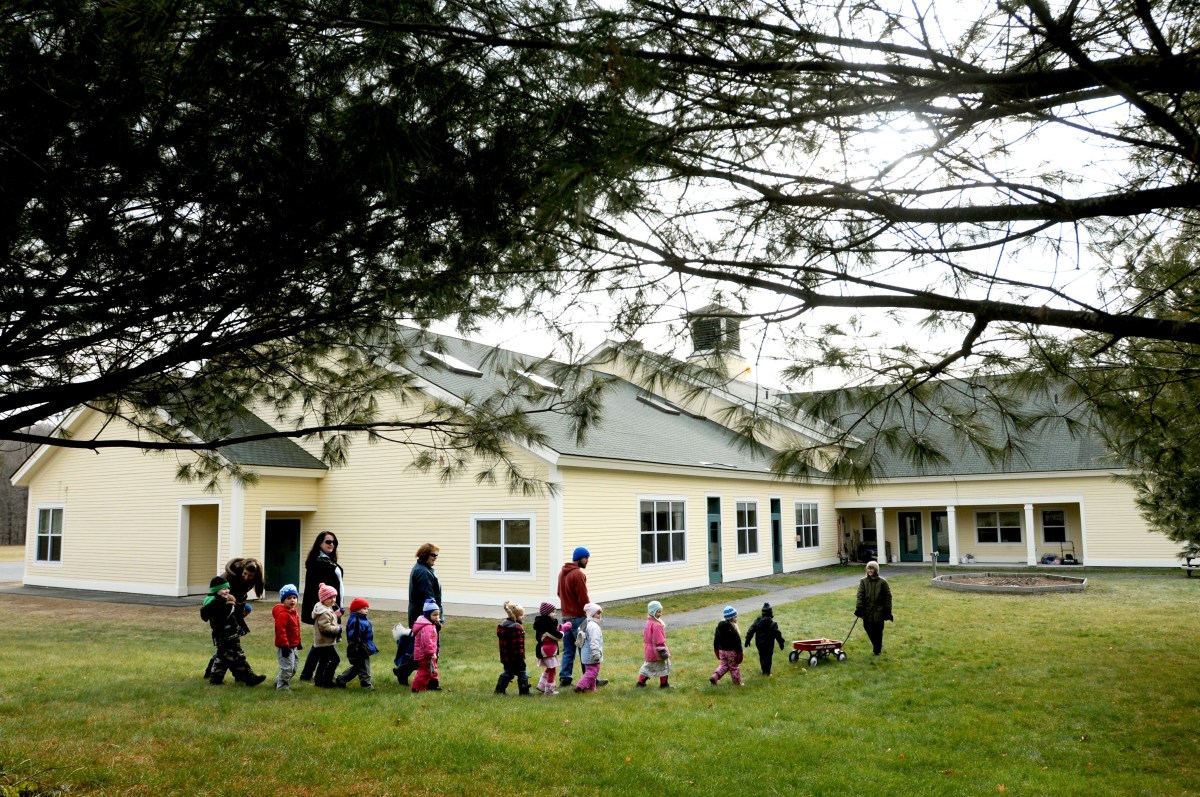
In an effort to avoid another major school tax increase, the Rivendell Interstate School District is asking people in Fairlee, West Fairlee, Vershire and the New Hampshire town of Orford to consider major school reconfigurations.
“In general, we have a community who are tremendously supportive of education,” Board Chairwoman Kathy Hooke, a Vershire resident, said in a phone interview last week.
Even so, she said, the takeaway message of the last annual school meeting was that taxpayers were feeling the strain.
“They were saying, ‘This is a lot, folks,’ ” Hooke said. “Our thinking is: ‘Yeah, how do we move together as a community and get to a place where we can all feel good — not all of us — a lot of us?’ ”
There are five options on the table as the School Board crafts its budget for next school year:
- Maintaining the status quo, which is two elementary schools, Samuel Morey in Fairlee and Westshire in West Fairlee, and one middle and high school, Rivendell Academy in Orford;
- Creating multi-age classrooms in the elementary schools;
- Moving all K-2-grade students to one elementary school and all 3-5-grade students to the other;
- Consolidating all younger students at one elementary school and closing the other;
- Offering school choice and paying tuition for all students in grades 9-12.
Maintaining the status quo is expected to lead to a budget increase of 10%, or $1.4 million, for the 2023-24 school year. That estimate comes following a similar increase in the $14.7 million budget voters approved, 134-111, in March for the current academic year.
Going to multi-age classes in the elementary schools has the possibility of saving $650,000 in staffing costs, according to numbers presented to the board by Nancy Murphy, the district’s business manager.
The option that would leave grades 6-12 at Rivendell Academy and move pre-K-through-second-grade students to one elementary school and pre-K and grades 3-5 to the other has the potential of saving $800,000.
The option that would close an elementary school could save more than $1 million in staffing costs.
Meanwhile, paying tuition to send the district’s 130 high school students to other schools would cost slightly more than operating the school, Murphy said.
Hooke said the tuition option is worth discussing because the board heard in a recent survey that moving to choice for high school is something many families are interested in exploring.
Moving to paying tuition for all Rivendell high schoolers would be “virtually impossible to implement in a one-year timeframe,” Hooke said in the phone interview. But still she said the board would like to “hear what people have to say.”
The School Board started its annual budget deliberations by asking the administration to rough out some options for how the district might be reconfigured to save money on personnel.
At a special meeting earlier this month, the board selected the five current options from a larger list. That meeting, which did not include public comment, drew so much interest that it hit the 100-viewer maximum on Zoom. The district, first formed by a vote in 1998, has fewer than 500 students.
Two budget forums for community members were scheduled for the past week.
In a recording of an Oct. 12 meeting, Hooke explained that the bulk of the district’s costs are in salaries and benefits.
If the district can find a way to save money by being “more efficient with our teaching staff,” Hooke said, there are other potential uses for the money, such as increasing course options at the high school level.
“It’s not just about how much money can we save,” she said.
Following Hooke’s comments, Keri Gelenian, principal of Rivendell Academy and head of schools for the district, bristled at the idea that part of the purpose of the discussion was to improve students’ learning opportunities.
“This is being driven by budget,” he said in the recording. “It is completely driven by budget. To think otherwise is crazy.”
Others at the meeting noted that the proposals, which just focused on staff costs, did not account for the effect of the changes on things such as transportation, revenue or building costs.
“Speaking as the Vershire (representative),” board member Nate Thames said in the meeting recording, “I don’t want to drive to Samuel Morey for everything,” should Westshire be closed.
“From my preliminary discussions with people on that end of the district,” Thames said, “people would obviously be very unhappy with district infrastructure all being located in Fairlee and Orford — upset and driving a lot.”
Barb Griffin, president of the Rivendell Education Association, the union the represents the district’s teachers, said the discussions about such significant changes to the schools’ configuration have “been a distraction” from the focus of educating students.
“People are worried,” said Griffin, who is a Title I math & reading interventionist at Westshire.
Should a building be closed, employees wonder whether they would be moved to another school or lose their jobs. If they’re moved to another school, they’re worried about what the additional commute might mean for them and their families.
If the district moves to multi-age classes, Griffin said, teachers would like to be assured that they would have the training and support necessary to make the model work. The suggestion of moving to multiage classes was discussed last year as well, said Griffin, who lives in Vershire.
“We felt as a staff … not opposed to multi-age,” Griffin said, “but we just need the training. If done correctly, multi-age could work.”
If the model is adopted “out of desperation,” Griffin said, the “fear is burnout.”
Griffin suggested looking at options that don’t cut jobs of people who work directly with students, such as finding a subcontractor to take on the district’s business services.
Delsie Hoyt, who chairs the West Fairlee Selectboard, is following the discussions with interest.
“I just have lots of questions here,” Hoyt said in a phone interview last week. “… The town sends the bills so we usually get the heat. Usually you just let it roll off. This year I pressed people a little bit. ‘What have you done?’ ”
West Fairlee, a town of about 620 people, is limited in how much it can grow its grand list to spread out the tax burden. It’s not on the interstate nor does it have a ski area, and it doesn’t have much commercial property.
“For little outlying towns, there’s only so much you can do,” Hoyt said.
While inflation and rising labor costs have contributed to higher costs for municipal projects such as paving and culvert replacements, the bulk of the property tax bill goes to support schools.
“People do in general want the best education money can buy,” Hoyt said. If they’ve “got the grand list and can continue to build that grand list with business (and) other properties, great, more power to you. Other towns just do not have that capability.”
Hooke, a Vershire resident, noted that her town is paying for a new town garage, so she’s aware of the way the school costs add to municipal expenses to create a growing burden on taxpayers. The School Board has been in touch with member towns’ selectboards, she said.
“Especially if in the long run (the district is) looking at options that might involve closing a school,” Hooke said, “coordinating with the Selectboard is going to be critical.”
The budget discussions come as the district also is working on a new strategic plan, which Hooke said she hopes will be completed in March when voters are deciding on the budget at the district’s annual meeting, so they can see how the coming year’s budget fits in with the district’s longer term plans.
She expressed skepticism that any of the plans that involve closing schools could be implemented for next school year, but said that given the high level of interest in the board’s Oct. 12 budget conversation, she’s “optimistic that we’ll come out of this with something.”
