

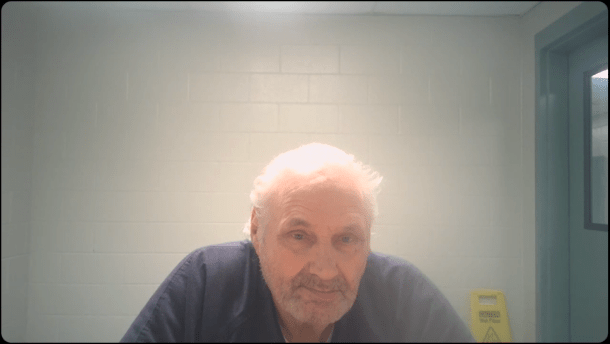
Michael Louise, the 80-year-old defendant in a double murder case dating back to 1989, has been held on $200,000 bail following his arrest a year ago. Since July, he has been held in three different medical facilities, including one in Connecticut, requiring correctional staff to be with him 24 hours a day, seven days a week.
Now, his defense lawyer is calling on a judge to reduce that bail to $10,000, saying his client is not a flight risk and needs to be released from custody to tend to his medical needs.
The case highlights the challenges of supervising an aging population in the state’s prisons and the costs of providing specialized medical care and security elsewhere.
Louise, of Liverpool, New York, was charged in October 2022 in the deaths of his wife’s parents in Danby in 1989. He faces two counts of second-degree murder, accused of fatally stabbing Catherine and George Peacock, who were 73 and 76 years old.
He has pleaded not guilty to the charges against him.
Dan Sedon, an attorney for Louise, argued during a hearing Tuesday in Rutland County Superior criminal court for the lower bail. He told Judge Cortland Corsones that his client is being held in a rehabilitation facility in Vermont.
Louise went to the rehabilitation facility, the defense attorney said, after a hospital stay in Connecticut — where he went in July to receive needed medical care that could not be provided in the Southern State Correctional Facility in Springfield.
Since Louise remains in custody for lack of $200,000 bail, corrections staff have been at those medical facilities since July guarding him, according to Joshua Rutherford, director of classification and facility designation at the state Department of Corrections.
“He was originally transferred to Springfield Hospital. They were unable to meet his medical needs, and the closest hospital available that could meet his needs and had a bed available to take him was in Connecticut,” Rutherford testified during the hearing Tuesday. “He was subsequently transferred to the state of Connecticut, and our staff went with him.”
The exact medical condition Louise requires care for was not revealed during the hearing, with the parties citing privacy considerations.
Rutherford testified that after a stay at the Connecticut medical facility, Louise was placed in a rehabilitation and skilled nursing facility in Vermont.
“We could not meet his needs in the correctional facility,” Rutherford said. “He’s not been back in a correctional facility since he exited on July 28.”
Due to Louise’s condition, he is not in restraints, Rutherford said, but at least one corrections staff member at a time is assigned to watch over him.
“We maintain 24 hours a day coverage,” he said.
At the time of his arrest a year ago, Louise appeared in court for his arraignment in a wheelchair. Rutherford said at Tuesday’s hearing that Louise has “significant mobility limitations” and only recently had been able to stand up “for a very short period of time and that was considered a milestone.”
Rutherford said he is not aware of when Louise might leave the medical facility he is in now. “I’ve not heard anything about discharge plans or timeline for that. He does appear to need that care and progress, to this point since July, has been very slow,” Rutherford said.
A “rough estimate” of the cost of staff time to supervise Louise since his hospitalization totals $167,842, based on the average wage of several of the staff members, according to Haley Sommer, a corrections department spokesperson. That figure, Sommer said, does not take into account mileage, meals or hotel stays.
With the incarcerated population aging and increasingly in need of specialized medical care outside of prison settings, Sommer said, managing the staffing and cost of providing corrections department supervision for those receiving care has been challenging. The department is working on standing up a team of corrections staff specifically assigned to the task of hospital coverage, she said.
Initially after his arrest, Louise was ordered held without bail. However, Corsones later set bail at $200,000, and following appeals from both the prosecution and defense, the Vermont Supreme Court upheld that amount, which Louise has been unable to post.
During Tuesday’s hearing, Sedon said Louise had health insurance before his arrest but lost that coverage following his incarceration and his medical care is now provided by the corrections department.
If released on bail, Sedon said, Louise would need to obtain insurance to cover the cost of his ongoing medical care and would need time to get that in place.
Setting bail at a lower amount of around $10,000, Sedon said, would allow his client to continue receiving the care that’s currently covered by the corrections department as he and his family work to put together his own insurance coverage. Once Louise has those plans in place, Sedon told the judge, his client could post a lower bail and be released from corrections custody.
“Mr. Louise is concerned about interruption in his medical care,” Sedon said.
Jared Bianchi, the Bennington County deputy state’s attorney prosecuting the case, told Corsones that he opposed lowering the $200,000 bail for Louise.
“We think that his placement, his security level, is all being dealt with appropriately right now. He’s received appropriate care,” Bianchi said.
“He was an old and infirmed defendant when he was arrested,” Bianchi later said of Louise. “He remains one now, albeit he’s taken what appears to be a temporary turn for needing the additional services to rehabilitate himself.”
Sedon countered that there has been a change in his client’s circumstances and condition, and those changes need to be taken into account.
“The fact that he is now rendered completely incapacitated by his health and age, requiring assistance with activities of daily living, should be considered,” the defense attorney said.
Any risk of flight, Sedon said, “has shrunk to the point where a $10,000 cash bail adequately and reasonably addresses that.”
Corsones, the judge, took the matter under advisement and said he would issue a written decision as soon as he could.
Thirty-three years after the Danby couple were fatally stabbed, Vermont State Police arrested Louise, citing advances in DNA technology that had resulted in new evidence identifying Louise as the alleged killer. That new evidence, according to court charging documents, was a spot of blood from inside his car that matched George Peacock’s blood.
Louise, when interviewed in 1989, according to charging documents, reported that on the day his parents-in-law were killed, he planned to drive to their home to pick up an item he wanted.
However, investigators reported Louise told them that after making it more than halfway to Danby, he decided to turn around. Investigators have also described as circumstantial evidence a couple of “suicide notes” Louise left for his wife shortly after her parents were killed.
Sedon, the defense attorney, filed a 20-page motion in August challenging the prosecution’s case, contending that investigators were overzealous in zeroing in on his client with “unhinged desperation.”
He called for the case against his client to be dismissed. No ruling has been made on that motion.
