

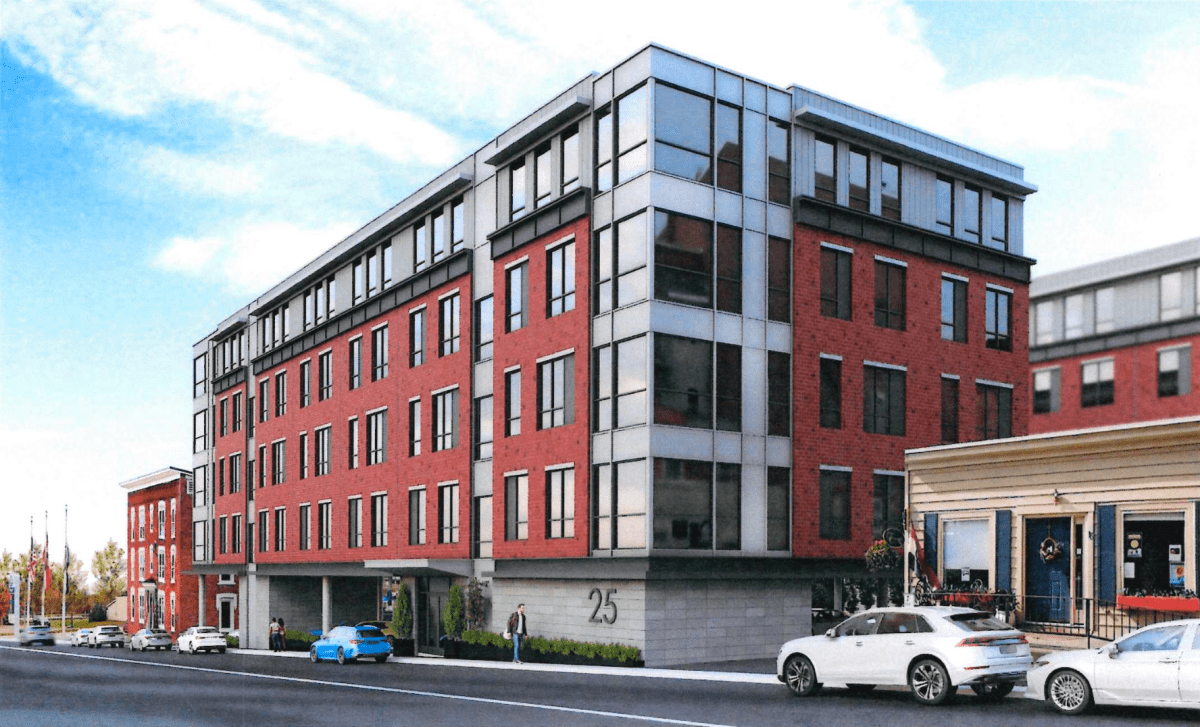
St. Albans leaders advanced plans this week for two large new apartment buildings in the heart of the city’s downtown — though the projects still need approval from state officials and, ultimately, local voters before construction could get underway.
Together, the two buildings behind City Hall would include about 90 new housing units, according to city planning documents. Officials said they want the units to be largely one- and two-bedroom apartments, and to be marketed as “workforce housing” — defined as affordable to people making between 80% and 120% of the area median income.
In Franklin County, area median income is $79,600 for a single-person household, and $113,600 for four people, according to estimates from the U.S. Department of Housing and Urban Development. (The federal government estimates area median income for Franklin, Grand Isle and Chittenden counties as a combined metropolitan area.)
The four-story buildings would largely fill in space between Hudson and Center streets that is either vacant or used for surface parking today. Two low-rise, city-owned buildings on Hudson Street would be demolished to make more space, according to planning documents, as would the back portion of the nearby Bellevue building.
Dominic Cloud, the St. Albans city manager, said the project is a direct response to the acute need for more multifamily housing in northwestern Vermont, as described in the area regional planning commission’s “housing needs assessment” released in March.
The report found that Franklin and Grand Isle counties need 3,350 new or improved housing units to meet the needs of current residents — not to mention those expected to move to the region in the future. Its authors specifically pointed to a dearth of one-bedroom housing to serve recent growth in single-person households.
“That’s not a new idea, but I think it’s risen to the top of the policy agenda,” Cloud said in an interview. “Major employers say, I’d love to expand in your community, but where are the workers going to live? And so this is one way we can answer that question.”
Local leaders say the city needs to build more housing, in part, to meet the needs of workers expected to move there for jobs at a battery testing facility planned just outside city limits in St. Albans Town by the electric aviation company Beta Technologies.

St. Albans officials have proposed to fund the housing project by issuing new debt under its tax increment financing, or TIF, program. At its meeting Monday night, the St. Albans City Council approved a plan to ask the state’s TIF regulator — the Vermont Economic Progress Council — for permission to borrow an additional $6.9 million, if needed.
With tax increment financing, municipalities designate an area for economic development construction improvements — such as downtown St. Albans — and borrow to pay for the work on the expectation that the work, when completed, will result in an increase in property tax revenues.
Cloud said the city hopes that the use of public funding through the TIF program will make the project more attractive to private developers, who may not otherwise find it financially viable to build workforce-level housing outside the Burlington area.
Using the money it borrows under TIF, the city — which already owns the land — would clean up any soil contamination found on the site, construct new parking and prepare utility hookups, Cloud said, essentially giving a project developer a head start.
“There’s a delta between what you can rent an apartment for in Franklin County and what you can rent it for in Chittenden County,” he said. “There’s a basic market failure. And so that’s the entree for us into using our tools of public finance to solve the problem.”
Early estimates have pegged the project cost at a maximum of $10 million.
Since the creation of its TIF district in 2012, the city has taken on about $21 million of debt to fund infrastructure projects, including new mixed-use and commercial buildings, streetscape improvements and environmental remediation work.
With approval from the economic progress council — which the city hopes to secure in the next few months — the maximum amount of debt the city could take on would increase from $25.5 million, its current ceiling, up to $32.4 million, Cloud told the city councilors.
A green light from the economic progress council would send the question of whether to issue new debt to city voters on Town Meeting Day in March. The timeline is tight, Cloud said, because the city’s decade-long authority to issue TIF debt expires in April 2024.
In addition to the new apartment buildings, the $6.9 million increase to the city’s borrowing capacity would also fund two additional projects. One is the construction of new pedestrian infrastructure that will better link downtown with the Missisquoi Valley Rail Trail; the other is environmental cleanup work on the site of a new mixed-use development at the foot of Kingman Street, in the former courthouse building.

The city also plans to no longer use TIF funding for a slate of planned improvements to Taylor Park, Cloud said Monday. The city manager said he and his staff believe a better use of that funding right now is new housing rather than the downtown green space.
Jess Graff, a housing advocate and director of the nonprofit Franklin/Grand Isle Community Action, said she was encouraged to see a large number of multifamily housing units being proposed downtown — especially as infill on largely empty lots.
Graff noted that apartments renting at 80% to 120% of the area median income will be affordable to certain types of workers, but not all, and hopes the city can continue to look for ways to build housing that is affordable to people with lower incomes, too.
“But this is a piece of the housing puzzle solution,” she said in an interview. “There certainly is a need for all types of housing.”
