

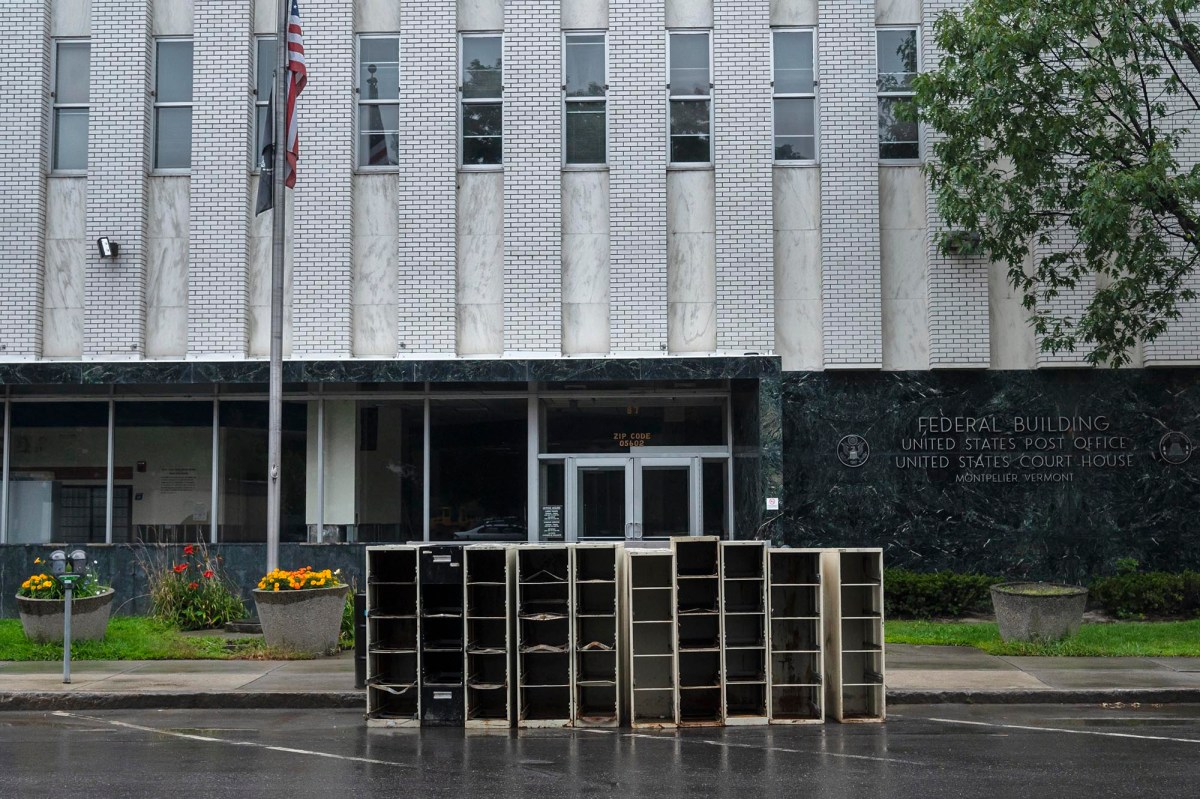
Three months after floods swept through downtown Montpelier, the city’s post office and the federal building that housed it remain in an uncertain state.
The Montpelier post office has already changed location three times: first to the National Life building in the week after the flood, then to a parking lot at the Vermont College of Fine Arts, and now at 367 River St., also called Route 302, close to the border with Berlin, U.S. Postal Service spokesperson Stephen Doherty confirmed via email this week.
But the post office might not be there for very long. According to Doherty, the line for postal services starts outside the building, so the location won’t be ideal as winter hits the state capital.
“Our facilities folks are actively looking for another local site to facilitate retail operations until the Post Office can be reopened,” he said via email.
Meanwhile, the former postal headquarters at 87 State Street will likely be off the table as an option for the foreseeable future. Work on the federal building that housed the post office and a half-dozen other federal offices will continue into “late 2024,” Paul Hughes, a spokesperson for the General Services Administration, said via email.
Hughes said the building’s first floor flooded, damaging critical building systems that were located in its basement. The General Services Administration’s immediate objective is to rehabilitate the heating system so the building does not degrade any further over the winter.
Other federal agencies that were located in the building, including the Internal Revenue Service and the Small Business Administration, did not respond to inquiries about where they are currently located or plan to relocate. The flood also closed the offices of U.S. Sen. Peter Welch, D-Vt., who also maintains an office in Burlington.
With the status of the post office up in the air, Montpelier residents have taken to social media and Front Porch Forum to discuss where the post office can, and should, go. Many have expressed concern that it might move out of the city’s walkable downtown, making it harder to access for people without transportation.
A flood-resilient post office located in Montpelier’s core downtown area is an immediate priority of the Montpelier Commission for Recovery and Resilience, a group that committed after the flooding to act on residents’ key ideas from three town hall meetings.
Ben Doyle, president of the commission and head of the Preservation Trust of Vermont, said the post office serves as a “community anchor” and as a “powerful symbol of belief” in Montpelier’s well-being from the federal government.
Having it within walking distance of downtown would not only help it serve its critical functions, but help combat climate change by reducing transportation-related emissions, he said.
“We have an opportunity to make an investment in downtown to be adaptive,” he said. He added that Montpelier’s post office would be a model for post offices nationwide that could be affected by climate change-related disasters in the years to come.
Doyle believes federal statute requires the postal service to notify local officials and the public about the potential relocation and give them the opportunity to respond. At this point, those steps have not been taken, according to Doyle.
“They need to engage with the public,” he said.
Asked about the statute, Doherty wrote it would apply only “if and when a determination is made to permanently close the current office and establish a permanent new location. We’re not at that point.”
The statute allows for a 180-day grace period for temporary relocation, about half of which has passed.
Doyle said post office changes have long been a concern for small Vermont towns, to the point where he recently unearthed a 25-year-old Preservation Trust document titled “So Your Post Office Is Relocating.”
One recent example is Elmore, where residents rallied in 2022 to save a post office located inside a privately owned general store. Doyle said the congressional delegation’s advocacy helped save the location. (Welch’s office did not respond to a request for comment about the Montpelier post office situation.)
Doyle said the situation carried echoes of the decision to tear down Montpelier’s historic 1891 post office, once lauded as one of the prettiest in the state, in favor of the current modern federal structure built in the 1960s.
“People might think it’s a good idea” to relocate now, he said, “but they might look back in 50 years and see it as a mistake.”
“Let’s not throw the baby out with the floodwaters,” he said.
