


The Deeper Dig is a biweekly podcast from the VTDigger newsroom, hosted and produced by Sam Gale Rosen. Listen below, and subscribe on Apple Podcasts, Google Play, Spotify or anywhere you listen to podcasts.

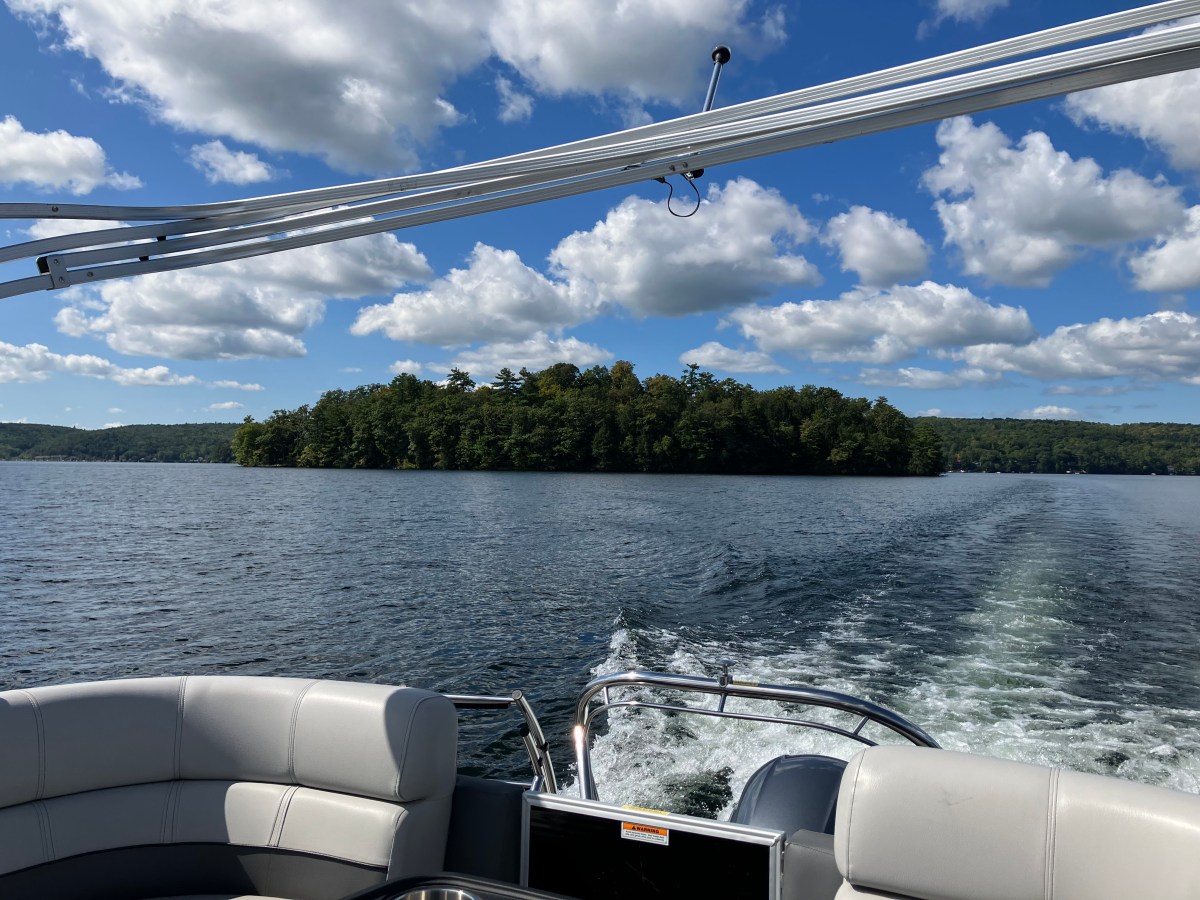
Neshobe Island is a small island located on the Castleton side of Lake Bomoseen. It has two houses, a barn and some surrounding woods, and that’s about it.
In the 1920s and ’30s, though, the island hosted a who’s who of celebrities and intellectuals most summers. These included Walt Disney, Margaret Mitchell, Noël Coward, Thornton Wilder, Irving Berlin, Dorothy Parker, Laurence Olivier, Vivien Leigh and Harpo Marx.
Host Sam Gale Rosen toured the island with its current owners and talked about some of its surprisingly star-studded history.
This transcript has been edited for length and clarity.
Sam: In particular, the island hosted many of the members of the so-called Algonquin Round Table.
Mark Bushnell is a journalist and historian who writes the Then Again column for VTDigger.
Mark: The origin of this group was something called the Algonquin Round Table, which was a big deal at the time, and I think it’s largely forgotten today. It was a group of sort of the top literary people in the country who gathered for almost daily lunches at the Algonquin Hotel in Manhattan.
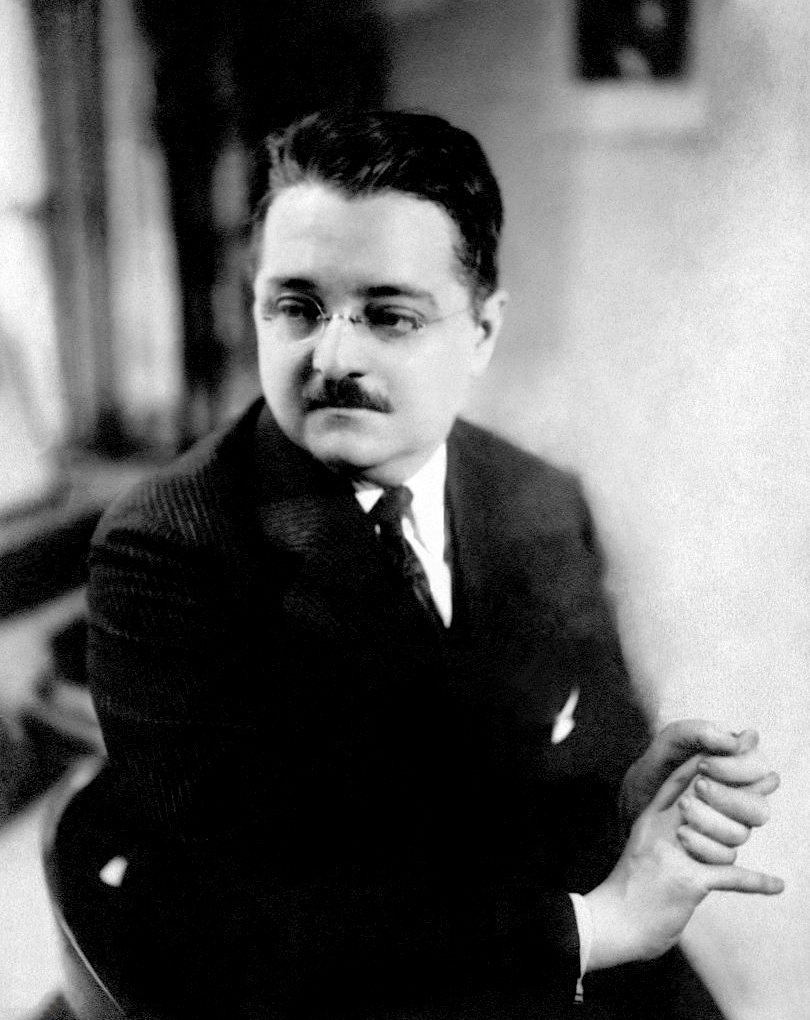
It came out of sort of an accidental convergence of things. A guy named Alexander Woollcott, who had been a reporter for a new publication called Stars and Stripes, he’d been covering World War One. And he came home and they hosted a luncheon for him at the hotel in 1919. And, or at least, he thought it was a welcome home lunch and, in fact, it was a roast and Woollcott apparently had a very good sense of humor.
He loved it, started organizing these daily lunches, and it grew bigger and bigger. They were newspaper columnists, playwrights, poets, screenwriters and at least one actor: Harpo Marx was there. He’s probably the most famous person still from that group. Another one is Dorothy Parker, a lot of people might know.
As the lunches got bigger and bigger, the hotel gave them their own room. Eventually, they sat seated at a round table, which is where the name comes from. This was a group of extremely quick-witted people with biting sense of humor, we, you know, we would probably call them snarky.
Some of the members started referring to the roundtable gatherings as board meetings. They noticed that the waiter who was assigned to them was always the same waiter every day. His name was Luigi. So they started referring to it as the Luigi board. And eventually some people decided that a better name for the round table was the vicious circle, which sort of gives you a sense of the kind of comments, everyone digs on each other. And you sort of had to be the one who had the next good shot at somebody. It’s something that the public knew about
Sam: This idea of the Algonquin Round Table as a group of very funny people scoring points off of each other made its way into pop culture, including a gag on an early Simpsons episode.
SIMPSONS CLIP: Pure hilarity! Pure Homer! I pronounce it to be the most whimsical jape of the season.
Sam: Alexander Woollcott, who had the starring role in the genesis of the Round Table, is also the person who brought members of the club, as well as his other celebrity friends, to Neshobe Island.
Mark: He was very well known at the time. And he wore a bunch of hats. He was a drama critic and influential book reviewer. He wrote for The New Yorker magazine. He was a prominent radio personality. And he came up to Vermont, visited Neshobe Island in 1924, and then ended up purchasing a large section of the island with friends. He would later buy them out.
And then he started sending out invitations to his friends — and he just seemed to know everybody in the writing world and in the entertainment world. Laurence Olivier came here with his future wife, Vivien Leigh, who had just won an Oscar for “Gone With the Wind.” The author of “Gone with the Wind,” Margaret Mitchell, visited. Other actors came: Helen Hayes, Ruth Gordon. There were writers: Dorothy Parker, who was part of the round table. Noël Coward, Ring Lardner, Thorton Wilder, Robert Benchley, who is a humor writer whose grandson Peter is actually more famous because he wrote “Jaws.”
Sam: I’ve been interested in the stories about Neshobe Island since a long time before I moved to Vermont. That interest comes mostly from reading Harpo Marx’s autobiography, “Harpo Speaks,” at a pretty young age. Harpo is one of the Marx brothers, who started in vaudeville before becoming well known for their comedy films. He’s the one who doesn’t talk, though he plays the harp and piano.
Harpo and his co-author paint a really fascinating picture of what the summers on Neshobe Island were like, sort of a wild summer camp for a bunch of very smart, very strange people. A lot of time was spent playing croquet and party games. Clothing was mostly optional for everyone involved. And Alexander Woollcott presided over everything like a well-meaning petty dictator, who insisted people abide by the schedules he wrote up and got extremely sulky when anyone beat him at croquet.

Every so often, curious tourists would try to snoop around on the island, where they were often scared off by Harpo.
Mark: There’s a story about these people pulling up in a couple of boats and getting out, and they were going to look at the island, and all of a sudden this guy came running out of the bushes, wearing a red wig, smeared in mud. And that’s all he was wearing. He was also carrying an ax and yelling gibberish at them. And these tourists clambered into their boats and got away as fast as they could, as you would imagine. And that guy was Harpo Marx. And the reason he was naked was because he had been skinny dipping at the time. It was a very casual attitude.
Sam: So I was excited to get the chance to visit the island this summer, where I was shown around by the island’s current owners, Davene and Jerry Brown.
They gave me a very thorough tour, which started as soon as I got on the boat for the ride over to the island.
Davene: We have an eagle. An eagle nest on our island.
Sam: Oh my gosh.
Davene: That tallest pine tree there. You can see it better from … Do a little loop de loop. You can see it if we go north a little bit.
Sam: Once on the island, Davene and Jerry had encyclopedic knowledge of the history of the place, from the docks to the houses to the slate in the paths. Davene says she had never even heard of the Algonquin Round Table before they moved there, but since then, she’s immersed herself in the history, and she also learned some from previous owner Merritt Chandler.
Davene: He left a lot of information as it was left to him by Woollcott’s secretary, who inherited the island when Woollcott died in ‘43. And his name was Joe Hennessy. And Joe and his wife, Helen, were friends of my friends. This is before we bought the island. And I’d gone to the house once and my friend said, “Well, you know, Joe was a personal secretary to Alexander Woollcott.” And I said, “Oh wow,” not knowing who they were, but I knew it sounded important. And then a few years later, we bought it and, like, they told me about it, and it’s, like, ding, ding, ding, this is it. And so I went on eBay, and I bought every book I could: books about, or by the people who are part of the Round Table.
Sam: So Davene knows a lot about this little island.
Davene: There was like a little shed here. And they went swimming. This was more the area. And you can see, when you’re diving, scuba diving or snorkeling, you can see the framework of the dock. So Jerry just made this launch here so we can get our boats in and out of the water. Because we do keep some of them on the island. Some go back to the mainland. Of course the last boat has to stay on the mainland when we leave.
Sam: And how long have you folks been here?
Davene: We bought it in ’98. In the winter of … well, the February of ’98. So this is our 25th year. Our kids moved on — we have a son, and his family moved on this summer, which was wonderful. So having them with us in the summer was really great. But they moved off last week because they have a lot of activities.
I’ll give you a short ride around the island.
Sam: Oh, I would love that. Thank you.
Davene: Sit up here.
Woollcott had a rickshaw! He was a very large man. He didn’t like to walk. And so he got this rickshaw probably after he went to China and saw them. And so he had roads built around the island and when friends came to visit, he’d have them pull him.
Sam: I got a golf-cart ride circuiting the island, which would have had few trees in the ’30s but now is pretty thoroughly forested. You can make it all the way around in a few minutes. Jerry drove and would stop at points of interest, including a small bench in the process of being swallowed up by a tree, which they said was built specifically for Dorothy Parker to sit in when she was feeling low. Parker was an author well known for her biting wit, but she also struggled with severe depression and substance use disorder.
Davene: This was put in, the tree, so Dorothy would have a place to sit and pout. And now you can see how the tree has really grown over. But that was her pouting bench.

Sam: Jerry’s theory is that the seat is facing the interior of the island, rather than the lake, so passers-by wouldn’t get too good a view of Parker, who often wore nothing except a gardening hat.
There are three main structures on the island. There’s a barn, the Stone House, where Woollcott lived, and the Club House, where he’d put up more friends when there were too many to stay in the Stone House with him.
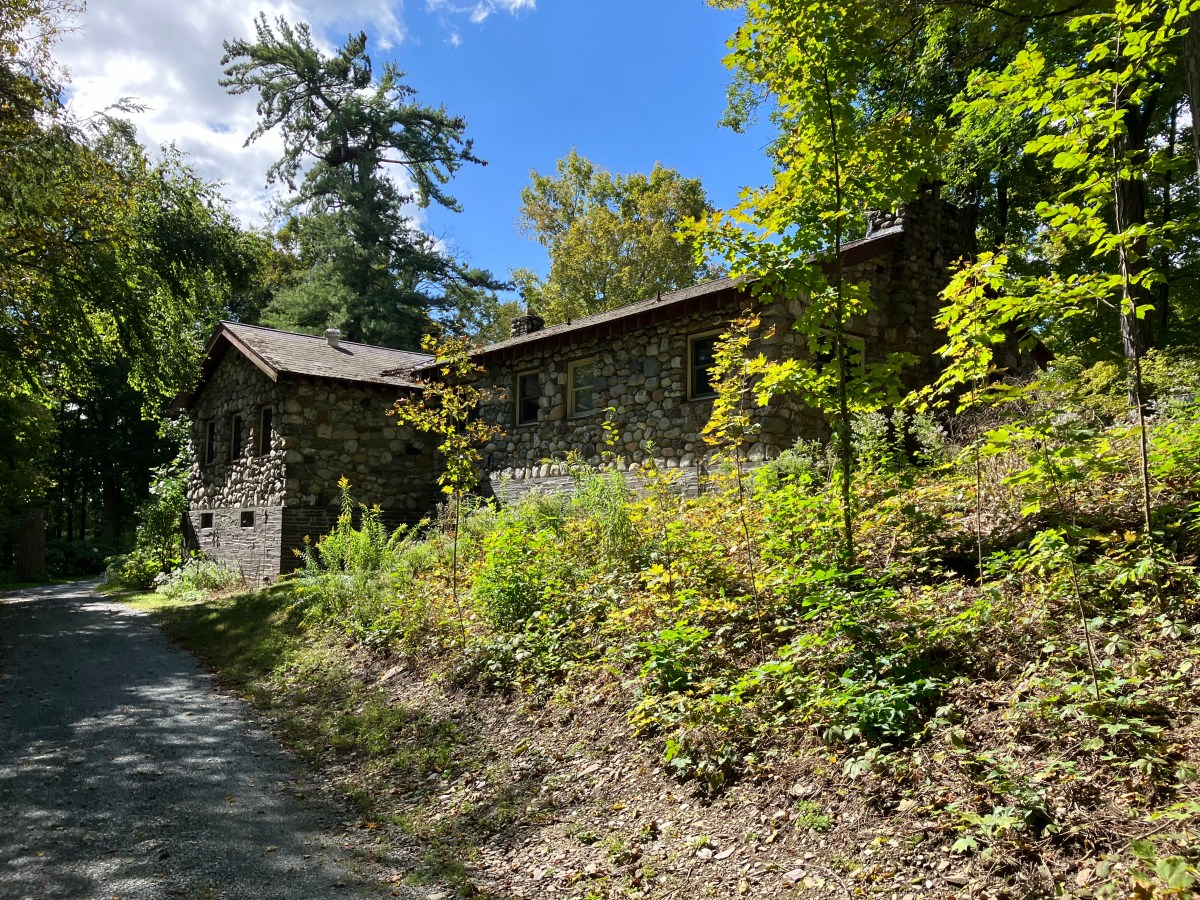
Reading about the history, I had sort of pictured a giant fancy house with loads of rooms. In fact, that’s not accurate at all; both houses are sort of small to medium, though very pleasant. When people like Lawrence Olivier and Vivien Leigh stayed here, they were roughing it, especially back then. Gradually, Woollcott, then the succeeding owners, made improvements to make things more homey.
Here’s Mark Bushnell again:
Mark: Things at first were really primitive. The only way to clean up was with cold water with a pitcher in a basin or go swim in the lake. There were outhouses; it was kerosene lamp lit, woodstoves were how you got heat. It was like a pretty unglamorous form of glamping. And then there was this debate that started with about how much to bring the amenities up, or whether to. The guests and the owners divided among what they call the masses and the classes. The masses were the ones who wanted to keep things simple and the classes wanted to bring in modern amenities. And the classes eventually won and they brought in running water and refrigeration to the island.
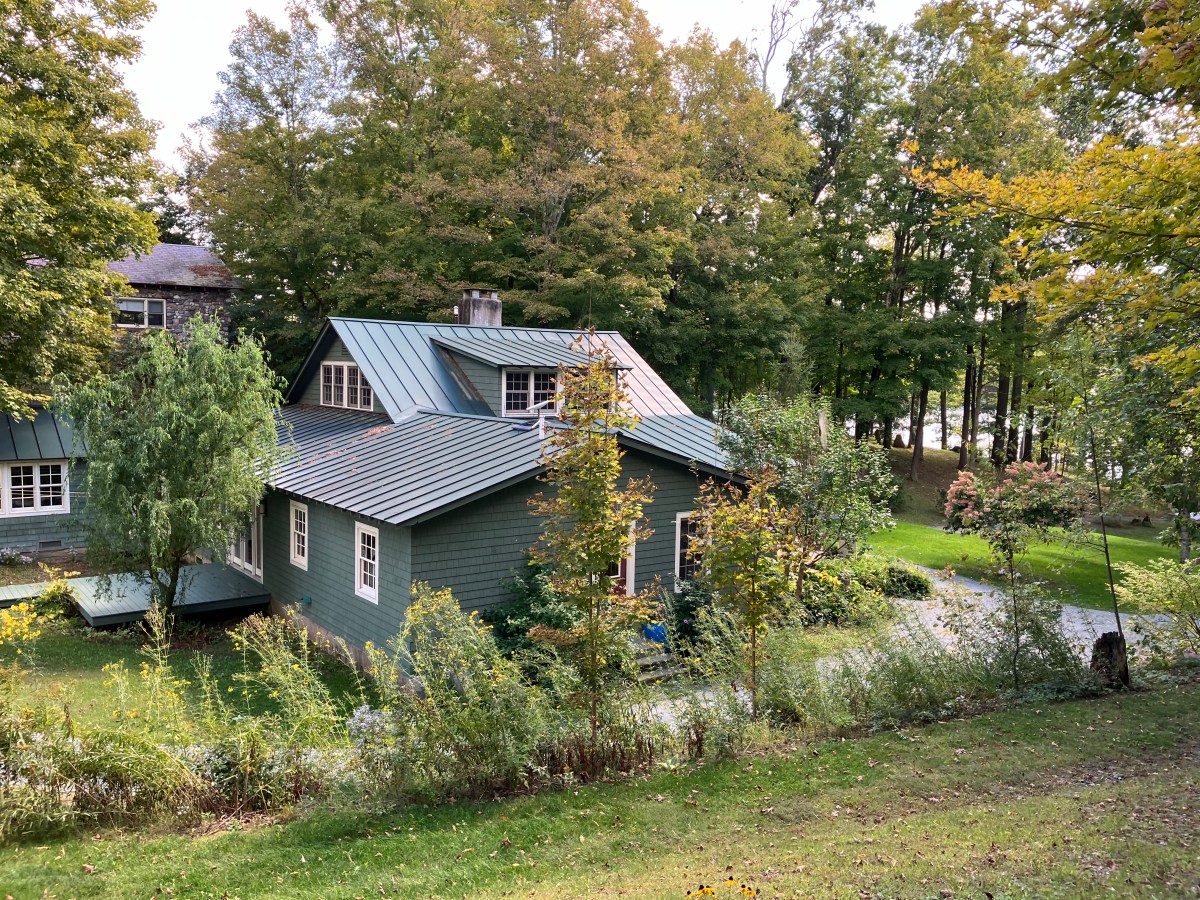
Sam: The Browns have also done an enormous amount of work on the property. There are a lot of original features, but these aren’t museums. They’re houses where people live.
The layout of the buildings has been changed and updated, but everywhere you go there are artifacts of earlier periods on the island, from signs warning “keep out!” that the Browns think were hand-painted by Harpo, to a piano in the Stone House that at least COULD have been played by Irving Berlin, one of the greatest American songwriters.
Davene: The piano, we think Irving Berlin played that because when I opened it up, it said last tuned in 1948, and I know Helen and Joe had a daughter born the same year I was born and there’s music books here that belong to her. So she played it. But Irving Berlin was here so he could have played it.
Sam: And then there’s the bathroom entirely decorated in Vermont marble, which Jerry thinks was purchased in its entirety from an exhibit in a World’s Fair.
Jerry: So Vermont Marble made this bathroom, put it in the 1930s World’s Fair as a demonstrator for Vermont marble, and Woollcott bought it right out there. We think that this would have been all his bedroom until he bought this bathroom and he said put it in my bedroom.
Sam: I also got to sit in a very old chair of Alexander Woollcott’s that nearly tips you upside-down.
Davene: This is neat. Sit in this, Sam. This is, I think, one of the first zero gravity chairs. OK, now lay back.
Sam: Aahhh!
Jerry: It’ll come back up straight. First La-Z-Boy ever built.
Davene: So here’s a date, 1860… ’66 maybe.
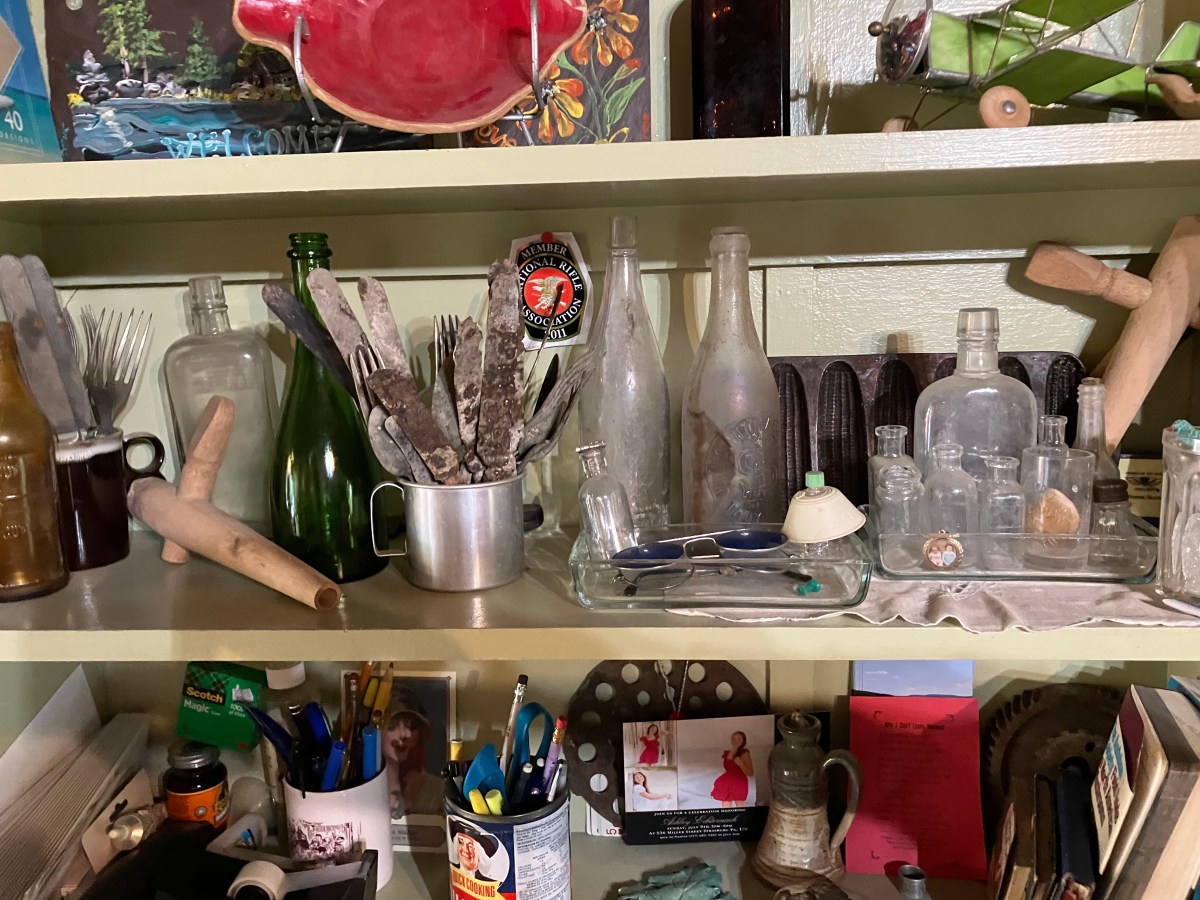
Sam: Even with all the work Jerry and Davene have put in, it’s still not a very hospitable place in the winter. They move into a different house nearby as soon as it gets cold enough to make the boat rides to and from the island unpleasant. Alexander Woollcott apparently originally had the idea to live there year-round, but it just wasn’t doable.
Davene: Like we tried to figure out a way we could live here year round. And there’s really no way. I mean, if you had a hovercraft, but still that needs to be heated in a building on both sides. And it doesn’t go up hills to say we just came home, there’s three feet of snow and we have no way to get over here. Unless we trudge through the three feet of snow. Yeah. And it’s I mean, this is beautiful, but in the winter it’s … not.
Sam: The Browns say that one of the reasons that the previous owner sold to them is that he preferred the property continue to be used for a private home rather than turned into a hotel, or used for something else. At least in their telling, other interested parties included the band Phish. But they hit it off with Merritt Chandler, who thought they’d be able to handle the upkeep and renovation that the property required.
Davene: He showed us the whole house. And he’s just like Jerry, picking up limbs as we walk along and throwing them over the edge. And he would say things to Jerry. So he knew that Jerry could take care of it. He says anybody can afford to buy it, but can they afford to keep it, you know. The rock group Phish had offered to buy it, I think for the asking price. And he didn’t want to sell to them. So in the end, when he offered it to us, it was way below the asking price. He wanted to make sure he got to choose who was going to live here next. So I’m excited because our kids just love it.
Sam: In the end, Neshobe wasn’t quite how I imagined it when I first became fascinated with the idea of Dorothy Parker and Harpo Marx playing party games and running around a tiny island run by a benevolent weirdo on their summers off.
But, those days being long past, it couldn’t really be. It was illuminating seeing how one very small place in a lake west of Rutland had evolved over the years, and still maintained echoes of its far-off glory days even after nearly a century.
And I was struck seeing how deeply people still cared about the history of the place, and maintaining its memories and artifacts, even after so much time.
