

Editor’s note: A week after this story was published, the Vermont Department of Health disclosed that the number of Covid-19 hospitalizations it reported for the final week of September was inaccurate. Rather than 64 hospitalizations that week, the department said on Oct. 11, there were 47. The department attributed the error to incorrect data provided by hospitals. Read more about the revision here.
Vermont reported 64 hospital admissions due to Covid-19 in the past week, more than double the number of the week before, according to the latest Department of Health surveillance update.
The latest data brought the state’s Covid levels to “medium,” the department said, the first time Vermont’s levels have risen above “low” since January. Covid hospitalizations have been rising since August, but this week marked a significant uptick over the previous three months.
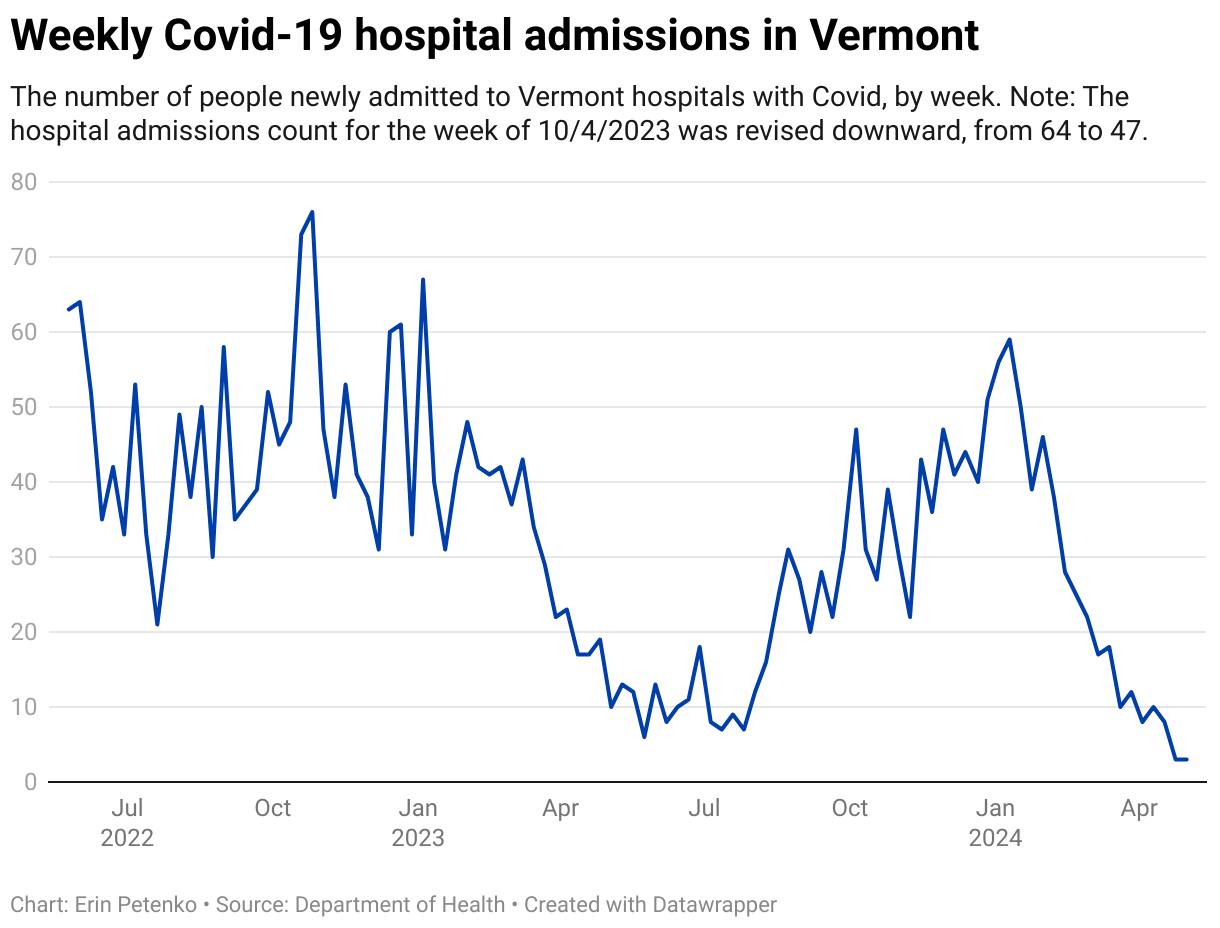
Neighboring New Hampshire has also reported a surge in Covid hospitalizations, although they remain low overall, according to The New York Times. But national Covid hospitalizations have begun to level out after months of slowly rising, the newspaper reported.
Two University of Vermont Health Network hospitals in New York state have reinstated masking due to increased cases, but the Vermont hospitals in the network have not done so yet, health network spokesperson Annie Mackin said via email.
She wrote that there were 10 Covid-positive patients at UVM Medical Center, four at Central Vermont Medical Center and two at Porter Medical Center as of Thursday. The network is asking people with Covid-like symptoms not to visit their loved ones at the hospitals.
According to the U.S. Centers for Disease Control and Prevention, Windham County has “high” Covid levels and Washington, Orange, and Windsor counties have “medium” Covid levels. Their levels are calculated based on hospital admissions per capita, using the nearest hospital region for that county.
All individuals in high-level counties are recommended to wear a high-quality mask or respirator, while the CDC recommends high-risk individuals also wear masks in medium-level counties.
Ben Truman, a spokesperson for the health department, said via email the department had anticipated a return to “medium” Covid levels at some point this fall or winter. “Case rates reached that threshold a little sooner than expected, but the overall rate trend is in line with the current outlook,” he wrote.
He noted that hospitalizations were just one indicator of Covid activity, although a “good” one. Other indicators haven’t similarly jumped, he said.
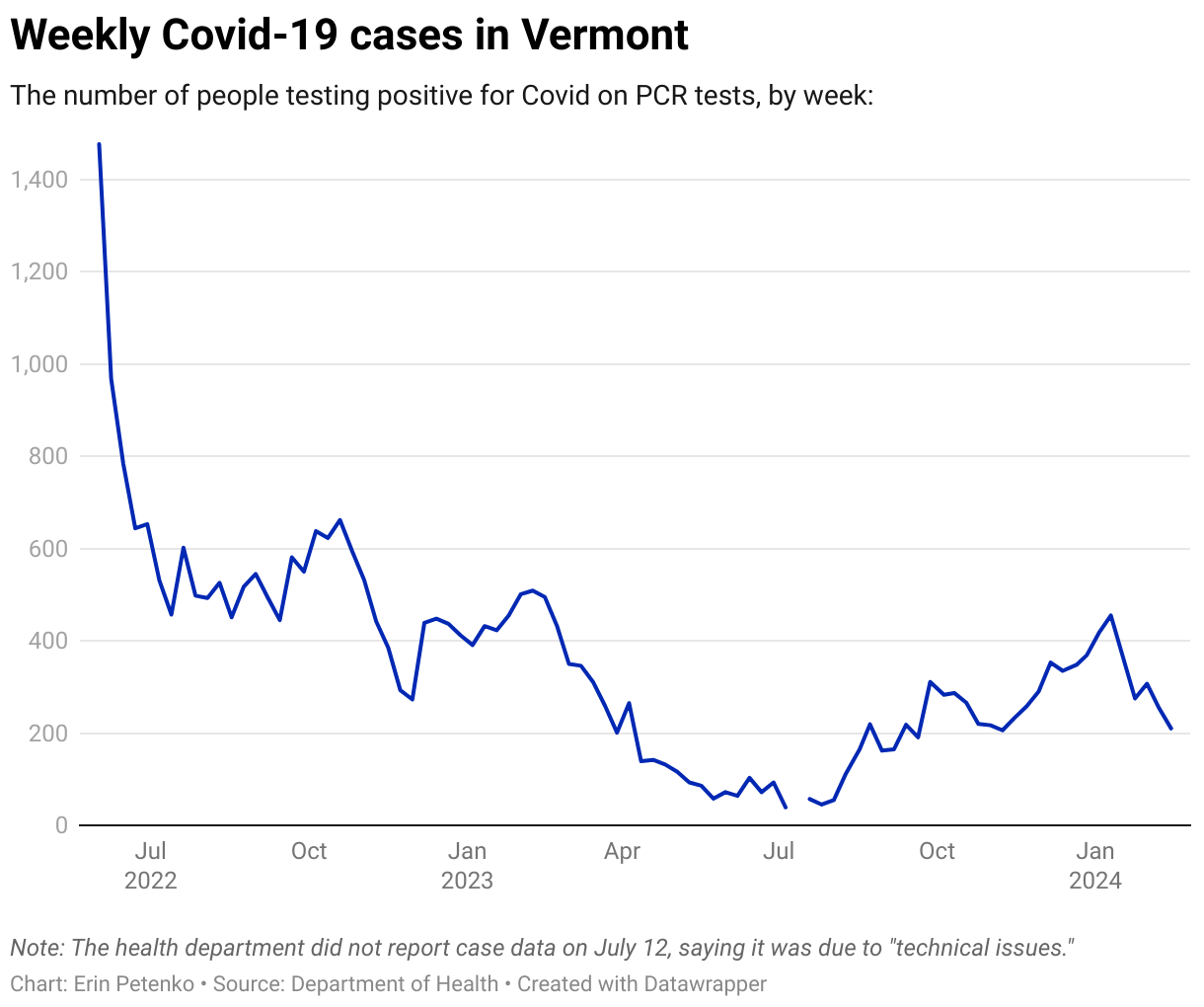
The department reported 283 Covid cases in the past week, roughly in line with the week before. But the state’s case data, based primarily on PCR test reports, has become a less important metric of Covid levels over the past year as Vermonters have switched to at-home antigen testing.
The department generally tracks wastewater testing data at 12 different treatment plants across the state, but the report said only three reported data this week due to a “laboratory contract transition” for the program, which is administered by the U.S. Centers for Disease Control and Prevention. Those three treatment plants had “plateaued” Covid levels.
Data from the syndromic surveillance system, which tracks visits to hospitals and some urgent care centers for Covid-like illnesses, showed that the number of visits has risen but remains lower than this time in 2021 or 2022.
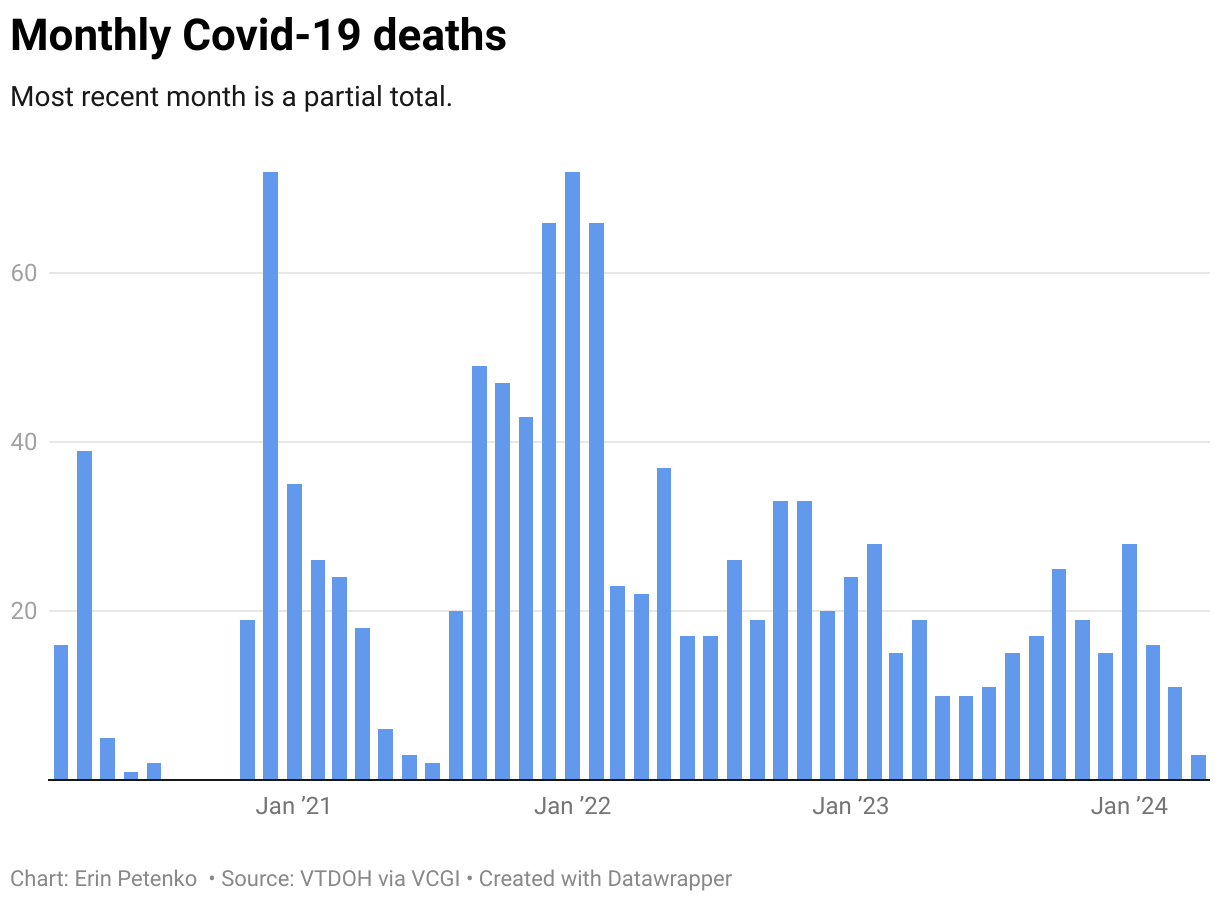
The number of deaths for Covid has ticked up, although not as dramatically as hospitalizations. The department reported 15 Covid deaths for September, compared to 14 in August and 11 in July. Covid deaths are often added retroactively as death certificates are completed and reported to the department.
Truman wrote that “we are at a different place than we were during the global pandemic,” citing the better treatment options and natural immunity among the population that could help make the disease more mild.
He said the latest Covid vaccine would further help — although Vermonters have struggled to access the vaccine in recent weeks with limited appointments at pharmacies and insurance issues.
The department expects doses will become more available in the coming weeks at pharmacies and provider practices, including federally qualified health centers that offer low-cost health care. “So, if you can’t get the vaccine yet, it’s okay to be patient, more is on the way,” Truman wrote.
Vermonters without insurance or with insurance that doesn’t cover the vaccine should utilize the federal Bridge Access Program to get vaccinated, he said.
In the meantime, he said Vermonters should follow the department’s longstanding Covid guidance: Wash your hands, stay home when sick, and get tested for Covid when symptoms arise. The federal government is offering another round of free at-home Covid tests to all households.
The health department also recommends that Vermonters consider wearing a mask if they are at higher risk of severe Covid complications or have been exposed to someone with Covid.
Correction: An earlier version of this story understated CDC guidance related to masking in areas with “medium” levels of Covid.
