


A wooded 56-acre patch of land along a branch of the White River could soon serve as the final resting place for Vermonters seeking a disposition after death that’s different from the usual.
When the Vermont Forest Cemetery opens in Roxbury later this month, it will be the first cemetery in the state devoted entirely to natural burials.
Natural burials forgo embalming and traditional caskets. Instead, the body is placed unaltered into the ground, wrapped in a burial shroud or a casket made of biodegradable materials.
At the Vermont Forest Cemetery, which plans to host a grand opening event this Saturday, gravesites will be minimally marked and will not be plowed or mowed. The cemetery’s founder, Michelle Acciavatti, explained that both the graves and the bodies beneath will become part of the natural environment of the surrounding forest, which the cemetery plans to conserve for the foreseeable future.
The concept of natural burials has caught on nationally as a way to minimize the environmental impact of death. Acciavatti described it as “our way of giving back to the planet that we take from in life.”
But she also sees it as an opportunity to rethink approaches to burials, cemeteries and death in general.
“We really do want the cemetery to be meaningful on many different levels,” she said. “It’s always a cemetery; people are coming to bury their loved ones there. But this idea of, ‘What does the forest offer to you? What can this forest mean to you?’”
A career in death
Sitting outside her home in Montpelier in early October, Acciavatti wore a black T-shirt that read in big, white letters: “This body will be a corpse.”
She has been thinking about death for years.
Acciavatti began her career as a neuroscience and ethics researcher for Boston Children’s Hospital, where studying the experiences of terminally ill children led her to wonder if there were different ways to approach end-of-life care.
“I was really struggling with people’s experiences. I mean, it’s a child dying. There’s no way to make that good, right?” she said.
A friend suggested she become a death midwife, or death doula — people who offer emotional and logistical support to those approaching their deaths. Acciavatti was particularly moved by the stories of nurses during the AIDS crisis who would take their dying friends into their homes to make their final days more comfortable.
Acciavatti took her friend’s advice and began working as a death doula, but she also became interested in the next steps of natural death care, a national movement that also includes home funerals and natural burials. “You keep the body at home, you care for it with your own hands, and then you return the body to the earth in some way,” she said.
“I’ve never enjoyed conventional funerals. I mean, ‘enjoy’ is the wrong word. But they’ve never given meaning in my life,” she said.
She put her professional experience to personal use last year, when her aunt was diagnosed with cancer. Her aunt had been one of the first clients for whom she’d created a natural death plan, and the entire family came together to put that plan into action on Earth Day.
“It was a really incredibly moving experience for my whole family,” she said. The process drew in her father, who now serves as a board member for the new cemetery. Her partner, Paul, is also helping to set it up. Acciavatti joked that it was becoming a family business.
Changing the rules
Acciavatti was among those who pushed to change state law to allow for natural burial grounds.
Vermont is one of the less restrictive states when it comes to end-of-life options. It is one of 28 states in which aquamation (sometimes referred to as water cremation) is legal and one of five states in which composting human bodies in a facility is legal. The state also allows Vermonters to bury their loved ones on their own property.
Vermont legislators paved the way for natural burial grounds in 2015 when they passed a law that removed certain requirements for cemeteries, such as fencing and maintenance.
Two years later, Acciavatti and others successfully lobbied for removal of yet another restriction on cemeteries: the 6-foot minimum depth of burial, which natural burial advocates said prevented the full decomposition of bodies.

Some alternative burials, even when legally allowed, haven’t always been a practical option. For instance, years after their legalization, there are still no aquamation or human composting facilities in Vermont. Families who want those options would have to ship their loved ones’ bodies out of state instead.
Acciavatti said she thinks natural burials began to resonate with people during the Covid-19 pandemic, when nobody could do the “familiar thing” when it came to funerals. She assisted several natural burials at Green Mount Cemetery in Montpelier, which offers some natural burial plots alongside its traditional burial options.
At least three other locations in Vermont are “hybrid” cemeteries, with both natural and traditional plots: Meetinghouse Hill Cemetery in Brattleboro, Hazen Westview Cemetery in North Hero and Robinson Cemetery in Calais, according to Green Burial Vermont, a nonprofit that advocates for the practice.
“Whether we’re burying somebody on their own property or in a cemetery, (my experience) is that when people see how different it can be and how much more meaningful it can be, that they’re really drawn to it and want to do that,” Acciavatti said.
More than a cemetery
When setting up her own cemetery, Acciavatti ran into a number of complications — everything from navigating the Act 250 process to addressing local concerns that delayed town approval.
The cemetery land also had to be prepped for burials and configured for physical accessibility, a step that took almost another year. But Acciavatti said that accessibility — both physical and financial — was a priority for the cemetery, which is a registered nonprofit.
The cemetery has set the cost of burial at about $2,400 per person, which includes $1,000 for the the plot and $1,400 to open and close the grave.
It’s hard to say how that compares to the average cost of a burial in the area because few funeral homes or cemeteries advertise their prices. (The federal government is currently debating whether funeral homes should be required to publish their prices online.)
The National Funeral Directors Association said in 2021 that consumers on average spent $2,500 on a metal casket and $1,600 on a burial vault — expenses that could be reduced or eliminated in natural burial. Online estimates of the cost of a burial plot and internment range from $1,000 to $3,000 or more.
Acciavatti said the cemetery board is still figuring out ways to make its burials more affordable, such as setting up a donation fund for people who can’t afford the full cost.
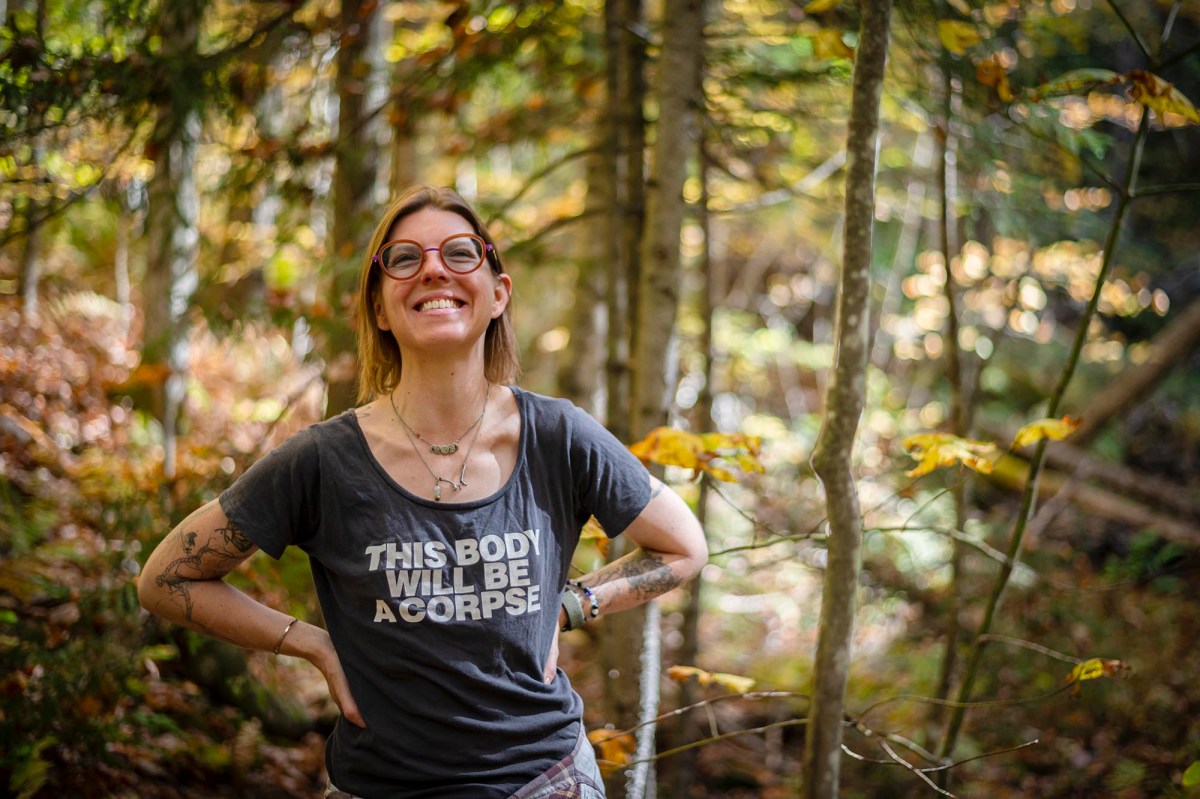
She has an ambitious vision for what the cemetery could become — a center for art, research, historic preservation and even climate resilience. (The property didn’t suffer at all in the recent flooding; Acciavatti called it a “sponge.”)
All these different uses would contribute to making the cemetery more beautiful for people who are grieving, she said.
“Grief is a way of loving, but we don’t love individually. We’re communal creatures. We do things in society. We do things together,” she said. “And so all the ways that people can come together and love and celebrate this piece of land is all in service of always going back to the burial.”
The cemetery’s first burial last year was Acciavatti’s dog, a 120-pound German shepherd who she said served as the “neighborhood ambassador” and was known to befriend rabbits. Her family carried his body half a mile into the woods to bury him.
But Acciavatti has found that she never feels the need to visit the exact spot where he was buried. “It feels like he is everywhere in the cemetery now,” she said. “And literally, he is.”
She recounted a conversation between two of her clients, who were discussing whether they needed to buy burial plots next to each other. Referring to underground fungal networks that run among trees, one said, “‘Well, we’ll always be connected by the mycelium.’”
