



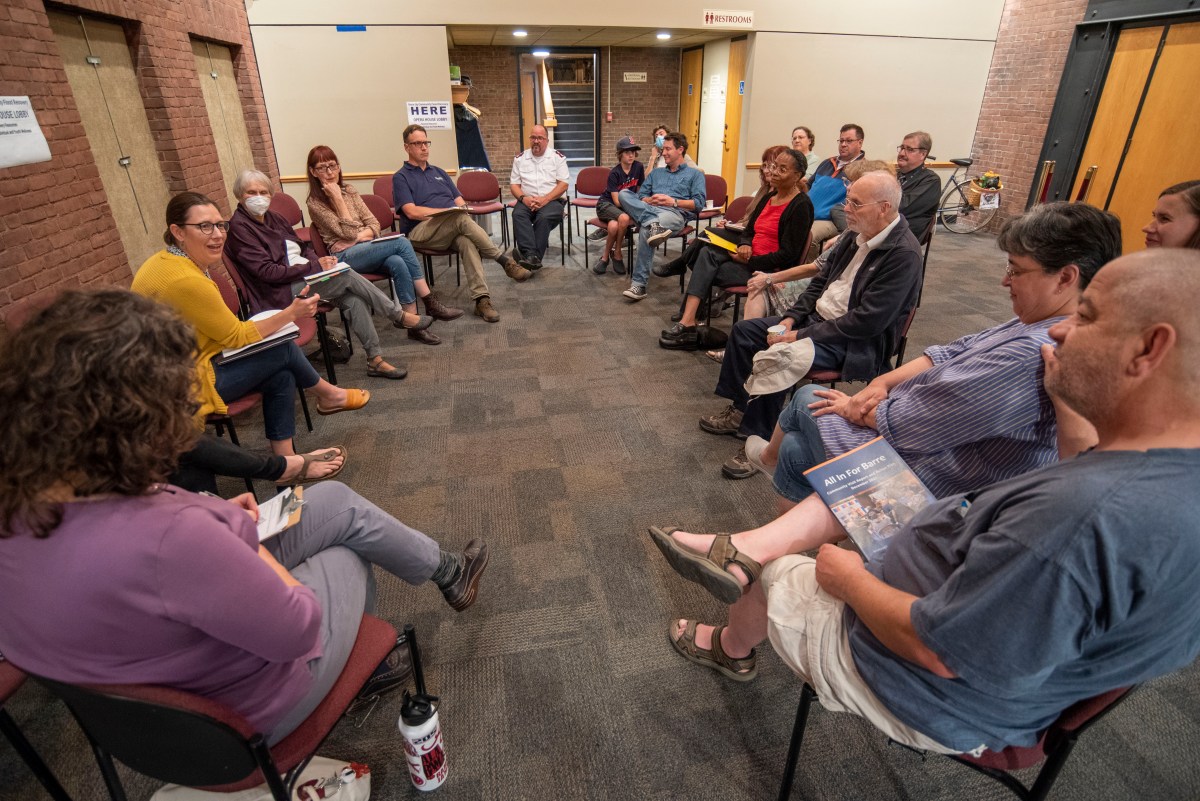
On a cool evening in mid-September, dozens of people trickled into the Barre Opera House, the turn-of-the-century theater that has long served as a performing arts center and the city’s municipal offices. The historic, Beaux Arts-style building was reconstructed in 1899 following a fire, and residents and local officials alike had gathered to talk about how to rebuild after Barre’s latest disaster: July’s catastrophic flood, which killed one resident and hit Barre’s working-class north end the hardest.
Two hours in, the conversation turned to housing, and Jake Hemmerick, who had been elected the city’s mayor only a year-and-a-half prior, took the microphone to offer his thoughts to the assembled crowd. Hemmerick, a community planner who works for the state, suggested the city look for property owners willing to subdivide their land for new housing.
He’d walked every single city street during his campaign, he said, and often noticed opportunities for small, infill development. Hemmerick then closed with a brief note of frustration: Alongside other city councilors, he’d helped put a plan before Barre’s governing body to build 100 homes in five years, he said, but many of those ideas had stalled.
“So I think we need political will on the city council, in a significant way, for housing,” he said.

Barre City is in a moment of transition. Long economically depressed, Washington County’s most populous municipality appeared, before the flood, on the cusp of a renaissance. Young families were flocking to the Granite City in search of comparatively affordable housing, and new businesses had begun repopulating the downtown’s empty storefronts.
But the floodwaters have brought fresh crises and badly exacerbated old ones. And with a city council split between more progressive and conservative wings, arriving at a common vision for rebuilding Barre City will not be easy. While July’s muck and water brought countless neighbors together in the city’s time of need, the recovery effort has failed to unify Barre’s warring new and old guards.
Thom Lauzon — a former mayor, one of the city’s largest property owners and a current member of the council — attended September’s community forum on housing but did not take the microphone. But outside the Opera House, he has been promoting his own “big, bold vision” for rebuilding Barre’s hard-hit north end — and often, in the same breath, criticizing Hemmerick for allegedly failing to meet the moment.
The line of attack is echoed by Lauzon’s allies, who cast the former mayor as a man of action with a track record of achievements in Barre, and Hemmerick, a city planner by profession, as somehow not. “There’s the planner and there’s the doer,” said Michael Boutin, a city councilor for Ward 2.
‘We need contractors — and large bags of cash.’
There’s widespread agreement that Barre needs more housing — and soon. Because while Vermont’s red-hot market is coaxing more people to move to the city, where home prices and rents are lower than in neighboring Montpelier, it is also threatening to displace those who already live there. Upwards of 500 housing units in the city, meanwhile, have been impacted in some manner by the flood. A significant chunk of those could be taken offline permanently, either through buyouts or because of an inspector’s red tag.
Adding to Barre’s challenges: Between tax abatements and the upfront costs of responding to the flood, this summer’s natural disaster is threatening to create a multi-million dollar shortfall in the city’s budget at a time in which its municipal tax rate is already the highest in the state.
As Vermont’s top state and federal officials have descended upon the Granite City to survey the damage, Teddy Waszazak, another city councilor for Ward 2, says he’s often delivered the same line: “We need contractors — and large bags of cash.”
And to those ends, the well-connected former mayor argues he would be useful. A longtime friend of Gov. Phil Scott (both Republicans who grew up in Barre), Lauzon casts himself as someone who can help make sure the blue-collar city isn’t overlooked when the powers that be reconvene at the Statehouse to discuss a flood relief package this winter.
The former mayor said he’s been able to get the governor and the chair of the state Senate’s economic development committee to listen at length to his pitch for a reimagined north end in Barre. And after decades in public life (“I’ve served with four governors”) Lauzon said he can tell when he’s got someone’s attention or when he’s getting a polite brushoff. The message he’s getting from power brokers in Montpelier, he said, is that his ideas make “a tremendous amount of sense.”
“And the amazing thing is, even though I reiterated that to Jake, nope, he doesn’t want to know about it. Because he is so afraid that Thom Lauzon will be able to get something done that he couldn’t,” he said, referring to himself in the third person. And yes, he told VTDigger, he is considering challenging Hemmerick in March for the mayor’s office.
Hemmerick has expressed skepticism about Lauzon’s plan, but insists he’s willing to hear more. And others offer different explanations as to why Lauzon’s ideas may be getting pushback.
“It’s no secret that Thom is a polarizing figure in town,” said Waszazak, who typically sides with Hemmerick on the council. “Frankly, no matter what he does, no matter what he proposes, there’s going to be anxiety and skepticism about that.”
After all, Lauzon spent over a decade as mayor and Barre’s biggest developer. Those dual roles have often left people with the perception that he’s had unfair advantages in politics and real estate. Lauzon often argues that he picks projects that are good for him and for Barre, and Waszazak thinks “more often than not” that’s indeed the case. But it’s up to individuals, he said, to decide for themselves to what extent they feel comfortable with Lauzon playing such an outsize role in the city.
“Thom is very comfortable with it. He’s made a career in doing it, and other people are not at all comfortable with it,” Waszazak said. “So what I try to do with him and his projects is trust but verify.”
‘That shift on city council’
For now, Lauzon’s vision is just that — a vision. There are no blueprints, no development proposals, no public presentations to council, no permits filed. He spoke to a reporter about a greenway in the lowest elevations of Barre’s north end, with two or three housing complexes — with maybe 40 to 60 units apiece — a little higher up. He’s also pointed to a popular trend in the construction industry — modular — as a way to speed up the process, and visited a project completed by RCM Groupe, a Canadian company that specializes in prefabricated construction.
Asked about his thoughts on Lauzon’s ideas, Hemmerick briefly turned the interview around. Could a reporter, he asked, explain to him precisely what Lauzon was even proposing?
“Because I’ve picked up little bits and pieces, but I haven’t seen him make any real public statement about what this vision is,” he said. “Or who he’s talking with. Or if it’s him as a city councilor thinking about public policy or him as an investor trying to put a deal together for his development interests. Do you have any background for me?” (Lauzon has said he would be interested in developing part of the project, if others did not come forward.)
Despite a lack of specifics from Lauzon, Hemmerick found plenty about which to express skepticism. Lauzon has said he wouldn’t take eminent domain off the table to make a project work — if a majority of residents supported a project — which Hemmerick categorically said he would never support.
And while Hemmerick said he could potentially get behind a large-scale redevelopment project in the city’s north end, it would do little good for Barre right now. Buying out enough properties to make something like that would take years, he noted.
“I think it’s really creative thinking but, boy, that sounds like a long-term project to me. And we need housing in the near term,” he said. Hemmerick said he’d much rather pursue “low-hanging fruit” — getting as many smaller and mid-scale development projects, such as accessory dwelling units, duplexes and townhomes, online as quickly as possible.
And if the council wants to get behind a bigger development project, Hemmerick suggested the city could sell an underutilized municipal parking lot to a developer for a nominal fee, in exchange for a promise to build a certain number of housing units.
“We could have that underway and it wouldn’t require three to five years of land assembly. So if the goal is to build homes as fast as possible, I would say we have a lot of choices, and I’d be looking at faster routes to build homes,” he said.
But Hemmerick freely acknowledged that there is no love lost between him and Lauzon.
“We probably don’t trust each other, to be quite honest,” he said.
While there is a noticeable ideological difference between the two sides on the city council (Hemmerick’s leans liberal, Lauzon’s conservative) municipal elections in Barre City, as is often the case in Vermont, are nonpartisan. And both camps often cast their divisions less in terms of a left-right divide and more about who, in a changing city, should set the agenda.
Because Barre City is changing. In 2012, 87 residential properties under six acres sold in the Granite City. Ten years later, in 2022, 206 such properties were sold.

Lauzon, who served as mayor for 12 years, stepped away from city politics in 2018. But he returned in 2022 to win a contested seat on the council.
“We started to see that shift on City Council, where I was the only person on the council that had been here longer than 10 years in the city,” Boutin said. “I reached out to Thom and I’m like: ‘Guess what, you need to run again.’ And after a significant amount of harassment, he decided to run.”
Despite Lauzon’s return to city council chambers, this role is new to him. He’d never served on the council except as mayor and, perhaps crucially, he does not run the show. Indeed, he is in the minority: while two councilors usually vote alongside him, three typically vote with Hemmerick.
‘A lot of my time and effort to do something so little’
While Lauzon insists he could support a version of Hemmerick’s plan to sell a municipal lot (“If he picks the right lot”), parking is often a matter of contention between Lauzon’s camp on the council and those backing Hemmerick.
In late August, the council considered a new ordinance that would have exempted an accessory dwelling unit built on an owner-occupied property from the city’s minimum parking requirements. Proponents hoped the change would make it easier for new ADUs to be built and argued that, in the wake of the flood, the council had no time to waste in getting more housing online.

But, warning that offering too little parking could create “chaos within the neighborhood,” according to an account in the Barre-Montpelier Times Argus, Lauzon voted against the measure and, without Hemmerick present to cast a tie-breaking vote, the council deadlocked and the measure failed.
Samn Stockwell, a councilor for Ward 3, is befuddled that this remains an area of such sharp contention among her colleagues. It’s one of the first things, she said, that struck her about Barre: lots of parking and not enough businesses or housing. She argued that a parking study conducted by outside consultants backed that up.
“Here’s someone with no dog in the fight saying Barre has a ton of parking, which is everyone’s perception and the reality. But there’s still not agreement on the council about that,” she said. (Boutin, for his part, dismisses the study’s methods for collecting data on usage in late 2021, during the pandemic.)
Barre’s debates about parking may appear parochial, but they are emblematic of a broader national debate about urbanism and the country’s car-centric culture. In cities and towns across America, housing reformers are taking aim at off-street parking minimums. For too long, their argument goes, zoning codes have required both residential and commercial property owners to guarantee too many parking spots — creating urban dead zones and crowding out space better spent on housing, greenery or active storefronts. “How Parking Destroys Cities” is how the Atlantic titled one 2021 article by an urban planning professor at UCLA.
Lauzon, however, remains unconvinced, dismissing such arguments as intellectual abstractions divorced from on-the-ground reality. He offered to take a reporter on a ride through Barre to point out where people have illegally parked in lots he owned and said he’d owned buildings where neighbors were constantly at odds over parking.
“Jake has — somehow — he has this idea that he knows this stuff. And okay, great. You’ve read a few books. You know, I’ve had to live it and I’ve had to practice it,” he said.
Hemmerick responded that it was “fair for Thom to say that,” since he was a landlord with experience navigating Barre’s zoning regulations — but reiterated that he did not think the city should prioritize parking over housing, particularly since it had avenues for regulating any nuisance impacts.
“Fundamentally, I think what’s more important to me is that we have affordable housing for people and not just affordable housing for cars,” he said.
The ADU ordinance is now back before city council and likely to pass. But the political stalemate came with a cost — Barre lost the chair of its planning commission, which first recommended the zoning code change unanimously to the city council over a year ago. Michael Hellein, who had served on the panel for nearly a decade, resigned his post in frustration after the first failed vote.
“There is a political minority in this town that gets all of its power from, like, being vocally obstructionist,” he said in an interview.
It’s not that Hellein believes the ADU ordinance would have been a game-changer for the city. There just isn’t that much demand for such units. But that’s precisely part of his frustration.
“Why does it take a lot of my time and effort to do something so little?” he said.
Stockwell, for her part, does think there’s some value in what Lauzon is pitching. She’s on the board of Central Vermont Habitat for Humanity, and the nonprofit is using prefabricated panels in one of its projects. She’s excited about the model. It probably won’t save money, she said, but it will likely save much needed time.
“If we could make that happen, that’s the fastest thing,” she said. And a big redevelopment project in the north end could make sense, she said, though it would be no panacea and wouldn’t provide for the many types of housing the city needs for its residents. Ultimately, she’s hopeful the two sides might reconcile their competing visions. But it might take awhile.
“It’s whether they can be reconciled in a timely way,” she said. “That’s the thing that worries me.”
Erin Petenko contributed data analysis.
