




This story, by Tommy Gardner, was first published by the Stowe Reporter on Sept. 21.
Education officials hope to make significant improvements to the Stowe middle and high school campus on Barrows Road and plan to ask residents to approve a $39 million bond to pay for it.
And it intends to put that bond to a vote in about six weeks. It will most likely be Nov. 7 by Australian ballot, although the school board has not yet officially warned the vote.
During a community forum held last Wednesday in the school auditorium, officials unveiled plans that have long been in the works. School board chair Tiffany Donza has been involved in various facilities studies since 2015, before she first joined the board, and said she’s seen estimated costs go up every year without ever getting a bond vote across the finish line.
“We are long overdue for some money to be put into this school,” Donza said last week, noting the last real upgrade were science classrooms in 2008. “I’ve wanted this for a long time, but I do also want the community to want it.”
Last Wednesday’s forum and campus tour drew only 20-30 people — many of them school district officials or facilities committee members — and there was little to no explicit naysaying about the need for the work. Donza said she could think of plenty of people who will vote no, but she said even if this bond vote fails, there are still millions of dollars in needed safety- and health-related fixes that need to be done.
Superintendent Ryan Heraty said there will be an encore presentation Sept. 27.
Some people expressed concern that the district is too ambitious with its timeline and advised to instead hold a bond vote on Town Meeting Day in March. But Heraty said that would be too late for architecture firm Black River Design to finalize plans and the district to put the project out to bid in time to break ground next spring — the rough timeline would see the project complete in 2025.
And, Heraty said, things are just going to get more expensive. “I see waiting as more detrimental to taxpayers,” he said.
Big money plans
The $39 million bond that Stowe voters will consider includes nearly $10 million in contingencies and “soft costs,” such as design and permitting fees. The actual hard costs, the various projects’ estimated base costs, ring in at $29.8 million.
An extra $6 million in contingencies are baked into the overall figure, which Heraty said are the universe of unforeseen “what ifs” and cost overruns that construction projects always run into. The bulk of the $3.3 million in estimated soft costs include $2.1 million for design fees.
As for those hard costs, this is how some of the estimated school fixes break down:
• $4.7 million for a new gym and connecting areas.
• $2.1 million for new road access and parking areas.
• $2.5 million for new athletic fields and a track.
• $1.2 million for auditorium renovations.
• $8.5 million for systems upgrades, such as sprinklers.
• $6.1 million in other general renovations — think walls, floors, roof and the like.
According to Donza, the tax impact on a 30-year bond would add $1,245 to the tax bill of a Stowe resident with a $700,000 home.
Clark Andelin, who has children in all three levels of Stowe schools, said a cursory look at the line items and designs doesn’t show much to highlight classroom improvements as much as it draws attention to things like athletics infrastructure.
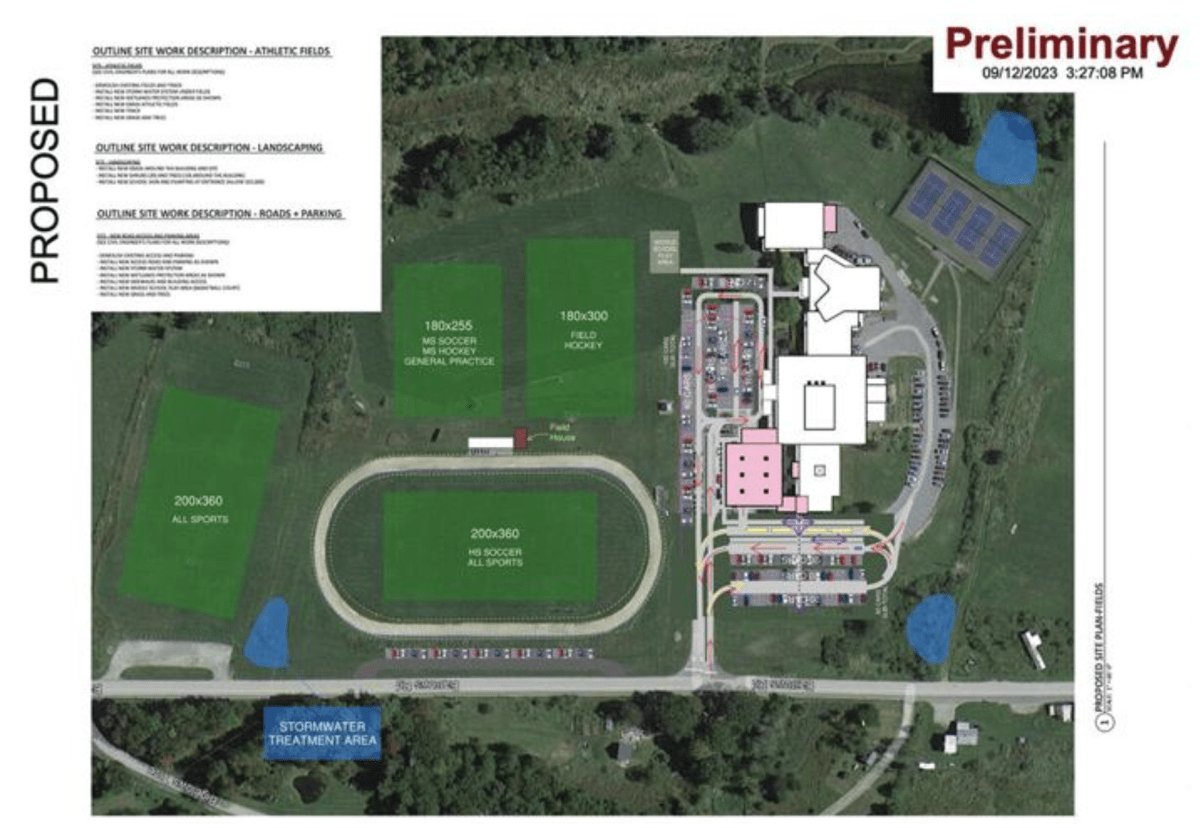
“I do agree our sports facilities are embarrassing, and I’m excited about improving them,” Andelin said. “But other than general improvements to the classroom spaces, this seems very sports oriented.”
Donza said the idea for a track and more grandstand-style seating, along with the new gym and auditorium fixes, are also features aimed at bringing the public at large to the school for events.
“We want these facilities to be community places where everybody congregates,” Donza said. “I think that’s more than the driver than when you just look at it and see the fields and the track and gym.”
One person in the audience said that a lot of the proposals seemed to her to be “pretty” for pretty’s sake. But Nancy Gleason said that’s OK.
“I think what plays a huge role here in this project is school pride, and how you feel about your school and what that actually does for your confidence,” Gleason said. “Yes, there’s a lot of pretty. But pretty feels good.”
School officials said much of the proposed work is to give the middle schoolers more of their own space. As they illustrated on a tour of the school last Wednesday, the middle school is largely enveloped by the high school — one must enter the high school lobby and walk through a series of halls before even getting to the middle level campus.
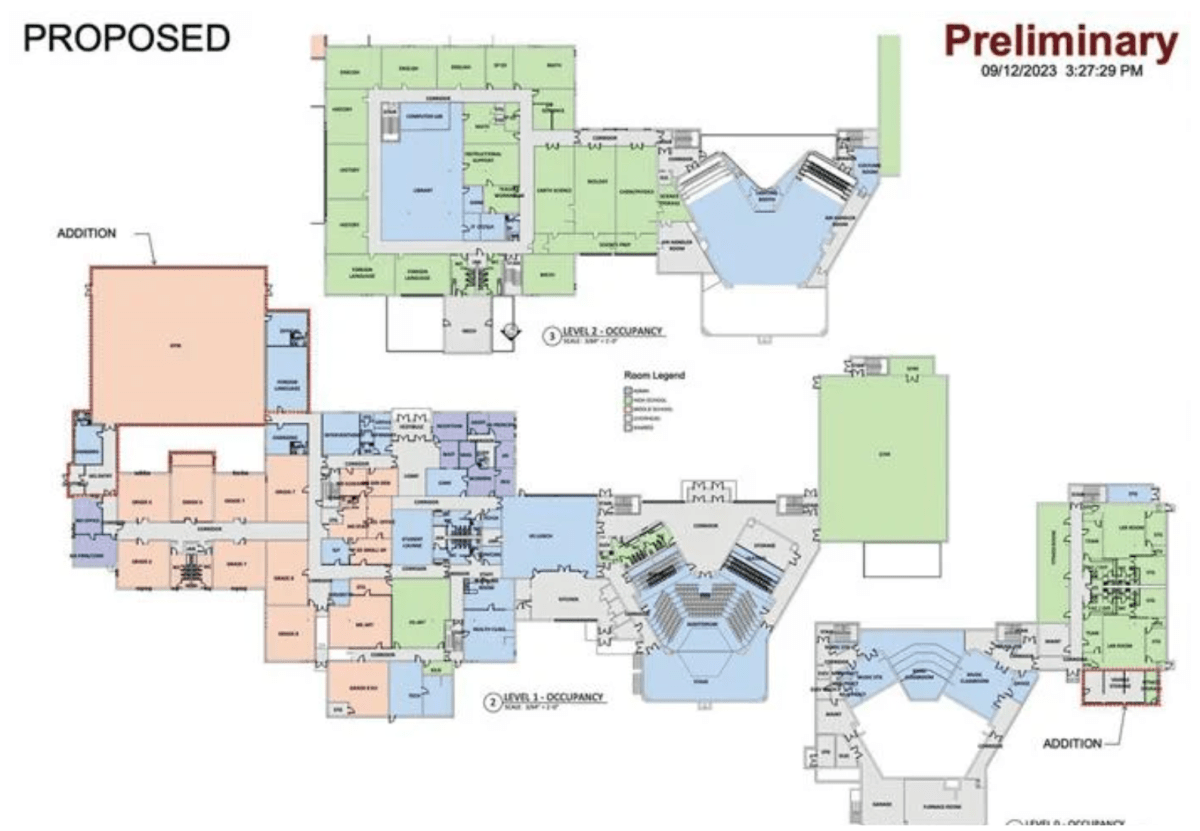
That focus on middle schoolers applies to the proposed new gym, which would be used by kids in grades 6-8 during the day but would host varsity basketball games during winter nights — it would be less cramped than the current gym.
Heraty said although it’s pegged at $4.7 million, it would also host temporary classrooms while construction is occurring.
If the gym is not built, he said the project would have roughly $2 million anyway to build temporary, modular classrooms, and those would just be removed when the project was done.
Trip through time
Many of the people taking the tour of the school last week were either alumni or former employees, who remarked with nostalgic eye-rolls about the circular, foot-operated group hand-washing sink in the girls’ locker room and the double-doored, right-angled entrance to the restrooms near the auditorium — the ones most frequently used by the community — along with approving coos on the new weight room and fond memories of when the “new” science labs were added in 2008.
They beheld in near-wonderment the new walls on the high school’s second floor, a new addition made last month that did away with the 1970s-era open concept where, as one educator noted “if anything was happening in the Spanish room, it was happening in every room.”
There is only one elevator in the school, and it cannot fit a stretcher, which is why there is one mounted to the wall at the top of the nearby staircase.
Stowe High was built in 1973 and has remained largely unchanged since. The current middle school wing was added in 1992 and a group of science laboratory classrooms was added in 2008.
The Stowe School District launched a facilities review in 2015 that culminated in the fall of 2018 with a similar community forum and building tour and a strategy to go to bond for a similar amount — although in 2018 dollars, $40 million would have also paid for renovations to Stowe Elementary school and the move of fifth grade from the village to the middle school.
All that was tabled just days after the community forum when the State Board of Education forced Stowe to merge into one tri-town school district with supervisory union mates Morristown and Elmore, despite years-long efforts by the towns to prevent that merger.
Last year, tweaks to state law allowed Stowe to leave the merged district. Part of the reason the other two towns gave their blessing for the withdrawal was that Stowe had more expensive facilities needs, and Morristown and Elmore taxpayers didn’t want to have to pay for all that work.
Heraty said in 2007, a decade after the Vermont Legislature enacted education law Act 60, the state stopped funding school construction. He said that differs from other New England states like Connecticut and Massachusetts, the latter of which Heraty said funds at least half of new builds.
“The reason that’s really important is because, when you look around the state of Vermont, there hasn’t been a new school constructed in this state since 2010,” Heraty said, noting Burlington High School as the lone outlier. “What that has evolved into is we are renovating schools.”
