


Burlington may not be known as a hub for space technology, but in recent years, a local company focused on satellite propulsion has been taking off.
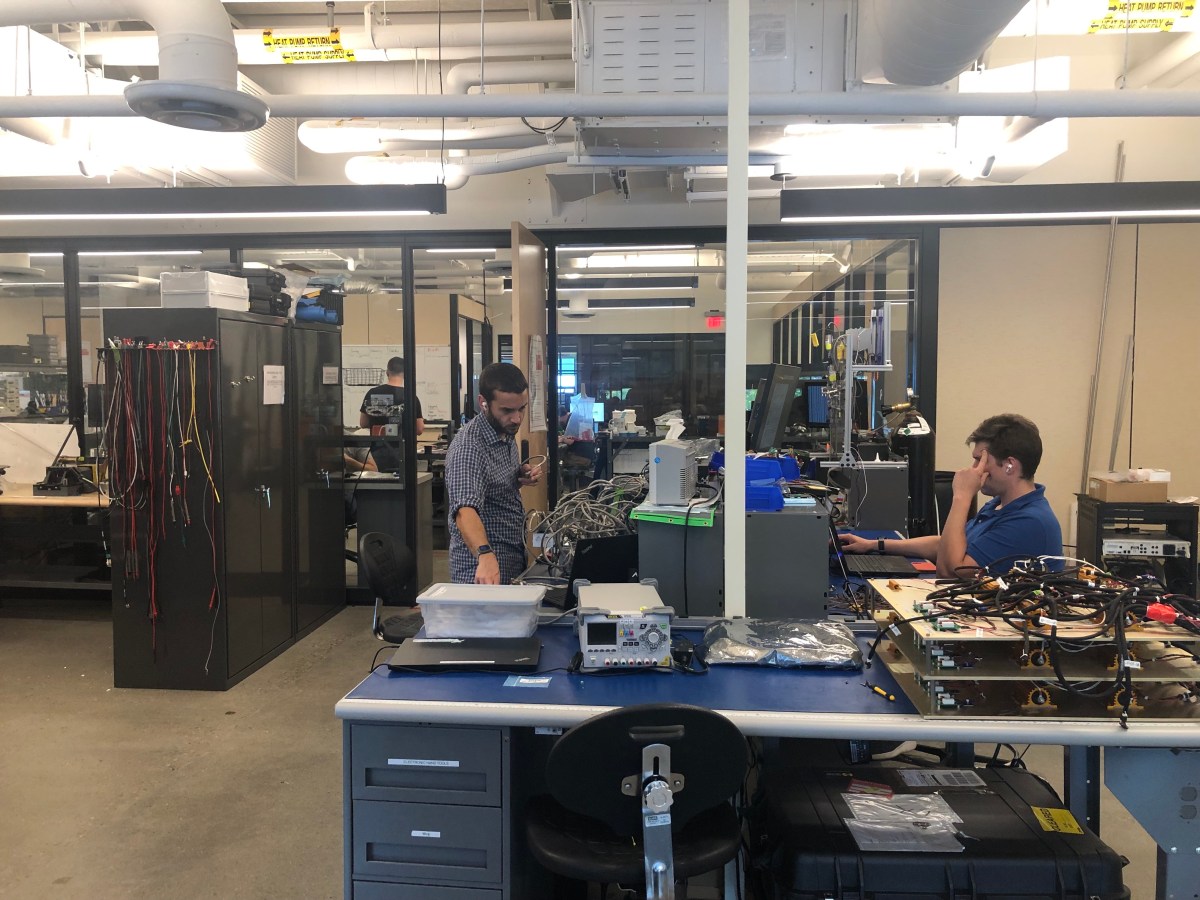
Founded in a South Burlington strip mall in 2017, Benchmark Space Systems has grown to employ 80 people in Vermont, California and the United Kingdom, according to founder and CEO Ryan McDevitt. Along the way, it expanded to Hula, the Burlington tech incubator, and this summer moved into a 40,000-square-foot testing and manufacturing facility nearby. There, it hopes to produce 1,000 thrusters a year.
The company, which received critical early funding from the University of Vermont and local investors, announced last month that it had raised an additional $33 million. Later in August, it won a nearly $3 million U.S. Air Force contract to test safer and more affordable satellite thrusters.
Benchmark produces propulsion systems that move small satellites once they’re in orbit. Most of the company’s customers are satellite manufacturers, according to McDevitt.
“They’re building the car,” he said. “We’re building the engine.”
Such engines have grown increasingly important in recent years as satellites have proliferated. The most attractive places to orbit Earth have become crowded, and satellites are often at risk of collision — unless they have a reliable form of propulsion.
Benchmark’s challenge has been to develop propulsion systems small enough — and affordable enough — to work in a satellite the size of a microwave.
“It is very easy to build a propulsion system that no one can afford to buy,” McDevitt said. “If you’ve got a billion-dollar satellite, you might be willing to pay $50 million to $100 million for your propulsion system, but if you have a $100,000 satellite, you don’t want to pay more than $10,000 for your propulsion system.”
Building systems that are as capable and inexpensive as Benchmark’s, he said, is “the kind of secret sauce that makes what we’re doing attractive.”
That’s not to say that Benchmark hasn’t faced turbulence.
In July, it announced that it had laid off 15% of its workforce. In a statement at the time, McDevitt characterized the move as a “realignment” as the company transitioned “from research and development to a production-focused team.”
Another challenge has been to grow fast enough to meet the demands of customers but not so fast that there is idle production capacity, according to McDevitt.
“If I wait until customers are screaming, ‘Hey, we’re building thousands of satellites,’ and you can only make 10 units a year, they’re going to go find other people with more capacity,” he said.
McDevitt hopes that Benchmark becomes profitable in 2025. For the past three years, he said, revenue has increased by 200% to 300% a year. Through next year, McDevitt said, the company plans to be in a growth phase, after which it will turn to driving down its costs and increasing profitability.
McDevitt, who grew up in the Burlington area and earned a Ph.D in mechanical engineering at the University of Vermont, credits the university with helping to launch Benchmark. There, he worked with his adviser, mechanical engineering professor Darren Hitt, on a NASA-funded program to develop propulsion systems for small satellites. Hitt, who died in 2019, also directed NASA’s Vermont Space Grant Consortium.

According to Corine Farewell, director of UVM Innovations, when McDevitt started working with Hitt, it became clear that the former was not only scientifically oriented, but also had a good business sense. Hitt and McDevitt then received two Spark awards from the University of Vermont to make a prototype. And, in 2017, McDevitt founded Benchmark Space Systems with a former classmate at Worcester Polytechnic Institute, Matthew Shea.
McDevitt said his UVM connections proved invaluable.
“When we were doing our first round of testing, I didn’t have to invest the first $3 million to get started,” he said. “I could lease or rent equipment at UVM to get us going.”
McDevitt could also count on funding the university helped to secure.
“One of the best-kept secrets — for reasons that are not entirely clear — about the University of Vermont is that they have a fantastic track record of attracting NASA funding,” he said.
“It’s a wonderful model of how a university can contribute to the local and state economy,” said Erik Monsen, associate professor of entrepreneurship at UVM’s Grossman School of Business. “A professor in combination with a grad student or a post-grad student comes up with this wonderful technology.”
Now McDevitt is trying to create opportunities for other UVM graduates. In the past, he said, they have gone on to work at space companies around the country, such as SpaceX, Blue Origin and Lockheed Martin, but now they work for a company closer to home.
“That’s one of the things that we were able to do,” McDevitt said. “We’re seeing a growing ecosystem here.”
