


The Deeper Dig is a biweekly podcast from the VTDigger newsroom, hosted and produced by Sam Gale Rosen. Listen below, and subscribe on Apple Podcasts, Google Play, Spotify or anywhere you listen to podcasts.
Updated at 3:43 p.m.
Vermont’s oldest synagogue has been sold — and its new owner plans to turn it into a food hall and apartments.

Ahavath Gerim — the nearly 140-year-old brick synagogue in Burlington’s Old North End — served as an important center for the city’s Jewish community for decades. Now deteriorating physically, with its congregation mostly dwindled away, it has been sold to an entrepreneur who plans to redevelop the building.
Host Sam Gale Rosen toured the historic building with the new owner and visited the nearby, newer synagogue that has now acquired many of the historic artifacts from the older location.
On this episode of The Deeper Dig, we talk about the history at play, what’s planned for the building and what happens when a space for spirituality becomes something else.
This transcript has been edited for length and clarity.
Sam Gale Rosen: The Ahavath Gerim synagogue is in Burlington’s Old North End. A relatively small brick building on Archibald Street, it’s nearly 140 years old and served as one of the anchor points of Little Jerusalem, a dense, bustling Jewish neighborhood that thrived in the city from about the 1880s to the 1930s.
But the congregation that owned the synagogue most recently has been dwindling for years and no longer used it as an active place of worship. (Though there is a different congregation that recently did — more on that later.) The building itself was also deteriorating. They decided to sell, partially because they needed the money to maintain a Jewish cemetery that they own.
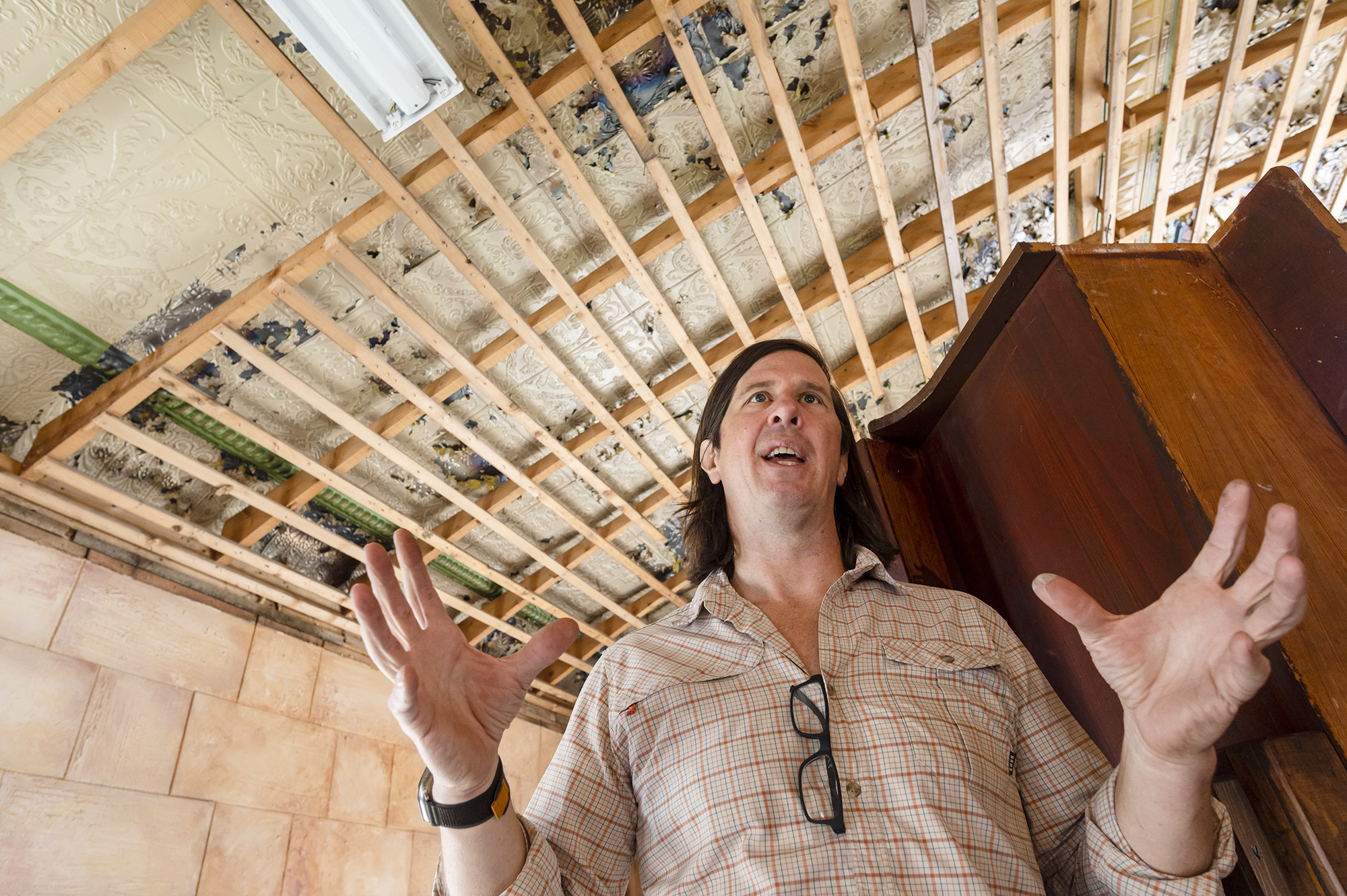
After years on the market, the building was purchased by Kitter Spater, a Burlington entrepreneur, as first reported by Seven Days. Spater started a dog gear company and more recently a business that makes travel racks for cars.
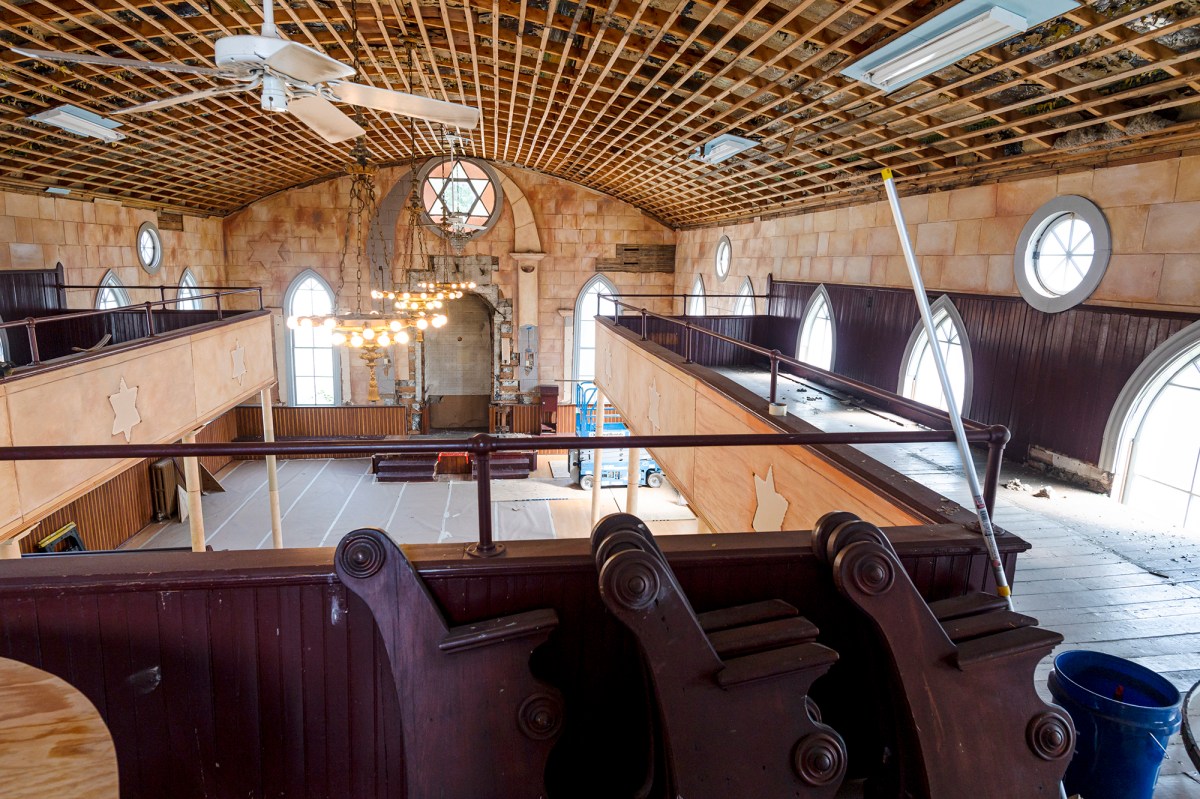
He showed me and VTDigger staff photographer Glenn Russell around the building, where there was already a lot of active work going on, and he talked about his plans — emphasizing that a lot could still change.
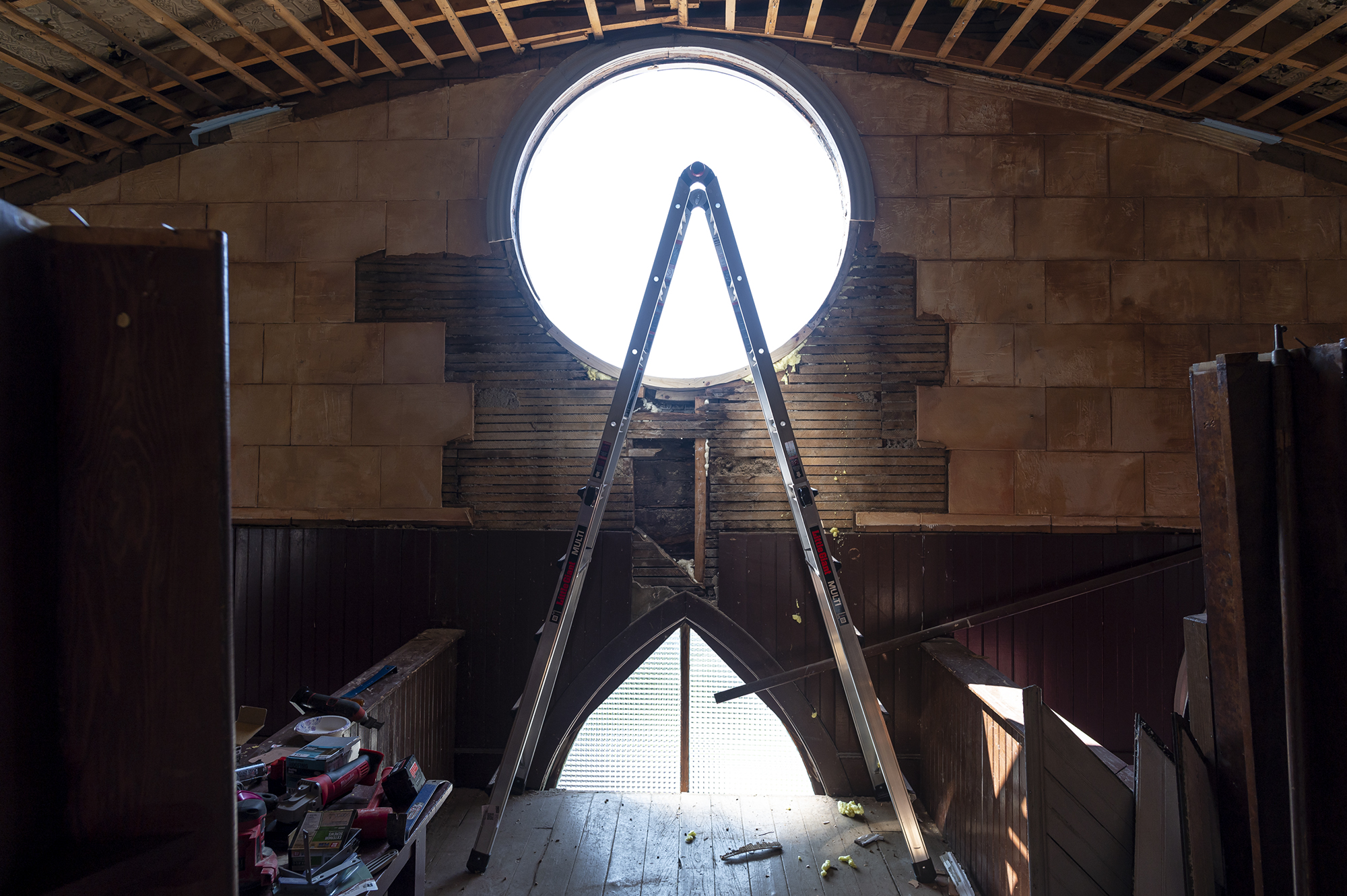
Kitter Spater: And there was one concept to turn it into an individual, like a single family house, but then the cost got too high. And so I looked at it from a value point of view. And I was like, well, the value’s there, what is it going to be, and that’s still even a little bit what stage we’re at now. So it’s looking like we’ll do apartments in the basement, at least one two-bedroom apartment. And I’ll give you guys a walking tour in a little bit. And then possibly a commercial kitchen, if this gets developed into the food hall concept, which is the leading idea right now, is to do six to eight food vendors. And it’s food trucks meet Fanueil Hall — and there are other models in Iceland and Singapore and Morocco, where it’s more this kind of concept. And then up here doing kind of a bar and cafe. And the idea would be, you know, this heads up Archibald (Street), North Winooski (Avenue). It’s kind of the top of the Old North End. It’s to create a little bit more of a community aspect where, you know, I have two kids, you come here, you know, the kids pick pizza, you pick poutine or a steak or something else, but creating more of an environment where everyone can kind of come together. And then up here doing a bar and with this ocular window, kind of looking at it, I think would be pretty cool.
Sam: And just for people who can’t see this, we’re standing on the balcony, and the main hall of the building, which would have been where people worshiped, is down there, right?
Kitter: Yep, and so the breakdown is originally when this was Orthodox, the women would be upstairs. So there was a separation between the women and men. So this was the women’s gallery.
Sam: And just you mentioned the window. Obviously, one of the first things I noticed out there is that the stained glass Star of David is gone there. What’s happening to that?
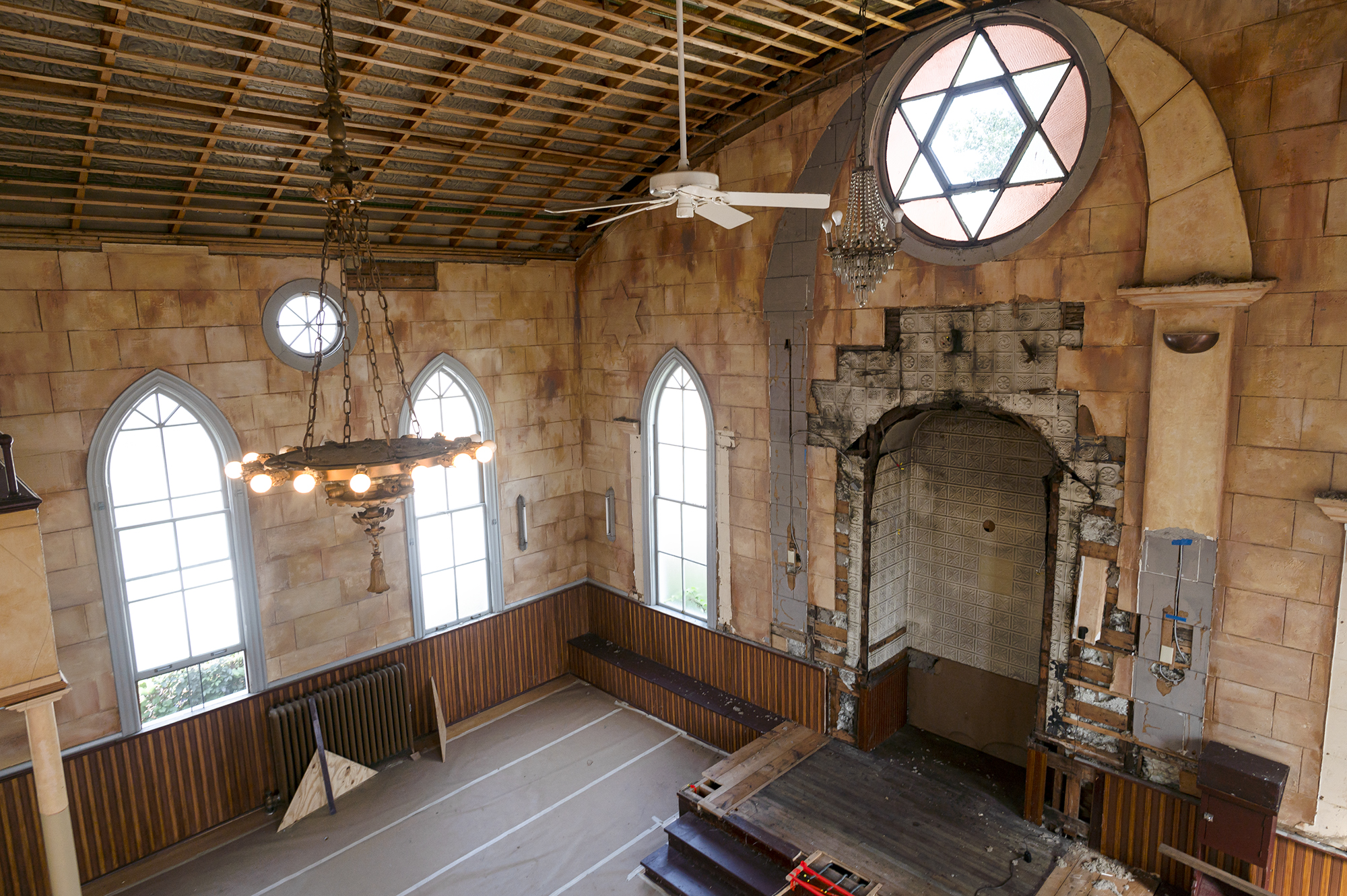
Kitter: So there’s a local historian, Ron Wanamaker, and so he’s rebuilding it. Basically it all had rotted out after years of neglect. So, yeah, he’s remaking the Star of David — will downplay the symbolism a little bit. But according to the city, it still has to remain the Star of David because it’s on the National Historic Registry that way.
Sam: Oh interesting.
Kitter: So you have a little bit of an issue … not issue … so you have cultural appropriation, but that’s just the way it has to work.
Sam: So in your imagination of how this is going to turn out in the end, how much will it look like clearly something that used to be a synagogue and how much won’t it?
Kitter: I think it won’t look so much like a synagogue, but you’ll still have the general sense of the place. Like you’ll walk in, you’ll see the 22-foot-high ceilings. You’ll still have the women’s gallery, two sets of stairs coming up. So from a structural and kind of overall emotional feel, it will still have that same sort of presence but not as much from like a synagogue point of view. So I think aesthetically, if someone from 100 years ago walked in here, they’d be like, oh, the building looks very different. But it looks the same. It still has the same feel and overall kind of area. The back Star of David will stay there. The chandeliers will stay here, and these are their original ones when they put it in electricity, I think in 1902.


Sam: Kitter clearly has a lot of enthusiasm for the history behind the building. He said he’s trying to preserve as many of the unique characteristics of the structure as possible, from those chandeliers to the maple floors and the tin ceiling — even a room with a mikvah, or ritual bath in the basement. But he’s also open about the fundamental fact of the sale being that a historic house of worship will become something different.
Sam: To be transparent, when I first heard about the sale, my reaction a little bit was: Oh, that’s a bummer — just as someone who lives in Burlington and who is interested in the Jewish community’s history — oh man, I wish this could somehow stay, you know, at least tangentially related to the Jewish community, whether it’s a community center or museum or anything like that. And, obviously, you know, you can do whatever you want with what you buy. But what would you say to people who have a reaction like that, at least initially?
Kitter: I would say, between Chabad and the OZ and some of the other synagogues in the area, there’s a certain level of sadness that it’s not being retained as a synagogue. But they also have their own buildings right now. And so when you have a diminishing population, it’s like a sense of sadness, but then a sense of OK, at least it’s going to be revitalized and rebuilt and reused again. So I think there’s that juxtaposition where, you know, it would have been great if it could have been preserved as a museum or as a synagogue. But a lot of times, you just have to look at the next step and say, well, what’s another use for the building?
Sam: A little more history: The synagogue we’re talking about was originally the home of the Ohavi Zedek congregation, which moved in 1952 to a much larger modern building, less than a 10-minute walk up the street. That’s the “OZ” that Kitter mentioned.
Now, Ohavi Zedek is part of an effort to preserve some of the important artifacts and objects being removed from the older building, including the pulpit, plaques and some pews. Perhaps most notably, Ray O’Connor, an expert preservationist, has painstakingly removed the 13-foot-high copper ark from the Ahavath Gerim synagogue’s back wall. The ark once held that congregation’s Torah scrolls.
When I visited OZ in early September, the ark was in multiple pieces, carefully packed into wooden crates, along with other artifacts. These crates filled the newer synagogue’s small sanctuary. OZ plans to install the ark and other objects in that room, which will become a worship space that — the hope is — replicates some of the feel and history of the older brick synagogue.
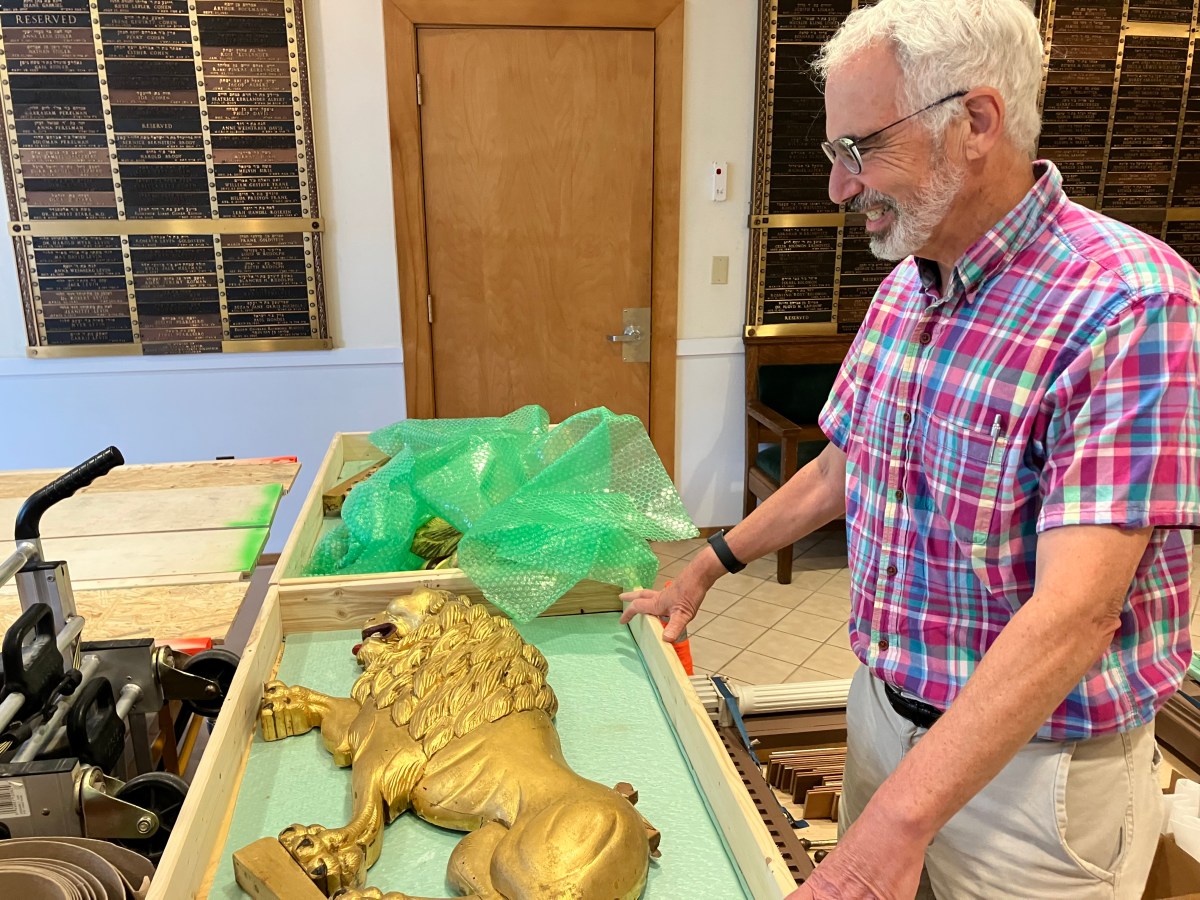
Jeffrey Potash, a historian and the president of Ohavi Zedek, showed me a few of the pieces of the ark in the crates. The full ark includes some very impressive ornamentation, including an illuminated crown, the Ten Commandments, hands giving a priestly blessing and twin golden lions.
Jeffrey Potash: What’s interesting within the pediment is, I mean, there’s an abundance of light that highlights and just graces the beauty, the natural beauty of the copper, I mean, it’s just an exquisite material with which to work. But what he’s incorporated into the pediment is the pair of hands. Those are the priestly hands making the priestly prayer. So the priestly blessings are contained within the pediment. But at the same while, you’ve got the same imagery, which is core to all Jewish icons, notably in the in the tent of the Tabernacle, the Ten Commandments are basically situated at the top being held by the Lions of Judah, the strength of Judaism, and then a crown above the Ten Commandments signifying that these have a divine authority that is what we adhere to. This particular piece has a light, interestingly enough, built in underneath that sort of bathes the Ten Commandments in a particular light, Star of David, and then on top of that is a little dove. Now, let’s take a look at it.

And isn’t that exquisite. And again, it’s very simple. It’s extraordinarily elegant. And what’s remarkable, we’re absolutely astounded with just the extraordinary skill set that’s incorporated here, because normally, you would see seams and you might see solder. And in none of this, do you see any of that whatsoever.
Sam: Jeff also talked me through how it came together that OZ would end up with what he called “the treasures” from the synagogue on Archibald Street.
Jeff: I contacted their board before Kitter had actually bought the property. The building has been for sale for multiple years, and there had been an effort on the part of many people within the Jewish community to try and purchase the building and to preserve it in some fashion as a synagogue. In practicality, I mean, the expense, you know — doing so just far exceeded what we could really handle at that point in time. So I reached out to their board, and I asked them if they would be open to giving us, you know, effectively our treasures back. I mean, they really did belong to this congregation, and I was delighted and appreciative that they said yes.
Kitter then needed to be in the picture, and so I reached out to Kitter and just asked if he would give us a month. And if he would give our craftsman Ray O’Connor the time with which to very carefully and expertly extract the treasures, in particular the ark, but also a number of other items that we thought were core to who we are in our identity. And he was extraordinarily gracious and delightful.
So it all worked out extraordinarily well for us.
You know, the goal, the intent, in the immediate term, is to reconstruct the ark, at the far windows here. It will barely fit without the bottom pieces. It originally sat on three steps. And we’re going to situate it so that it is fully functional. And at the same we’re going to basically rethink the structure of this space. So that in effect, we can recreate that particular wall on which the ark was situated. Surrounded with: We have the pews. We have the Torah table. We have the bimah. We have all of the core elements of the interior of that sanctuary, so that we can replicate the feel and hopefully the experience of seeing this particular piece.
Sam: And that would all be in this space here?
Jeff: That is the current mindset. The intent ultimately is to do justice to the ark and the feel of that original sanctuary.

Sam: Is there a part of you that is still, you know, disappointed that the building didn’t end up being a synagogue or a museum or a community center or something adjacent to the Jewish community?
Jeff: We talked extensively about that. You know, we talked about the possibility that if we could purchase and upgrade and repair and do everything that needs to be done in the building, could it functionally be a museum? Could it be a combination of a museum and a facility … ? It had extraordinary acoustics, just extraordinary acoustics. And could it have been a musical site? Could it have been used for any number of other purposes?
You know, yes. I mean, yes, there’s a sense that, you know, it would have been nice, but at the same while, you know, I mean, the story of the Burlington Jewish community is that it constantly moves forth.
So sadness tempered with a real sense of reality and pragmatic understanding that life goes on. The Jewish community in Burlington survives. It flourishes. It continues to, to serve, ultimately, the original values and intentions of its founders. And so, yes, the building may not be there, you know, as the synagogue, but we’re still here.
Sam: While the Ahavath Gerim congregation hadn’t really used their synagogue as an active house of worship for some time, it was used by another congregation. The Jewish renewal congregation Ruach HaMaqom held services there for a few years until 2020. Now, they meet at the Unitarian Universalist Church in Burlington. The rabbi of that congregation is Jan Salzman.
Rabbi Jan Salzman: As you walked into that building, you felt a certain connection. Even if you knew nothing about your Judaism, you got the feeling it’s kind of stuck in time. And people who would come and visit us would inevitably say, oh, this is just like my grandfather’s synagogue, you know, because the other thing about it is that it wasn’t created when Judaism had become a frontal experience. Most synagogues built in the last century were based on what a church looks like, right? With pews facing forward. Everything happens in the front. Ahavath Gerim was based in the Old World way with the Torah in the middle of the room. Rabbis didn’t give sermons. People came together. And it had that really womb-like feeling.
Sam: Jan was part of an effort to buy the synagogue that ultimately didn’t work out.
Jan: We formed a separate group — the Little Red Brick Synagogue Group — that was not my congregation but a separate group of interested individuals who tried to buy the building in a variety of ways. And that was not seemingly not possible at every event at every turn of events.
And so part of our idea was to turn it into a community space along with maintaining it as a synagogue. And when that didn’t happen, I experienced the whole range of feelings, of course — rage and sadness and loss and mourning and crying and lifting my fists to the sky — just like any other kind of loss. I mean, I’m a rabbi. I teach people about loss, right? Eventually it’s like, well, this is just not going to happen. And maybe ultimately an acceptance that though the Jewish community has lost a historic building. The person who has bought it, Kitter Spater, is a great guy. We are blessed, believe me, to have someone like him with his vision, purchase the building.

Sam: Jan had some thoughts on why the discussion of how we use these kind of spaces is important in the first place.
Jan: Well, I think what’s interesting about all of us synagogues is that we are in opposition to what happened during the Enlightenment, right, where the individual becomes primary. And as time has gone on the role of the individual to help create community and have an holy obligation, you know, not a drudgery obligation, but a holy obligation to support community-based experiences, especially ritual services, the marking of our calendar time. That is something that we all struggle with — synagogues and churches across the country. And so one of the tools that we have in our toolbox is to create these beautiful spaces and also expand the function, the roles of those beautiful spaces, to bring community back together.
Sam: With that in mind, here’s Jeff Potash again, the historian and Ohavi Zedek president, on his hopes for the future of the project to preserve at least some of what made the Ahavath Gerim synagogue so central to the city’s Jewish community.
Jeff: In any challenge, you can find, you know, a certain degree of opportunity. And it just seems to me as though — you know, as I say, when we’re done with this, we’ll see whether we succeed or not, but I think we will. When this project is completed, we’ll have preserved for posterity and future generations, that sense that when they walk in, and they see something, they can experience it. They can feel it. They recognize that it has meaning, not just to the population of folks who created it, but really to posterity. And that’s the hope and dream for this. And, you know, if we succeed, then we will have done what needed to be done.
