

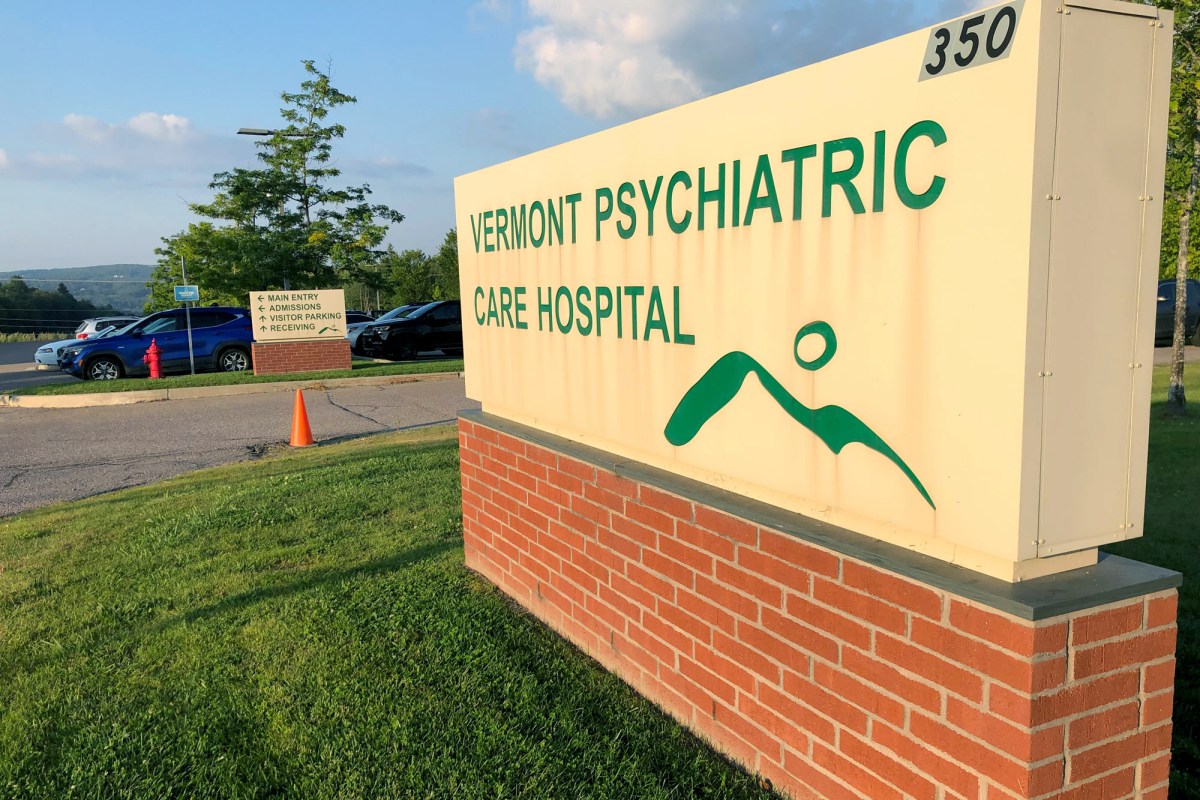
The Vermont Psychiatric Care Hospital in Berlin stopped admitting new patients during parts of June and July, leading to the lowest numbers of patients in residence since the hospital opened in the summer of 2014.
Patient counts dropped in the latter part of June, which marked the end of a fiscal year during which the Vermont Department of Mental Health spent more than $19.5 million on contract and temporary staffing at the hospital, according to a state database of vendor payments. That is an increase of around $15 million over the average annual costs prior to the Covid-19 pandemic staffing shortage.
An average of eight patients were at the hospital each day during July, the department’s spokesperson, Alex Frantz, told VTDigger in an email. That is less than one-third of the total licensed capacity of 25.
The average patient count increased during August to 9.9. On Wednesday there were eight inpatients with one referral pending, with a total capacity for 12 patients, she said.
The pause in admissions this summer was to accommodate training for physicians provided to the hospital under a new psychiatric care contract that began July 1, Frantz said.
The psychiatric hospital stopped admitting new patients in June, a month in which the average daily patient count was reported as 10, she said. The hospital began admitting new patients again in July, though Frantz did not have a specific restart date.
University of Vermont Medical Center psychiatrists staffed the hospital for nine years, but did not renew the contract for fiscal year 2024. The department hired Columbus Medical Services, a Pennsylvania company, after a competitive bid process.
“With the contract change we had to hire and onboard all new physicians,” Joanna Stevens, quality director at the psychiatric hospital, wrote in an email. “We wanted to ensure that they were trained and onboarded appropriately to ensure that our patients continue to receive the best care possible. Keeping the census low allowed the transition to take place smoothly without impacting patients.”
The decision to close admissions at the state hospital did not impact the system’s ability to respond to patients in need, as other facilities were able to accept people during that time, Frantz said in the statement.
“We witnessed no discernible impact on our patient admission capacity during the brief pause on inpatient admissions at VPCH,” she wrote.
A decentralized system
Two other facilities in the state, Rutland Regional Medical Center and the Brattleboro Retreat, are licensed for the “Level 1” care required by people with the most acute and complex mental health diagnoses such as schizophrenia and psychosis.
Rutland and the Retreat operate six and 14 beds respectively. On Wednesday, a regularly updated database showed them with one open bed a piece.
In her statement, Frantz said such a decentralized system has some “distinct advantages,” including flexibility. The system can “adapt when one facility cannot accommodate its usual patient load, a situation that can arise for various reasons, including acuity or illness,” she said.
The persistently low inpatient numbers at the state psychiatric hospital after admissions reopened are partly attributable to the regular ebb and flow of need statewide, Frantz said. All referrals for placement at the Berlin hospital must come after evaluation by the department’s central office team, she said.
But the low count also reflects the fact that several patients there were able to be transferred to River Valley Therapeutic Residence, a new state-operated secure residential facility in Essex that opened in May. The database on Wednesday showed all eight available beds at River Valley were occupied.
The state-run hospital often provides care for people who are in the custody of the state as the result of a court order, either because they have been charged with a crime or have been found to be a danger to themselves or others. People may also be admitted there while awaiting a court hearing on the question of whether ongoing involuntary hospitalization is needed.
The majority of people in need of inpatient mental health care do not require a Level 1 facility, even when they are being hospitalized involuntarily, Frantz said. Six other hospitals are able to accept those patients, in addition to the Berlin facility, including Rutland and the Retreat.
“Average wait times for adults on involuntary status remains very low and the census at VPCH has not impacted wait times,” Frantz said by email.
Most involuntarily hospitalized patients are represented by the Mental Health Law Project at Vermont Legal Aid. Project director Jack McCullough said that his team has noticed that almost all its new cases in the past several months have been with clients being treated at the Brattleboro Retreat.
That trend may pose a challenge if it continues, McCullough said. Many of those involuntary patients with hearings pending are far from home, as they are from northern Vermont, most often Chittenden County. (Driving from Brattleboro to Burlington takes well over two hours.) Also, so far, the Windham County court system has seemed to have less availability for hearings than in Washington County, where the state hospital is located.
“If there’s more and more cases down there and less court time, that seems to result in people who are not getting their hearings in a timely way,” he said.
Vermont Defender General Matt Valerio said he has not heard of any problems in recent months finding placement for inpatients who are in the custody of the state, often referred to as forensic patients. He noted that legislation signed earlier this year gave the department the go-ahead to open a new lower-acuity, nine-bed forensic unit within the psychiatric hospital building.
The new law requires a public rule-making process about admission criteria before the facility can open. Once that occurs, the number of Level 1 hospital beds in Berlin would be reduced to 16, giving the Brattleboro Retreat an even larger ongoing role in serving those patients.
For Rep. Anne Donahue, R-Northfield, a longtime advocate for people with mental illnesses, another concern with that development is that the Brattleboro Retreat is a stand-alone facility without the internal ability to handle acute medical needs. Vermont Psychiatric Care Hospital is also considered a stand-alone facility, but is located next to Central Vermont Medical Center.
Low count, high cost
July marked the first time since 2014, when the Berlin psychiatric care hospital opened, that the average daily number of patients per month fell below 10, according to the department’s statistical reports. Amid the Covid-19 pandemic, the inpatient census dropped to a monthly average of 10 in August and September 2021.
As patient counts have dropped, the hospital has also become much more expensive to operate.
When the 25-bed psychiatric hospital opened in 2014, total operating costs were projected to be around $20 million annually. That number had already raised eyebrows as only slightly less than the cost of operating Vermont State Hospital in Waterbury, which had 54 beds when it was closed following Tropical Storm Irene.
As Vermont Psychiatric Care Hospital struggled to retain a local workforce during the pandemic, the amount spent on contract staffing agencies primarily for traveling nurses ballooned.
Traveling nurses, who generally cost significantly more than employees in permanent positions, were staffing about 60% of all shifts, Mental Health Commissioner Emily Hawes told the Legislature in January when the department requested an additional $10 million over what was budgeted for the 2023 fiscal year to pay for the extraordinary expense.
The amount paid for contract staff at the psychiatric hospital grew from just under $5 million in fiscal year 2021, which ended on June 30 of that year, to more than $10.5 million in fiscal year 2022 and $19.5 million in the fiscal year that ended on June 30, 2023, according to a VTDigger analysis of the Vermont Department of Finance and Management’s vendor payment database. Of that, the majority were paid to two out-of-state temporary medical staffing companies.
The department projects spending $13.7 million on contract staffing across both its facilities during the current 2024 fiscal year.
Cost is not a factor in decision-making related to referrals to the hospital and how many patients are served there at a given time, Frantz said in her statement.
“The number of beds open are dependent on the staffing capacity, and needs of individuals,” she said.
The low numbers at the psychiatric hospital do not appear to have resulted in any noticeable increase in the number of people waiting for all types of inpatient psychiatric care, voluntary or involuntary, at the state’s 14 hospitals, said Emma Harrigan, vice president of policy for the Vermont Association of Hospitals and Health Systems.
The number of adults waiting for inpatient care started decreasing in May, with an average of 23 people waiting in hospitals statewide, down from the 25 to 30 people seen on average earlier in the year, she said.
Between June and August, the average number of adults waiting for care on any given day fluctuated between 15 and 16. Most were placed within 24 hours, according to information provided by the association’s members.
Harrigan attributes the improvement at least in part to Brattleboro Retreat opening the full complement of beds and contracting with an emergency medical services provider, Rescue Inc., for dedicated transportation from hospitals statewide this spring.
Sen. Ginny Lyons, D-Chittenden Southeast, who chairs the Senate’s Committee on Health and Welfare, said she believes the low count at the state psychiatric hospital is just a sign that the care system is in transition, due to both the new physician contract, a new chief psychiatrist being hired and the recent opening of the River Valley residence. But, she added, legislators are going to be paying attention to how space is being utilized there.
“We’ll keep our eyes on that for sure,” she said.
