


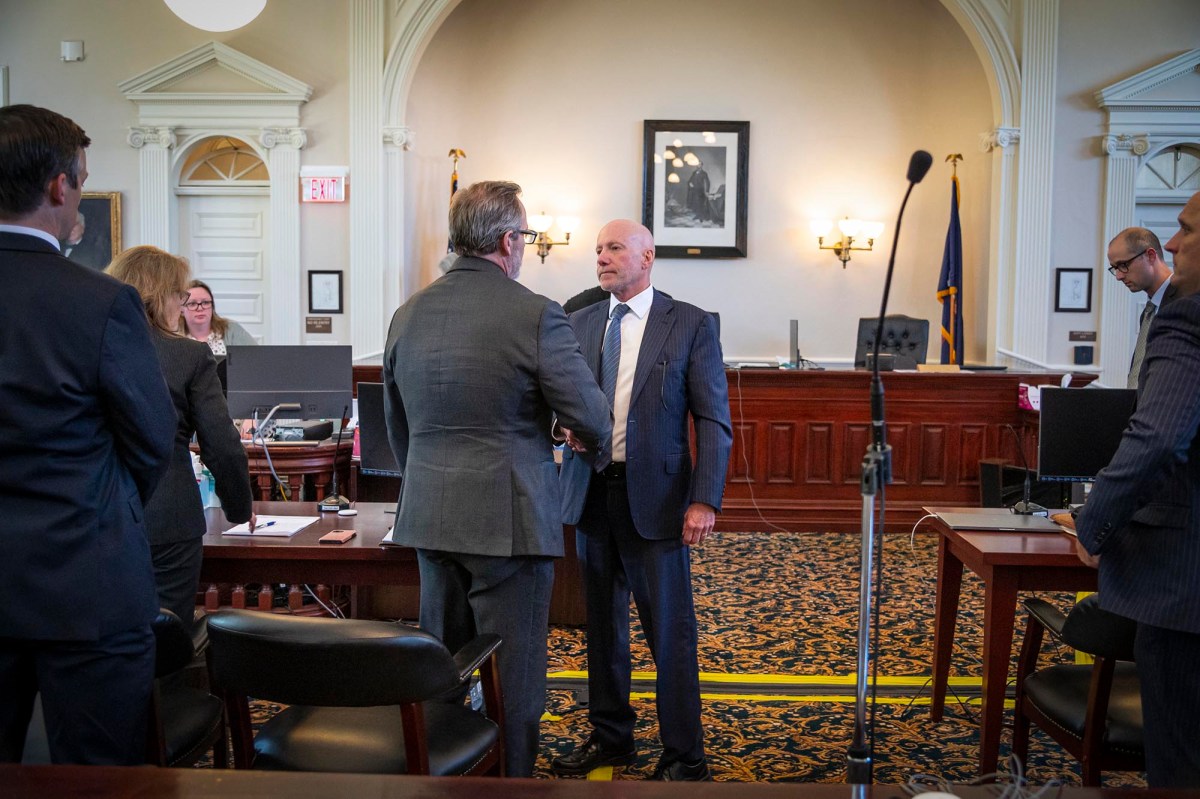
The court-appointed receiver overseeing properties at the center of Vermont’s largest known fraud scheme has disclosed how he intends to dole out $16.5 million in settlement funds from the state, resolving claims about its alleged role in the scandal.
Michael Goldberg, the receiver, has filed a court document outlining how that money could be distributed among the foreign investors who lost money and the attorneys who represented them. If approved, the latter would take home millions and the former anywhere from $1,000 to $75,000.
Russell Barr, a Stowe attorney who represents more than 60 investors, had alleged that the state and several officials were at best negligent and at worst active participants in the alleged fraud as they operated the state-run EB-5 regional center responsible for overseeing the Northeast Kingdom projects.
The settlement involves the state, Goldberg and the investors who sued Vermont. When the Vermont Attorney’s General’s Office announced the deal in July, it said the agreement would settle all “pending and potential” lawsuits filed against the state by the roughly 850 investors in the Northeast Kingdom projects.
Each EB-5 foreign investor put at least $500,000 into one of eight Northeast Kingdom projects with the expectation that, if their investment met job-creating requirements, they would be eligible for permanent U.S. residency, or green cards. However, because of the fraud, many of the investors have struggled to obtain green cards.
Details of how the settlement money would be divided up were not revealed when the agreement was announced.
According to Goldberg’s court filing last week, Barr and attorneys in his law firm, the Barr Law Group, will receive $5.5 million of the $16.5 million settlement “so the Investors need not pay such amounts.”
Barr and his legal team had taken the state to trial in June on behalf of a group of eight investors. However, that trial ended after two days when the settlement was reached.
According to Goldberg’s filing last week, those eight investors would receive five-figure payouts “for their efforts in attending the beginning” of the trial and “helping to obtain the settlement.” Three of the investors who have not obtained green cards would each receive $75,000, while the five who have obtained green cards would get $25,000 apiece.
As for the remaining 55 investors who sued the state, those without green cards will get $5,000 and those with green cards will receive $1,000, Goldberg’s filing stated.
“The balance of the Settlement Amount,” according to Goldberg’s filing, “shall be used for the benefit of the Receivership Estate from which all Investors and the plaintiffs in the Barr Actions benefit and which payments are being made on behalf of the Investors and the plaintiffs in the Barr Actions.” That amount was not immediately clear.
Former Jay Peak owner Ariel Quiros, former president and CEO Bill Stenger, and attorney William Kelly, a close adviser to Quiros, headed the projects. All three were indicted on federal criminal charges and sent to prison for their roles.
Across the eight Northeast Kingdom projects, Stenger and Quiros solicited more than $450 million in EB-5 money from more than 800 foreign investors.
Separate legal actions filed by state and federal regulators in April 2016 accused the two developers of misusing $200 million of the money they raised through the EB-5 program. The U.S. Securities and Exchange Commission said Quiros took $50 million for himself to pay for personal items, including a luxury condo in New York City.
Federal prosecutors brought criminal charges against Stenger, Quiros and Kelly related to one of the projects. In that instance, the developers proposed building a $110 million biomedical research center in Newport, which federal prosecutors later called “nearly a complete fraud.”
As part of the settlement, government officials deny wrongdoing.
The state’s Agency of Commerce and Community Development ran Vermont’s EB-5 regional center, which was charged with promoting the projects — a relationship some investors have said led them to believe that the developments had the state’s seal of approval and full oversight.
Among those who traveled overseas to promote Vermont EB-5 projects were former Gov. Peter Shumlin, a Democrat, and his predecessor, Gov. Jim Douglas, a Republican, as well as former U.S. Sen. Patrick Leahy, D-Vt.
As part of the settlement, the state agreed to continue to support investors in their efforts to secure permanent U.S. residency and, if successful, the state could cut its $16.5 payment by up to $4 million.
The settlement is contingent on obtaining a bar order, which has yet to be approved by the federal court in Florida overseeing the Jay Peak receivership. A bar order would prevent further litigation on the matter.
The federal case has been heard in Florida because that’s where Quiros had been based and many of his businesses had been located.
Judge Darrin P. Gayles has issued an order “preliminarily” approving the settlement and setting a hearing for Oct. 23 in U.S. District Court in Miami to consider objections to it.
Neither Barr nor Goldberg could be reached Monday for comment.
Correction: Due to an editing error, an earlier version of this story misstated in one instance how much investors and attorneys would receive if the settlement is approved.
