




Few roads in Marshfield were not affected by the July floods, and the small community is struggling to repair the damage.
“Things are very uncertain in Marshfield,” said Bobbi Brimblecombe, the town clerk and treasurer of the Washington County town of about 1,600. “The most significant problem in Marshfield is that we have to replace several bridges.”
Four bridges were washed out. Three of them — on Onion River Road, Sass Avenue and Holt Road — have to be replaced, and the abutment of a bridge on Cassady Road needs to be rebuilt, she said.
“Almost all of our roads were affected,” said Justin Campbell, the town’s director of emergency management and a new member of the selectboard.
A major concern: a lack of clarity around Federal Emergency Management Agency, or FEMA, reimbursement, according to local officials.
“We have to forge ahead with creating access for residents, of course, but it’s pretty stressful not having clarity on what we will and won’t be reimbursed for,” Campbell said.
Marshfield is struggling to balance immediate fixes, long-term costs and reimbursements for road repairs — just like many hard-hit small towns across Vermont more than a month after the historic floods.
‘Hoping for reimbursements’
In neighboring Plainfield, the road crew of three has worked nights to tackle the flood damage and has been “really stretched to the limit,” said Bram Towbin, Plainfield’s selectboard chair and road commissioner.
But to do the work, the town had to spend unbudgeted dollars, and like other hard-hit communities, it hopes to be reimbursed by FEMA.
“We are hoping for reimbursements, and we’ve filed the paperwork to FEMA and, where appropriate, the state,” Towbin said. “I think the real test is going to be when we get the reimbursement money.”
Plainfield, with about 1,200 residents, faced significant damage after the flood. It recently received a notice that FEMA would pay to reconstruct the Brook Road bridge over Great Brook, a tributary of the Winooski River.
In nearby Calais, a town of about 1,600, many of the roads were washed out, and some still await repairs, according to selectboard Chair Anne Winchester.
Its road crew of four full-time staff and two part-timers worked around the clock after the flood, trying to reach people who were stranded and figuring out which repairs had to come first, she said.
“For the longest time, our goal was to just get as many roads passable to one lane just so people could start to move around town again. We still have a couple of roads that are not open,” Winchester said.
Calais has a gravel pit in town but had a hard time getting that gravel to the places it needed to be, given the road conditions, she said. “It took a long time to find the equipment and get everything put in place.”
More than a month after the storm, Calais roads are still in need of attention.
“Mostly what they tried to do is just get them going in the middle. You still don’t want to get too close to the edges, and we had to put out bulletins telling people to pull over as best they could when they saw a truckload of gravel coming by,” Winchester said.
Officials there recently tallied flood damage at about $1.7 million. The Washington County town’s entire annual budget is $1.9 million, she said.
Extra material, extra work hours
A little to the north, in Lamoille County, the 1,300-strong town of Johnson has used 300 loads of road material to get roads opened up since the flood. That’s how much it normally uses in an entire season, said Evan Patch, the town’s emergency management director, road commissioner and vice chair of the selectboard.

“As far as budgets go, it’s going to be tough for the town of Johnson with the extra material and extra man-hours. We’re hoping to get some of it reimbursed through FEMA. We don’t know exactly what that will look like yet,” he said.
With a five-member road crew, Johnson is struggling to balance debris removal, road work and equipment maintenance. And Patch wondered how the town will best deal with the costs involved in keeping the roads open and safe.
“If it’s an incredibly bad winter, that could change things, but with kind of our new normal winters, I think we’ll make out fine,” he said.
In Addison County, road repairs are coming along in Ripton, a small town of about 600, where a landslide destroyed one home and a dozen people had to be evacuated. But unlike other small towns, Ripton has no dedicated road crew.
“We have three people in town who are private contractors who we hire to take on road work,” said Laurie Cox, a Ripton selectboard member. “We don’t have a department of public works or road crew here.”
Ripton’s longtime road commissioner, who handled most of the contracts, died two years ago, and selectboard member Tim Hanson volunteered to take up that role in an acting capacity. The town advertised for the position but received no applications, so Hanson became the road commissioner, Cox said.

With flood damage and continued rains, routine maintenance items have been put aside — tasks such as replacing or installing guardrails and fixing ditches, she said.
“With the kind of weather we’ve had, the ditches just got totally hammered,” Cox said. “Some of them had been repaired and relined with rock and everything, and then this one came along and it all washed out again.”
To the south, the Windsor County mountain town of Ludlow, with a population 2,170, was walloped. A motel flooded. Shaw’s supermarket operated from under a tent. Major roadways were swallowed by the Black River.
At least half the town’s infrastructure was affected in the rain and flooding, estimated Municipal Manager Brendan McNamara. Its six-person road crew has been working nonstop to shore things up.

The issue hasn’t been so much finding road contractors to do the work but keeping them, he said. Ludlow started work with 12 contractors after the flood and is down to half that number now. Many of those who responded after the flood had clients lined up that they had to return to, he said.
With a town crew of three and two major excavating companies in town, road repairs are coming along in Londonderry, a Windham County town of about 1,200 where nearly all of the roads were affected by the flood, according to selectboard Chair Tom Cavanagh.
“The only concern we have is getting our roads back in shape for winter,” he said.
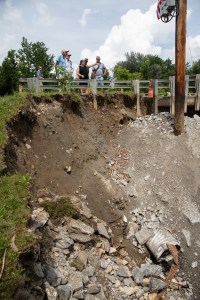
The Cobble Ridge Road bridge along the West River still stands, but the flood destroyed the access points at each end, so the bridge remains closed. Residents who were cut off have been allowed temporary access through a neighbor’s trailway, he said.
The Cobble Ridge bridge was a temporary fix after Tropical Storm Irene. The town tried to secure funding to replace it but was unable to, Cavanagh said.
“Our hope is that sometime soon we can get a new bridge built that meets current standards, but there is no certainty at this point,” he said.
Londonderry officials met this week for the first time with their FEMA coordinator to help navigate the federal funding process. Even though flood damage reimbursements are expected to cover 75% of the costs, Cavanagh expects funding will be tough for Londonderry.
Budget worries
The fiscal year for most towns began July 1, just 10 days before the flood, and many communities have not had time to look at the impact that road and bridge repairs will have on the annual town budget.
McNamara is pretty sure Ludlow has shot its annual road budget and plans to crunch the numbers in coming months. He is especially concerned right now about getting the roads ready for ski season.
“Okemo is one of our huge resources here, and ski season will be here before we know it. So getting our roads, utilities back up to where they should be, before we expand to 30,000, 40,000 people in December, is a race against time right now,” he said.
In Marshfield, “budget is a major, major concern for us. Having to replace this many bridges is a major strain on a small town budget,” Campbell said.
Marshfield has accepted bids to repair three of its damaged bridges totaling more than $400,600. The only bid to fix the Cassady Road embankment came in at $400,760 — a sum that is more than 25% of the town’s annual budget, officials said.
And replacing the bridges could stretch into millions of dollars, Brimblecombe said.
The widespread damage and its financial impact on towns makes Cox in Ripton think about what projects need to be prioritized and whether certain roads and buildings should be rebuilt, given the trajectory of climactic events.
“When you get these big weather events — and they do happen more frequently — you have to start thinking what makes the most sense in the long term,” she said. “But no matter where you are, that’s not an easy job.”
