


Vermont’s insurance regulator has recently started two different public processes for reviewing the proposed affiliation between the state’s largest commercial health insurer, Blue Cross Blue Shield of Vermont, and the much larger Blue Cross Blue Shield of Michigan.
Blue Cross Blue Shield of Vermont is subject to two different avenues of oversight by the Vermont Department of Financial Regulation under state law, one as an insurance holding company and the other as a licensed nonprofit health insurer.
On May 15, in coordinated filings, Detroit-based Michigan Blue applied for approval of its “acquisition of control” of Vermont Blue as an insurance holding company, while the Berlin-based Vermont Blue applied to request approval for a “change in control” of its own organization as a permitted non-profit insurer of hospital-based and general medical care.
“There are two different statutory processes that are running at the same time,” said Deputy Commissioner Emily Brown, who oversees the insurance division for the department. “There’s a lot of overlap in the review and what we are reviewing, but they are two completely separate requirements under our jurisdiction.”
On Friday, the department announced the public comment portion of these processes.
Mike Fisher, who heads the Office of the Health Care Advocate for Vermont Legal Aid, which represents the public and ratepayers in regulatory proceedings, said he and his staff plan to weigh in.
For more than 40 years, Vermonters have benefitted from having a “home-grown insurance company,” Fisher said. The issues of who controls Blue Cross Blue Shield of Vermont and where its leaders are focused are key, he said.
“If real decisions about how Blue Cross of Vermont behaves in the future are made in Michigan, we are very fearful that Vermonters will lose out, will lose access to care,” Fisher said.
An ‘affiliation,’ not an acquisition
The Michigan and Vermont organizations are among the 34 independent licensees of the national Blue Cross Blue Shield Association. Both are nonprofit corporations that spend a comparatively high percentage of premium dollars on claims, and a comparatively lower percentage on administration.
The differences are ones of scale and complexity.
Michigan Blue Cross — or BCBSM — provides health insurance to more than 20 times as many people, both within its home state and beyond. It processes almost 30 times the number of claims as its Vermont counterpart, BCBSVT.
The Michigan organization is the 10th largest health insurer in the country and seventh largest seller of Medicare Advantage plans, according to its application. Michigan’s CEO Daniel Loepp also was awarded almost 21 times the annual salary that went to BCBSVT CEO Don George last year, according to annual Michigan and Vermont regulatory filings.
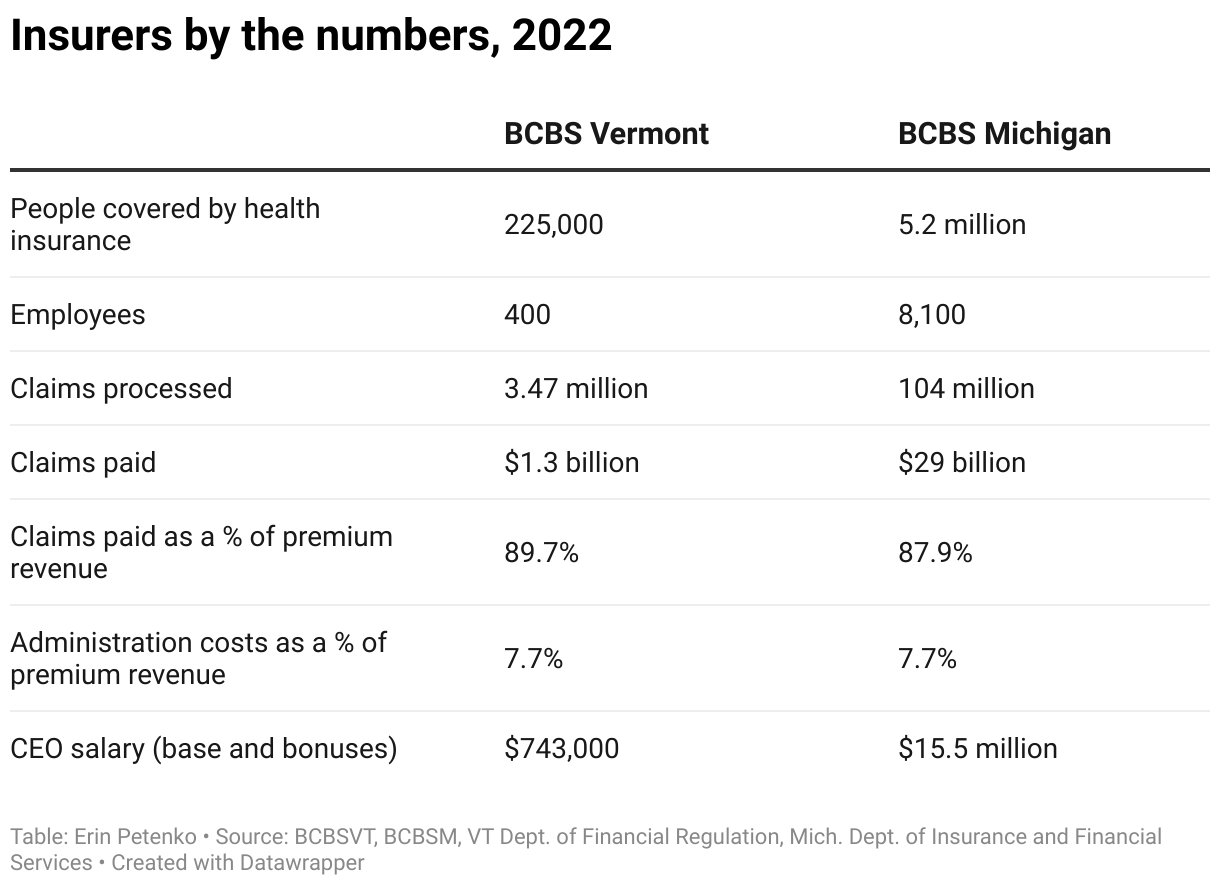
Blue Cross Blue Shield of Vermont states emphatically in its application that the new relationship “is not an acquisition, merger, conversion, stock purchase, asset purchase or consolidation.”
After the affiliation, the Vermont nonprofit organization will continue to exist and to operate as it does currently, setting its own rates and interacting as it has historically with regulators at the department and the Green Mountain Care Board, according to its application. The majority of the board of directors will be from Vermont.
No staff reductions or relocations are expected. Premiums and capital reserves will remain under the control of the Vermont organization and administration and customer service will continue to be based in Vermont, the document states.
The affiliation will allow the much smaller BCBSVT to access information technology and expertise “to remain competitive in a rapidly changing and highly competitive marketplace, increasingly dominated by national for-profit health plans,” the organization wrote. Trying to do so on its own would be an untenable cost burden for ratepayers, it said, noting that BCBSM spends upward of $250 million annually on IT development and upgrades.
Michigan Blue Cross has dozens of whole or partially owned subsidiary companies, which in several cases have dozens of their own nested subsidiaries, compared to the roughly dozen on the Vermont Blue organizational chart. Through those subsidiaries, the larger organization sells Medicare supplemental and Part C plans, as does BCBSVT.
In addition to that, the Michigan organization offers health plans to around 5 million Medicaid recipients in 10 states through a subsidiary, AmeriHealth Caritas Health Plan, which it co-owns with a Blue organization based in southeastern Pennsylvania. Through other subsidiaries, it develops information technology for both the back end — such as claims processing and care management support — and the customer-facing front-end, including mobile apps, for its plans.
Another outcome of affiliation is that Blue Cross Blue Shield of Michigan will become the “sole member” of BCBSVT, and the holder of the Blue Cross Blue Shield Association “exclusive service area” license for Vermont, giving the larger organization great sway within the smaller one.
In particular, Vermont’s CEO, chief information officer and chief financial officer will report to executive vice presidents at the Michigan insurer, according to an organizational chart in Vermont’s application.
After the affiliation, Michigan Blue Cross will not only appoint five members of Vermont Blue Cross’s 12-member board, but it will also have veto power over who sits in the seven seats appointed by a Vermont nominating committee. The latter ability is what constitutes the change in control of Vermont Blue, which is why regulatory approval of the agreement is required.
Seven current members of the Vermont board would remain after the affiliation: the organization’s CEO Don George as well as Charles Smith, Scott Giles, John Kassel, Kate Williams, Jason Robart and Robert Miller, according to Michigan Blue Cross’ application. Two BCBSM board members and three executives, including the company’s chief executive and chief operating officers, would be appointed to fill the remaining five seats.
There are limited grounds in state law for the Vermont department to deny either application.
In the BCBSM application, the criteria are largely related to the financial solvency of the acquiring holding company, Deputy Commissioner Brown said. With more than $10 billion in assets reported in 2022, the Michigan nonprofit has a higher solvency rating than its Vermont counterpart, though both applications stress that neither affiliate would have access to the reserves of the other.
However, both parties believe the relationship will lead to significant operational savings to Blue Cross Blue Shield of Vermont over the next three years. As part of the affiliation agreement, Michigan Blue Cross has guaranteed Vermont Blue Cross savings of $10 million by the end of that period, and has agreed to pay the difference if that amount is not achieved, the filings state.
To deny the Vermont Blue Cross application, according to state law, the department would need to find that the change in control would make the Vermont organization unable to meet the state’s requirements for doing business, would lower competition in the insurance marketplace, would put the organization in inexperienced hands or cause it financial jeopardy or, more broadly, would be “unfair and unreasonable to policyholders of the insurer and not in the public interest.”
The department has posted the regulatory filings provided by both companies and is accepting public comment on the Michigan Blue application via mail or e-mail through next Friday, August 25, at 5 p.m.. A public hearing is scheduled for Aug. 29 at 9 a.m. at the Waterbury State Office Complex on the Vermont Blue application.
State law requires that the department issue a decision within 30 days of the end of the public comment period in one process, and within 30 days of the public hearing in the other. In both cases, the decision would come in late September. Both Blues have said they hope to close on the affiliation agreement by Oct. 1.
