


Just over one month after torrential rain flooded thousands of acres of Vermont farmlands at the growing season’s peak, many of the state’s farmers are still in a holding pattern.
“It’s been a lot of, ‘Wait and see,’” Ransom Conant, a sixth-generation dairy farmer in Richmond, Vermont, told reporters on Monday. Conant’s Riverside Farms produces more than 1.2 million gallons of milk per year for regional distribution, as well as for cheese production at nearby Cabot Creamery.
On Monday, U.S. Department of Agriculture Under Secretary Robert Bonnie paid a visit to the farm, joined by U.S. Sens. Bernie Sanders, I-Vt., and Peter Welch, D-Vt., Vermont Secretary of Agriculture Anson Tebbetts and other officials.
Bonnie’s visit marked yet another high-profile visit from a Biden Administration official since the floods first hit last month. U.S. Secretary of Transportation Pete Buttigieg and Federal Emergency Management Agency Administrator Deanne Criswell have both come to survey the damage, as well.
“My job at USDA is to support agriculture on good days and support it on bad days, and we’ve had some tough days here up in Vermont,” Bonnie told reporters on Monday. “We’ve already had hundreds of farmers come into our offices with various issues that we’re now responding to. We’re trying to provide as much flexibility as we can in our programs, recognizing that farmers have a lot to do in the wake of the flood.”
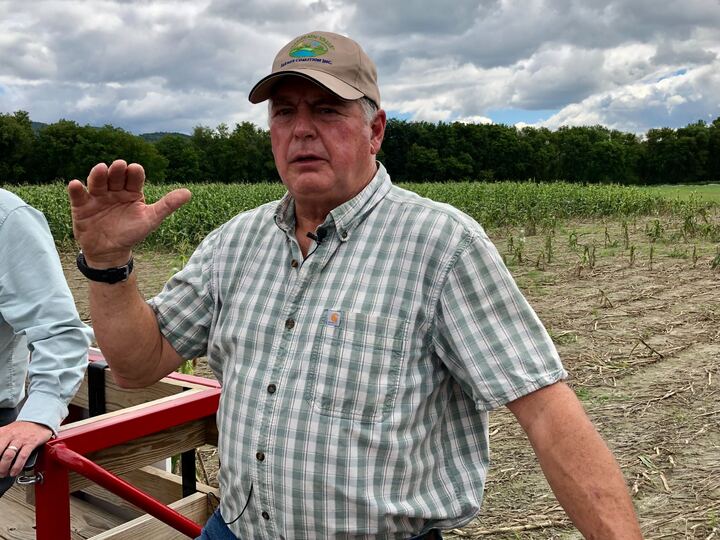
By the time Bonnie left the Richmond farm on Monday afternoon, he had swapped his USDA baseball cap for one newly gifted to him, adorned with the Champlain Valley Farmer Coalition’s logo.
Inside the Conants’ large barns, their dairy operations appeared to be running smoothly Monday morning. Rows of Holsteins appeared blissfully ignorant to the summer’s severe weather as they eyed the small crowd of humans invading their living quarters.
Outside the barns was another story. Swaths of the corn and hay fields were clearly decimated. “This is painful to see,” said Welch, nodding toward one particularly brutal patch.

Other stretches of crop appeared salvageable to the naked eye, but it remains to be seen whether that’s the case, according to the Conants. Sediment, carried by the floodwaters, is dispersed throughout their fields and could eventually suffocate the surviving plants, or render the crop unsafe for consumption. Even if the corn is safe to eat, the silt is abrasive and destructive to their farm equipment.
Those crops have not yet been tested for safety, nor has the sediment itself. When Tropical Storm Irene hit in 2011, floodwaters dumped roughly three tons of silt per acre, ruining what crops remained, according to Dave Conant, Ransom’s father. They don’t have comparable data on this year’s flood impact yet.
Standing before one healthy-looking field, Dave said, “There are many farms that would feel fortunate to have this right here. He knows other farmers who have lost everything. “We’re blessed to have that (field).”
The Conants do have crop insurance, but as of Monday, they don’t know if they will qualify for a payout. An insurance adjuster who visited several weeks ago told the Conants they have to wait and see how the crops ultimately fared before the adjuster can determine their eligibility.
For the Conants and other farmers from the Champlain Valley Farmer Coalition, cutting hay and growing corn is a lifeline, providing food for their cows. Unable to produce their own feed, they are forced to purchase it elsewhere — bearing an unforeseen, premium cost.
Thanks to amendments made to President Joe Biden’s major disaster declaration for Vermont, Vermont farmers are now eligible for expanded and expedited low-interest loan programs serviced through the USDA’s Farm Service Agency. But on Monday, Welch told reporters, “Loan programs don’t cut it.”
“They’re really squeezed, and you can’t take on more debt when you’re up to your eyeballs and you don’t know what the future is,” Welch said.
Welch, Sanders and U.S. Rep. Becca Balint, D-Vt., penned a letter to Biden last week pleading with the president to include additional flood recovery dollars for Vermont in his supplemental budget proposal to Congress. While Biden did include a nationside $12 billion boost to the Federal Emergency Management Agency’s Disaster Relief Fund, he did not fulfill the delegation’s additional requests for Vermont. One of their unanswered requests was for USDA grant dollars to offer an interest-free lifeline to the state’s farmers. (Farmers are not eligible for FEMA aid to cover their losses.)
Asked by VTDigger on Monday whether he thought Biden’s proposal went far enough, Sanders answered, “No, and not only for Vermont.”
“But as you know, it’s Congress who writes the budget,” Sanders said with a grin. “The president makes recommendations. So we will take what he has recommended as positive, and we will go beyond that. So we’re going to fight very hard for agriculture. We’re going to fight very hard for small business and for other areas that were neglected in the proposal.”
