


MONTPELIER — In the wake of severe flooding that devastated their downtown, hundreds of Montpelier residents gathered Thursday to discuss how to rebuild the state’s capital — and how to prepare it for the next extreme weather event.
Thursday’s meeting was the first of three planned by Montpelier Strong, a fundraising effort organized by Montpelier Alive, which promotes downtown businesses, and the city’s development nonprofit, Montpelier Foundation. Moderator Paul Costello encouraged the crowd to focus on gathering ideas and suggestions that could be explored in greater detail at the next event on Aug. 22.
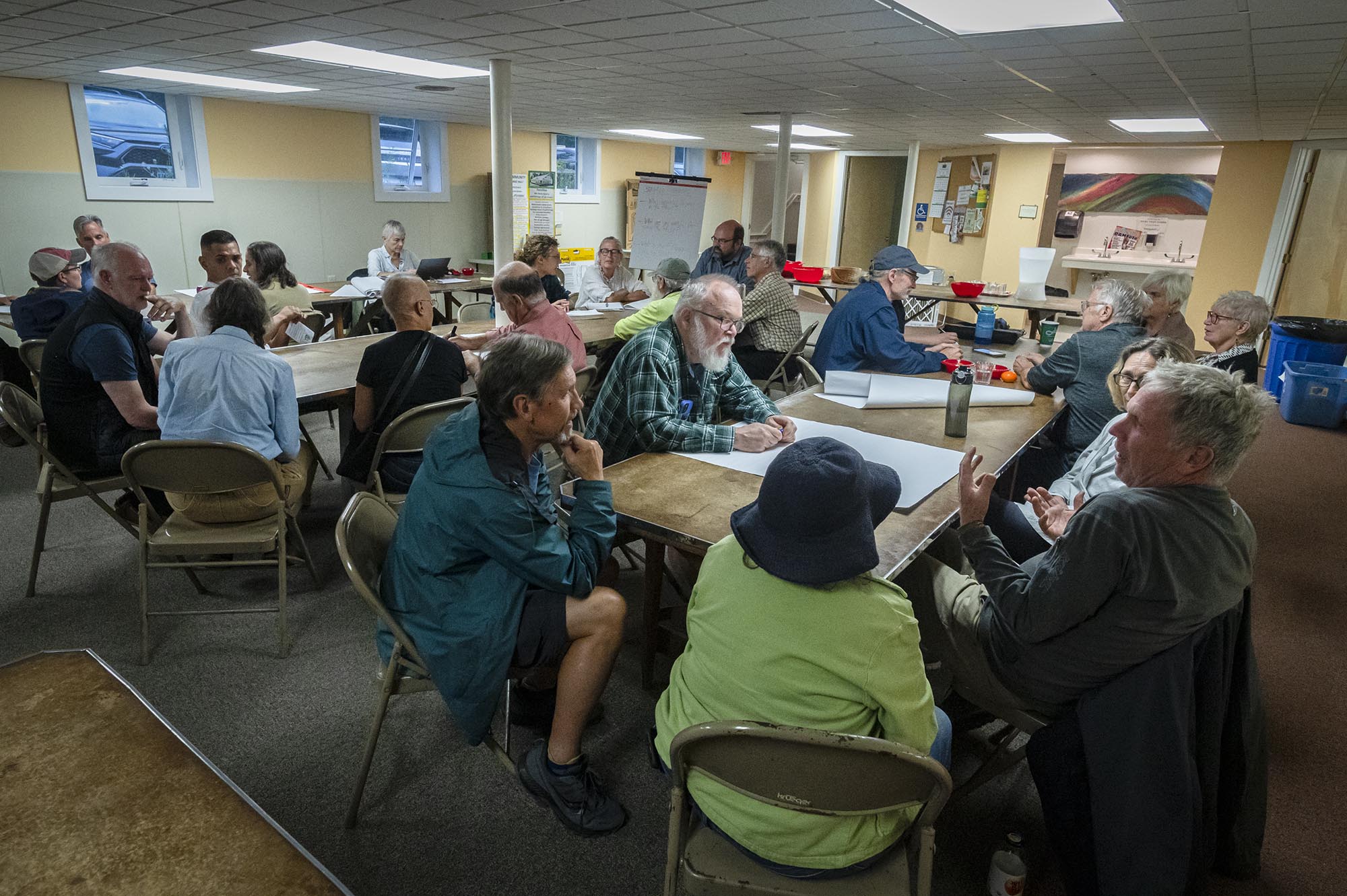
Residents turned out in droves to have their ideas be heard. The 300-person room at the Vermont College of Fine Arts was packed to capacity, and Costello noted that another 250 people were listening on Zoom.
Unitarian Church Rev. Joan Javier-Duval, whose Main Street church was one of the hundreds of buildings damaged by 4- to 6-foot-high floodwaters that poured into the city in July, began with a reflection.
“(As) I gazed out at the North Branch River right outside my window — and even spotted a blue heron dipping its beak into the river in search of its next meal — in that moment, the immensity of the loss that I, and really all of us, have endured was quite palpable,” she told the crowd.

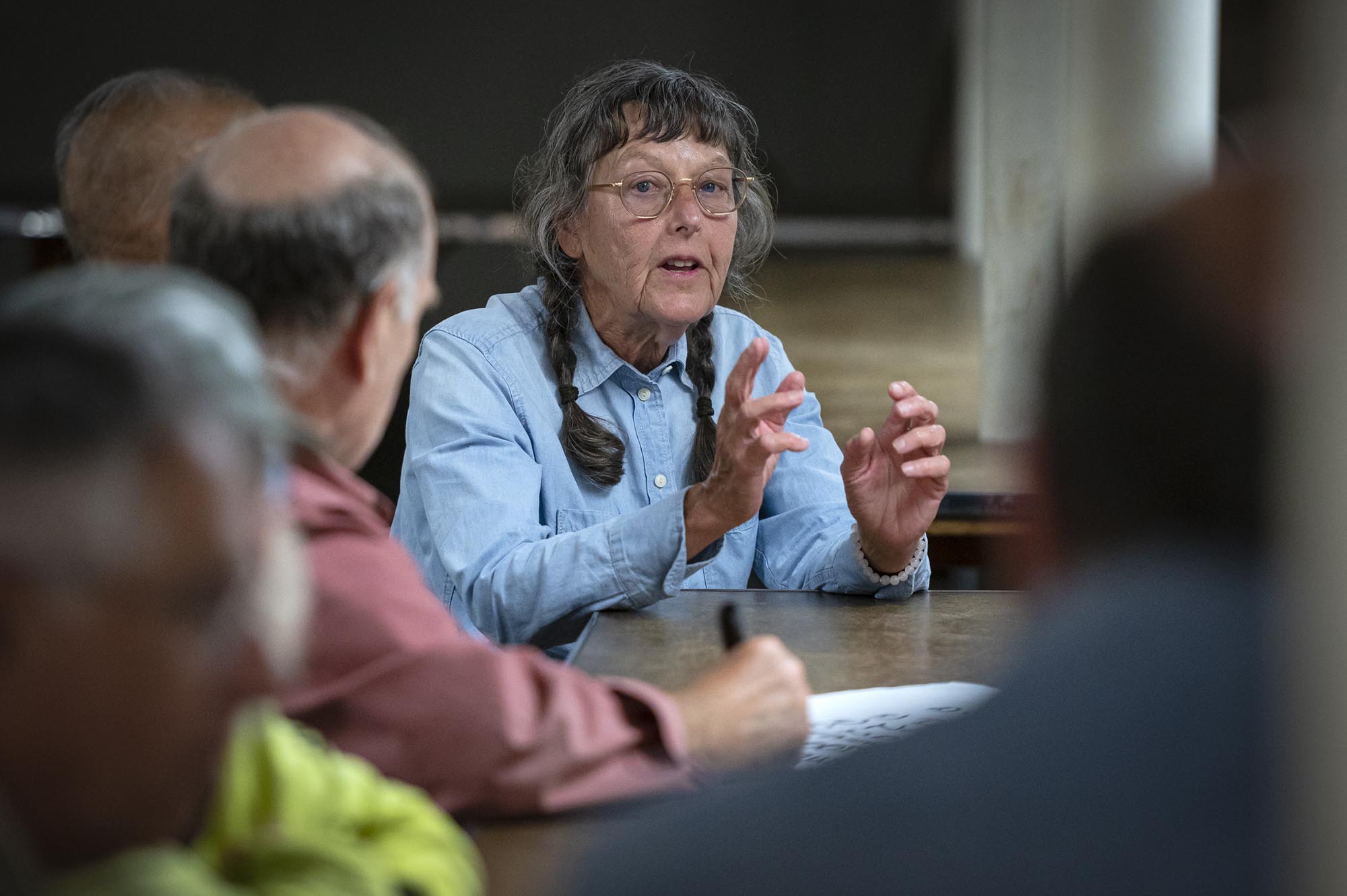
More than 60 people stood up to speak, with a handful of repeats. Their comments encompassed a broad range of emotion — including grief, anger and hope. Some expressed a desire for people to come together, while others emphasized the need to remember certain groups that were heavily affected, from businesses to homeowners to unhoused people.
There was one fact most speakers seemed to implicitly accept: This level of devastation had happened before, and it was likely to happen again, due to Montpelier’s central location in a flood zone and the increasingly apparent reality of the climate crisis.
“You can’t build high enough to support yourself in the next flood,” said Kirk Gardner, a Montpelier resident and a retired employee of the Scripps Institution of Oceanography.
“The amount of humidity the atmosphere can now tolerate means that the next time we have a flood, it’s going to probably be higher by a considerable margin than we’ve already had,” he said. “When we do our planning, bear that in mind.”
Climate resilience was a key theme Thursday night, particularly among speakers from a group called Resilient Montpelier, which formed in December 2022 to address Montpelier’s infrastructure issues and emergency readiness.
“Climate change is no longer out there to be dealt with in 2030 or 2050. It’s here,” said Dan Jones, one of the group’s leaders.
“If we don’t start making the work that is going to be required — moving our businesses, preparing for the kind of shifts that are coming — because this will happen again, as well as heat domes, as well as fires,” he said. “We are living in a time that’s becoming a chaotic situation that is going to get worse, and we have to start acting as if that’s the truth.”
Some suggested moving businesses or the flood-prone high school uphill to some now-vacant Vermont College of Fine Arts buildings.
Others said Montpelier needed to work on mitigating flood risk by developing wetlands and managing the rivers that run through the city — the Winooski, North Branch, and Dog rivers — further upstream.
Residents also raised more immediate concerns, including Montpelier’s stormwater and sewer systems, which they said backed up during the flood and caused more flooding. (The city has a contentious long-term plan to replace aging pipes that have caused sporadic water outages for years.)
Another issue Montpelier faced even prior to the floods, the lack of affordable housing options, came up repeatedly.
Rick DeAngelis, co-director of the Good Samaritan Haven shelter, said that loss of housing units in Montpelier and nearby Barre would only make the problem worse. “The problem in terms of housing that’s right in front of us is shelter for people over the next coming months,” he said.
Amid discussion on the possibility of new development, Montpelier resident Kate McCarthy said that those living in the city need to “prepare ourselves to say ‘yes’” to change. “I think that that is a skill set. That’s a muscle that we can build,” she said.
For both short-term problems and long-term plans, one drumbeat sounded throughout: Where could Montpelier get the money to make changes?
State Rep. Conor Casey, D-Montpelier, told the attendees “we all need to be advocates for the city when we leave the room” and seek attention and state aid.
“When 180 of my colleagues come back” to Montpelier for the legislative session, “we need to get really loud and say ‘Hey, you know, natural disasters, as other folks have said, are a regional issue. It can’t just be on the city here,’” he said.
There was also discussion of whether the city would follow through with these big ideas. One resident, who did not give their full name, said this was “not the first time that we’ve had a catalyst for such things,” but “nothing has come of it in the past.”
Some speakers pointed to Montpelier’s long history of rebuilding after catastrophic flooding as a reason for hope, as well as frustration. Montpelier’s biggest floods occurred in 2011, 1992 and 1927 — the latter was the worst on record, killing dozens statewide.
In her opening remarks, Javier-Duval described how one churchgoer doing repair work after July’s flood found the blueprints for when the church rebuilt after the 1927 flood; they were hidden under the stage.
“How serendipitous that it took another flood almost 100 years later to recover them,” she said.
“For me, these blueprints serve as a hopeful sign that building a new way forward is possible. In fact, it has happened before,” she said. “We will be the ones who together determine what values will guide us along the way and how we will arrive as a whole community.”
Correction: An earlier version of this story incorrectly stated when Resilient Montpelier formed.
