

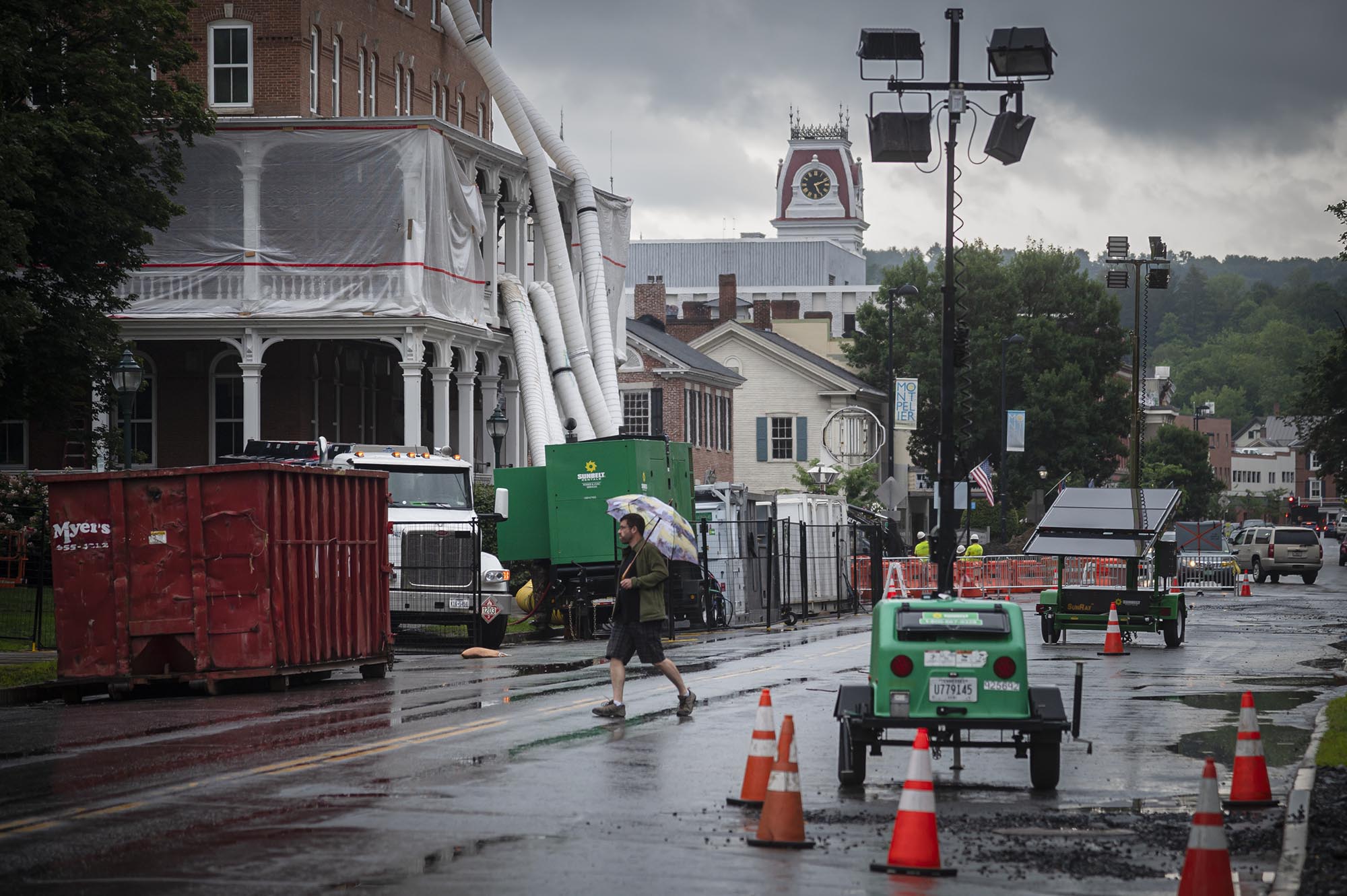
Parts of Addison County saw a month’s worth of rain — 6 inches — in a matter of hours last week, spurring a new round of devastating flooding, but its residents remain ineligible for individual assistance through the Federal Emergency Management Agency.
At a press conference Tuesday, Gov. Phil Scott said his administration is weighing whether to make an appeal to the federal government — arguing that this summer’s flooding was a prolonged disaster, with each new rain event piling onto the last — or request a new, separate disaster declaration to respond to the latest round of flooding in Addison and Rutland counties.
“We are contemplating all of the above, what the best approach is,” Scott said. “It’s not that they’re being difficult. It’s just that those are the guidelines. They have to follow them. And we’re trying — during this unusual time of unusual events — we’re trying to make the case that this one’s different, and maybe different in the future.”
Addison County is not among the nine Vermont counties that have been approved for individual assistance since President Joe Biden issued a major disaster declaration in mid-July amid the first, and most widespread, round of flooding.
“Typically,” according to Scott, “FEMA will look at the storm system — one storm system — and that’s the event” which constitutes a major disaster declaration.
But state officials point out that last week’s flooding in Addison County was likely as bad as it was because it directly followed July’s historic rain event.
“There’s nowhere for the water to go. It goes into the river and elevates, and that creates the flooding,” Scott said Tuesday. “But by FEMA’s standards, we have to contain this (disaster declaration) and end it sometime.”
Commissioner of Public Safety Jen Morrison told reporters that, between Thursday and Friday last week, 35 residents in Middlebury and Rutland were evacuated from their homes and cars.
Rutland County, which also saw extreme flood conditions after a new round of rain last week, is among the nine counties already approved for individual assistance.
To qualify, each county had to meet a certain damage threshold, determined by the federal government. On Tuesday, Scott said that Addison County did not meet that threshold during the first round of flooding.
Scott said he did not know whether last week’s damage alone could meet such a threshold, and encouraged Addison County residents to continue reporting damage to 211 so the state can make its case to the federal government.
In a warming climate prone to more frequent and more extreme weather events and patterns, Scott said the question of how major disaster declarations are defined and approved is ultimately up to Congress to decide.
“I think that’s something Congress will have to anticipate and talk about,” Scott said when asked whether disaster declaration guidelines should be amended. “It’s outside of our control. It’s outside of FEMA’s control. It’s really about Congress making some decisions about what to do next.”
Nodding his head in agreement, FEMA coordinating officer Will Roy added, “We are clearly recognizing that the weather patterns have certainly changed recently.”
“We’re recognizing that for Vermont, this is a historic summer for flooding, and the delegation can utilize its authorities in Congress to put forward changes, and I’m sure many other states are looking at this the same way,” Roy said.
In other news at Tuesday’s press conference:
- According to Roy, as of Tuesday morning, 4,535 Vermonters have applied to FEMA for individual assistance, resulting in over $11.6 million already dispersed in financial aid. Individual assistance can include money for home repairs, debris removal, unemployment, rental assistance and more.
- Scott said the state will soon implement a plan to help disassemble and clear debris from manufactured homes which are total losses due to the flood, at no cost to the owners.
- According to Morrison, 4,432 tons of debris have been hauled out under the state contract as of Tuesday, and debris removal remains a top priority for the state.
- A state-run hazardous materials collections site remains open at the former state police barracks in Middlesex, 1078 U.S. Route 2, from 10 a.m. to 4 p.m. through Saturday, according to Morrison. The site is collecting hazardous, toxic, poisonous, corrosive, reactive or flammable materials, such as paint, charcoal lighter, oven cleaner, drain cleaner, pesticides, and propane or other gas cylinders.
- Secretary of Transportation Joe Flynn said that as of Tuesday, four state roads remain closed and seven partially open. Since July’s initial flood event, Flynn said the state Agency of Transportation has identified 1,102 sites of damage on state-maintained roads and bridges, and 826 impacted culverts. The agency has completed 20 miles of new paving, used 366,000 pounds of rock, installed 7,000 feet of new guardrail, worked on 236 slopes or slides and performed 142,000 linear feet of ditch work.
- Also on Tuesday, Flynn announced the reopening of roughly one half of the Lamoille Valley Rail Trail. The trail is approximately 93 miles long — the longest rail trail in New England — stretching from St. Johnsbury to Swanton. According to Flynn, a roughly 30-mile section between Swanton and Cambridge Junction is now open, as is a 19.5-mile section between St. Johnsbury and Walden. Flynn said repairs to the full length of the trail will likely stretch into next year.
