


Town officials in Addison and Rutland counties are cleaning up after separate torrential rain events last week that overwhelmed stormwater systems, caused landslides, prompted evacuations and damaged homes, roads, water mains and sewer infrastructure.
The rainstorms marked the latest in a string of extreme precipitation events to hit Vermont over the past month. Middlebury received more than 5 inches of rain on Thursday evening, and adjacent towns Ripton and East Middlebury each received at least 3 inches of rain, according to the National Weather Service.
“It was just, like, a deluge for a couple of hours,” said Laurie Cox, chair of the Ripton Selectboard. “There are very few roads that came through unscathed.”
The city of Rutland received 2 inches of rain in one hour on Friday, with a total of 3.68 inches by the end of the day, the weather service said. The rain brought flash floods that inundated the southern part of the city, displacing at least 26 residents, according to Rutland City Fire Chief Bill Lovett.
He said Clover Street — a historically flood-prone area — was hit the hardest, with 6 to 8 feet of water accumulating in some areas. More than a dozen of its residents had to be evacuated by boat.
“I’ve been here since 1980, and we’ve never launched boats in the middle of South Main Street,” Lovett said. “It is certainly unusual we had that much water that quickly.”
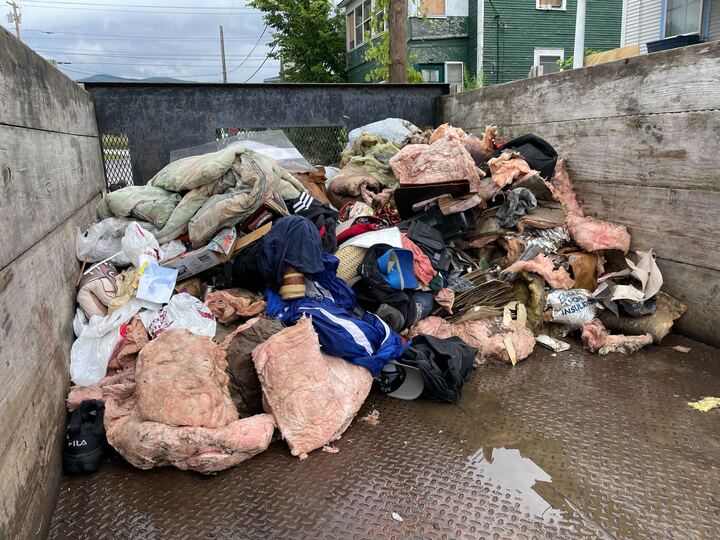
During the Friday afternoon rainfall, he said, there was a burst of hail that people observed at the fire station located on Center Street. The fire chief said this appeared to be an event isolated to within a few blocks.
Eleven people, including six children, sought shelter at an evacuation center the American Red Cross set up at the Rutland High School gymnasium on Friday, according to Red Cross spokesperson Jennifer Costa.
The emergency shelter, she said, will be open until all displaced individuals have another place to stay.

Some of those who had to evacuate their homes appeared to have stayed with family or friends because they didn’t use the shelter, Board of Aldermen President Michael Talbott said. The floodwaters receded soon after midnight, said Talbott, who is acting mayor while Rutland Mayor Mike Doenges is out of town.
Rutland is prone to urban flooding, according to Scott Whittier, warning coordination meteorologist with the National Weather Service in Burlington.
“When you start getting 1 to 1.5 inches of rain in just a one-hour period … with all the hills surrounding it and all the asphalt and just the way the city is planned, there’s a lot of runoff in the streets that causes problems,” Whittier said. “And that’s exactly what happened Friday afternoon and Friday evening in Rutland.”
Apartment uninhabitable without water, power
When Derek Gilman, 24, returned home to his Rutland apartment on Killington Avenue on Friday, he saw a fire truck on the side of the road and a hose pumping water out of the building.
Water had filled the basement almost to its ceiling, Gilman said.
“It was kind of a shock,” he said.
Where the water came from remained a mystery to Gilman. The building sat on high ground, without a body of water nearby. He hypothesized that the yard, already saturated with water, had refused to absorb Friday’s rain, and all that water found its way to the basement.
Inside the basement, fuel oil leaked into the water, and the building’s electrical and water systems stopped working, according to Gilman. The property has since been red-tagged, meaning it’s been marked as uninhabitable.
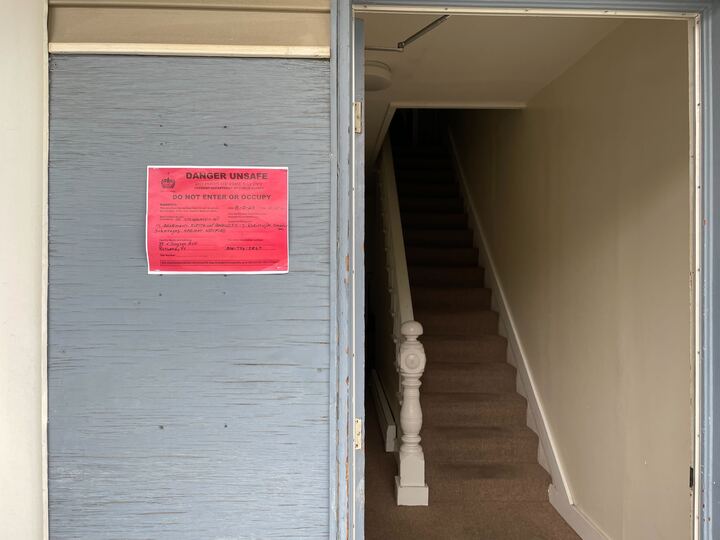
Initially, Gilman said a plumbing company had pumped the contaminated water directly into the street. But once the fire department arrived, “they were pretty upset” to see what was going on, he said, and stopped sending the hazardous fluid into the storm drains.
Without a place to stay, Gilman crashed with his grandparents in West Rutland and paid for a hotel room in Killington. He’d heard from another tenant that the landlord would be putting residents up elsewhere, but he was struggling to get in touch with the property manager to find out for himself.
“This was supposed to be my vacation week,” Gilman said. Now, he was overcome with “unknowing.”
“We don’t have a timetable on when things are going to be fixed.”
‘Swamped’: repairs begin in Middlebury
An hour north, the town of Middlebury was “in recovery mode,” Tom Hanley, chief of the Middlebury Police Department, said Monday.
The police station “got swamped,” he said, and police were operating out of a mobile command post next to the building.
Some residents of the town remained under boil-water notices as officials continued to repair a broken water main. About 170 service connections, which include homes and businesses, did not have access to clean water from the town’s drinking water system as of Monday.
Residents were instructed to pick up drinking water, provided by Vermont Emergency Management, from the Middlebury Police Department.
“They can take all they want,” Hanley said. “We’re going to be doing this for the next several weeks until that water main is repaired.”
The water main broke after water overflowed a structure on the top of a dam on Dow Pond, according to Emmalee Cherington, director of planning at the Middlebury Department of Public Works.

Along with the water main, the water destroyed a culvert beneath Route 116, causing a sinkhole and crumbling part of the road. While officials have installed a temporary water line, it does not provide potable water.
The state Agency of Transportation was in the process of replacing the culvert with a larger concrete box, Cherington said. Officials were waiting to hear whether an existing box in New York would do the job, in which case the repair could take place in the coming days, or whether they needed to pour a new concrete box, which could take a month.
Though the structure atop the dam failed — not the dam itself — the town has been moving through a permitting process to remove the dam, according to Cherington.
Rain on repeat
Some towns, such as Middlebury, were largely spared by last month’s flooding but hit hard during last week’s rain. Ripton, on the other hand, was slammed by both. During the July flooding, a mudslide destroyed a Ripton home and caused others to be evacuated.
Cox, the town selectboard chair, said the rain was heavier the second time around. It caused another landslide, significantly damaged at least one home and made roads difficult to navigate.
“Most of it was water coming off hillsides,” she said. “And that’s really — everything is so saturated that you get a downpouring like that, and the water just — it runs places it’s never run before.”

Road crews were “working like crazy right now,” she said, but it remained uncertain whether the Federal Emergency Management Agency would provide disaster relief to residents of Addison County, complicating the recovery timeline.
In nearby Hancock, officials have deemed a bridge on Route 125 structurally unsound, according to Dan Perara, who serves on that town’s selectboard and as road commissioner.
“So as of just an hour ago, there’s no east-west traffic on 125,” he said on Monday afternoon, and the closure has rendered the town “cut in half.”
Perara said that, in total, six roads have sustained damage. The flooding has washed out driveways, and rivers in Hancock have jumped their banks.
Hanley, the Middlebury police chief, encouraged residents to report damage to 211, which both connects them to resources and could give FEMA the data it needs to include the county in the disaster declaration.
But there’s more rain on the horizon in what’s turning out to be a very wet summer in various parts of Vermont.
The National Weather Service said moderate to heavy rainfall is expected in Rutland City Monday through Tuesday, which could bring anywhere from 1 to 4 inches of precipitation. The weather service had not issued a flood warning as of early Monday afternoon, but that could change, said meteorologist Conor Lahiff.
Recent heavy rains, such as ones in July that led to historic flooding around the state, have left the ground saturated with water, and flooding more likely.
“I think everybody’s kind of on heightened awareness that any thunderstorms that we get, or any heavy rain we get in a period of one to two hours, if it’s over an inch or 2 inches, it’s likely going to cause flash flooding,” Lahiff said.
