

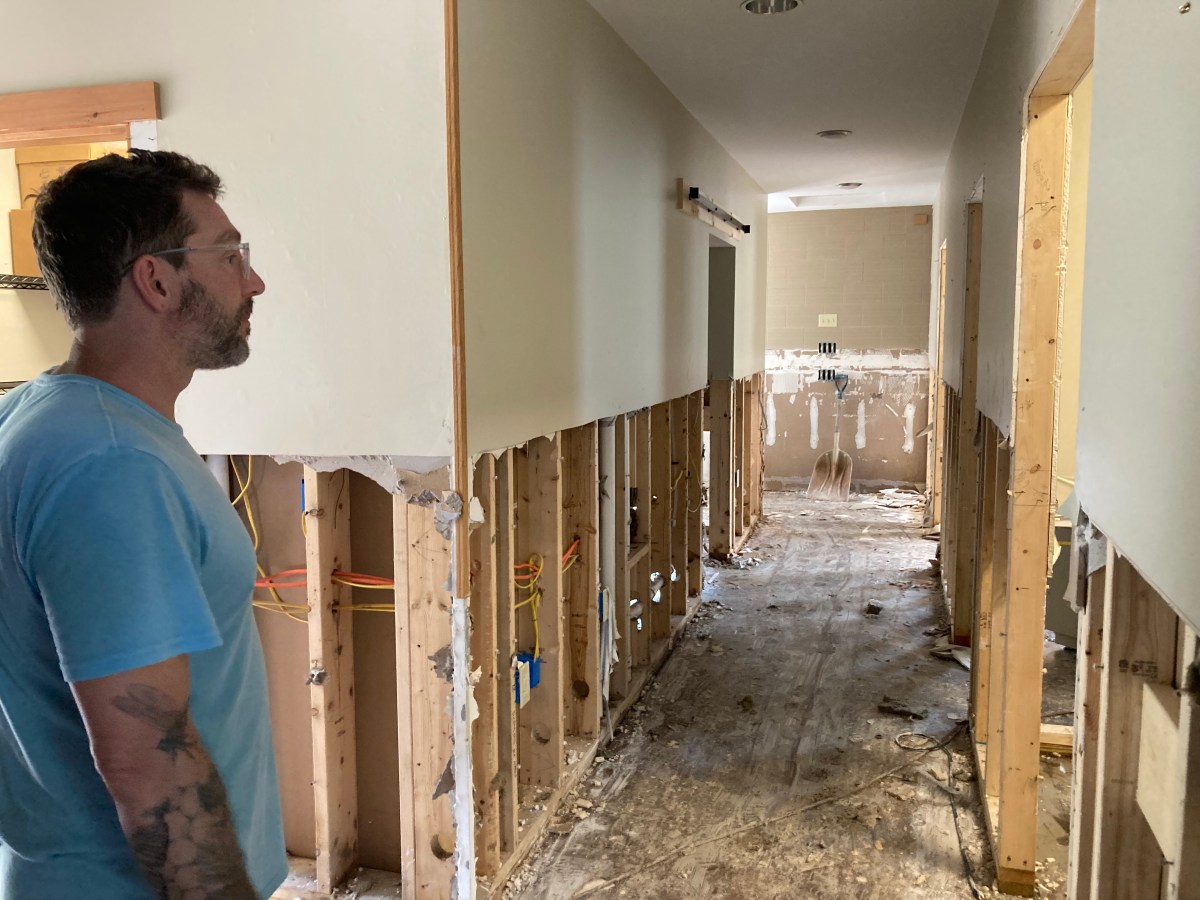
If you only look at the top half of the Johnson Health Center — everything roughly 4 feet high and above — the facility looks clean and new. The paint is fresh and neat, and a chalkboard greets visitors with a cheery “Welcome!”
“We just opened in November,” said Geoffrey Butler, the executive director of the Johnson Health Center. “It was completely remodeled. Like, the entire building was redone. Floors, paint, walls.”
That work was undone this week, when relentless rainfall brought the Lamoille River sweeping into the medical center. Four feet of water destroyed computers, furniture and a host of medical equipment, including microscopes, otoscopes and exam tables.
“We have, as you can see, lost everything in here,” Butler said. “It’s been a complete loss.”
As floodwaters recede across Vermont, the scope of the damage is just becoming clear. On Thursday, residents in Johnson, which abuts the Lamoille River and experienced some of the worst flooding in the state, hauled debris out of buildings and aired out mud-streaked rooms.

The town is grappling with what was lost to the water: homes, farm produce, the Sterling Market grocery store, which “suffered significant damage and will remain closed for the foreseeable future,” according to a Wednesday post on its Facebook page.
Residents are also facing a sudden dearth of medical and substance use disorder facilities.

Daniel Franklin, the chief operating officer at the substance use recovery nonprofit Jenna’s Promise, based in Johnson, said that one of their residential facilities “sustained substantial damage.”
Six residents were displaced because of the flooding, Franklin said. He declined to say where they are staying.
Jenna’s Promise usually has a waiting list of between 10 and 40 people, he said, and the nonprofit was gearing up to bring in more residential clients to reach a full capacity of 17. The organization has put new applications on hold as it assesses the damage.
Franklin said he could not say how many people might be affected by that hold. But the flooding “means that we can’t take in a lot of people that we were planning on taking because we don’t have the room for them anymore,” he said.
And because the nonprofit accepts many people coming out of prisons, he said, “we have people who will be incarcerated longer because they can’t come to us.”
Meanwhile, the Johnson Health Center is working to accommodate its patients as well. The nonprofit health facility offers primary care and substance use disorder treatment. Approximately 100 out of its roughly 250 patients are receiving treatment for opioid use disorder.
“We’re sort of reconfiguring all of that and figuring out how to make that continue to happen,” said Caroline Butler, a nurse practitioner and founding member of the Health Center, as well as Geoffrey Butler’s wife. “Because it’s so needed, and it’s harder to do when you’re not in a specific place.”


The Butlers said it’s not clear how long it will take to get the health center back up and running, but Geoffrey estimated it would be a monthslong process. The couple has received offers for a temporary location and plan to transition to Telehealth visits as much as possible.
“Not having those services available — I don’t even want to go there, you know?” Geoffrey Butler said as he surveyed the devastated health center. “We’re going to get through this.”
