

An attorney representing nearly every Vermont school district has filed a lawsuit against Monsanto, seeking damages from the multinational chemical company for polychlorinated biphenyl (PCB) contamination in school buildings.
The complaint, filed Thursday in U.S. District Court in Burlington, alleges that Monsanto continued to market and sell products containing toxic PCBs, even though it was aware of the chemicals’ dangers.
“Prior to the construction of District facilities, (Monsanto) knew its PCBs would cause indoor air contamination-yet it falsely reassured the public that the opposite was true,” the lawsuit reads.
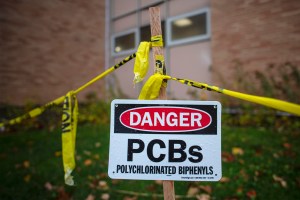
The lawsuit is the latest in a stream of litigation over PCB contamination in Vermont, joining cases previously filed by Vermont’s attorney general, the Burlington School District, and former educators at Burlington High School.
Ninety-two school districts across the state, as well as the private Burr and Burton Academy, are named as plaintiffs in the case.
Pietro Lynn, an attorney representing the schools, first described the case to VTDigger late last month. In a brief interview Monday, Lynn said that he was in touch with additional districts — Rutland City Public Schools and districts within the Bennington-Rutland Supervisory Union — but it was not yet clear whether they would join the case. The Burlington School District, having filed its own lawsuit, is not a plaintiff in this one.
Nicole Hayes, a spokesperson for German multinational Bayer, which owns Monsanto, sent a written statement describing Vermont’s PCB screening levels — which are significantly more stringent than those of the the federal Environmental Protection Agency — as “scientifically unsupported.” Hayes also pointed to “chronic deferred maintenance” in the state’s schools.
“We will respond to a complaint in detail in court, but this case has no merit,” Hayes said in the statement.
PCBs, a class of chemicals present in many building materials — electrical equipment, caulk, paint, and more — were manufactured by Monsanto for much of the 20th century, until federal officials banned their production in 1979. The chemicals have been linked to a number of health defects and are classified by the EPA as “probable” carcinogens.
Vermont schools’ PCB misadventures began in earnest in 2020, when officials shuttered Burlington High School after detecting high levels of the chemicals in the building’s air. That experience spurred Vermont lawmakers to mandate an unprecedented statewide program to test over 300 public and private schools across the state for PCB contamination.
Lawmakers have also set aside $32 million for PCB remediation and removal in schools, $16 million of which will go to the Burlington School District. But as the state’s testing program has progressed — and as PCBs have been found in more and more schools — local district officials have expressed concern that the state has not provided enough money for cleanup.
“The impetus for this (lawsuit) is that those communities are going to have to pay out of their own pockets for anything the state does not reimburse,” Lynn told VTDigger last month. “They deserve the right to pursue and control the litigation against Monsanto to recover those costs.”
Correction: An earlier version of this story misstated the time period during which Monsanto manufactured PCBs.
