


This story by Frances Mize was first published by the Valley News on June 24.
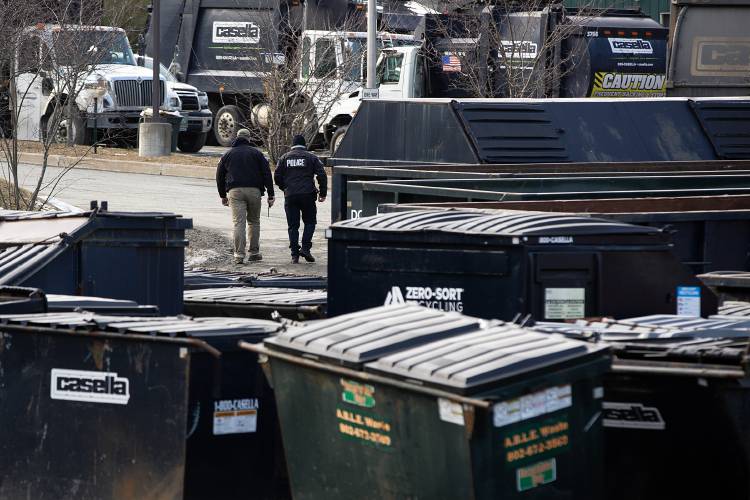
WHITE RIVER JUNCTION — Shortly after 9 a.m. on Jan. 17, a worker at the Casella Waste Systems recycling processing center on Route 4 was using a bucket loader to dig through a large pile of cardboard that had just arrived. Scanning the pile, he caught a glimpse of what appeared to be a mannequin.
Within minutes, the first wave of Hartford police officers who responded to the 911 call converged on the scene. Shocked Casella employees pointed them to the zero-sort recycling floor.
The motionless body of a woman wearing a hooded red sweatshirt, over another sweatshirt, was cast among the debris.
Police searched the pockets of the woman’s black sweatpants for anything that might help identify her. No clues turned up.
The Vermont State Police Major Crime Unit, which investigates primarily homicides and missing person cases that are suspicious in nature, was brought in. On the midwinter morning with temperatures below freezing, Windsor County State’s Attorney Ward Goodenough and an assistant state medical examiner joined law enforcement officers at the scene, which was cordoned off with crime tape.
From interviews with Casella workers, police ascertained the woman’s body must have been loaded unknowingly into a garbage compacting truck sent to empty dumpsters outside businesses and other sites in Hartford that morning.
Police compiled a list of about a dozen stops the truck’s driver had made before unloading at the recycling processing center around 9 a.m.
Meanwhile investigators examined the woman’s tattoos to help identify her. In Vermont and New Hampshire, photographs of people with criminal records are entered into computer databases.
Her name was Jessica Morehouse. She was 34 years old; the mother of three girls, ages 11, 13 and 15. For a while she had worked in a nursing home.
But how she had died still needed to be confirmed.

Within days of the gruesome discovery at the recycling facility, newspapers and social media news outlets across New England began running stories about the “woman who was found in a dumpster.”
But family and friends remember a different Jessica Morehouse than the one portrayed in court records and the police report.
“She had friends everywhere,” her mother, Diane Cavanaugh, said. “Wherever she worked.”
Morehouse made an old-fashioned photo album filled with pictures of her three daughters. She was an excellent cook and a skilled deer hunter.
She was an avid reader, as well. “Any kind of story, any love story, she’d read,” her mother said.
Morehouse was born in Lebanon, New Hampshire, and attended elementary school in South Royalton before moving with her mother and younger brother, John, to upstate New York.
After graduating from high school, Morehouse occasionally returned for stretches to the Upper Valley. When she was in her late 20s and living in the Upper Valley, she started heavily using heroin and other hard drugs. Diane took custody of her three granddaughters in upstate New York.
Morehouse’s struggles with substance use disorder deepened. Unable to hold a steady job, she had difficulty finding stable, permanent housing. Periodically, she ended up homeless, sleeping outdoors in all seasons.
She was arrested in Vermont and New Hampshire a half-dozen times for possession of heroin, court records show. She didn’t serve time in prison but bounced in and out of court-ordered, and sometimes voluntary, drug rehabilitation programs.
The Upper Valley was a challenging spot for her, said Emmett Wood, a Vermont public defender who sometimes represented Morehouse. “For a lot of folks who are recovering from addiction, being in the place where they first used is difficult,” she said.
A big heart
In elementary school, Morehouse rushed to perform the Heimlich maneuver to remove a Life Saver lodged in her younger brother’s throat.
“Good thing, too, ’cause I was choking bad,” John Cavanaugh said in a recent interview.
His sister always had a lot of friends, he said, recalling a family trip to Cape Cod in Massachusetts in middle school.
“She had a group of friends that she made in two seconds,” he said. “All week she had like 12 people that she was hanging out with constantly. And she had a big heart. She did about anything for anybody, if they asked her.”
Growing up, Morehouse took an interest in deer hunting. She didn’t hesitate when her mother’s longtime partner, Randy Vanderwalker, asked her to join him in the woods every fall.
On successful outings, Morehouse would volunteer to handle field dressing chores. “She would really almost climb right inside the deer, up to her freaking shoulders,” Diane Cavanaugh said.
“She also loved to cook, that kid,” her mother added. “I mean she didn’t like cleaning up her mess. But she liked to make fancy pastries.”

After high school, Morehouse was accepted at the New England Culinary Institute in Montpelier but opted not to go.
At 19, Morehouse became a mother. She and her husband, Coty Morehouse, had two more daughters before divorcing in 2016.
Bridgett Jones-Nelson and Morehouse were best friends who made the most of rural teenage life together.
“No matter how many times (Jessica) stubbed her toes when we were on bicycles barefoot, she’d still get back on the bike and take off,” Jones-Nelson recalled.
Over the years, riding bikes turned into raising children. Jones-Nelson and Morehouse each had girls around the same age.
In the summers, the two moms took their daughters to the same lake they went to as teenagers.
“She was the mom who didn’t want to miss any of the little things,” Jones-Nelson said. “Jess was always interested. How many times do you want to see the same little flower doodles that your children drew? Well, Jess always did. She didn’t want to miss those moments.”
Even when Morehouse started using drugs more heavily in the Upper Valley, she made regular phone calls to her daughters, who by then were living with their grandmother.
“No one ever thought that Jess would walk out on her girls, but drugs do funny things,” Jones-Nelson said. “And it’s a long road coming back.”
Morehouse called Jones-Nelson often too, sometimes when she’d been using.
“Even in those moments, she’d always asked about her girls,” Jones-Nelson said. “She asked if I’d talked to them or if I knew that they were doing OK. It’s strange how someone could love so much and stay so distant. But Jess is proof that it’s possible. I truly believe that she really loved them with every bit of her.”
‘I sure do regret that’
When reached in upstate New York by the Valley News, Coty Morehouse politely declined to talk about his former wife. He referred questions to Diane Cavanaugh and provided her contact information.
When not at her home in Minerva, N.Y., a town of about 1,000 people 90 miles north of Albany, Cavanaugh, 71, lives a few months of the year in the Tunbridge area. She occasionally works in Collis Café at Dartmouth College.
Morehouse’s three daughters are growing up in the same house in Minerva that she lived in as a teen.
When Morehouse started running afoul of the law, her mother and brother ponied up money to help pay her fines and keep her out of jail.
In the last few years — when Morehouse’s drug use spiked — communication between mother and daughter grew more strained.
“But I sure do regret that,” her mother said in an interview last month.
John Cavanaugh, manager at Home Depot in Glens Falls, N.Y., hadn’t spoken much to his sister in the last few years.
“I hate to lose somebody and not have a chance to make things right before they pass on,” he said. “The tough part was — you don’t expect to lose somebody at 34 years old. You’re trying to get your life together and then this happens.”
At 89, Ron Cavanaugh, Morehouse’s adoptive father, lives in South Royalton. In a recent interview at his home, he shared the disappointment and frustration he felt about Morehouse’s drug use.
But when the subject changed to her childhood years spent hiking, fishing and raising a cat that he got her, he broke into tears.
Cavanaugh remained close with Morehouse and her brother even after he and their mother were divorced.
Later, however, when Morehouse started using drugs, everything changed. Once, when they bumped into each other on the street, they barely nodded hello.
“When she went to rehab, I knew that something hit her up here,” he said, putting his forefinger to his temple.
“She wasn’t stupid,” he added. “She just was stupid with her friends.”
‘This death is considered accidental’
According to a state toxicology report, Morehouse had opioids in her system at the time of her death.
However, she wasn’t among the 18 people who died of an opioid overdose in Vermont last January, data from the state’s Department of Health shows.
A death certificate, filed after an autopsy was completed, indicates that Morehouse was inside a dumpster when it was “emptied into and compacted by (a) recycling truck.” She had visible bruises on her upper body along with facial injuries.
Police reviewed video footage captured on private surveillance cameras stationed around many of the dumpsters that Casella emptied the morning of Morehouse’s death.
One of the dumpsters was located behind the nonprofit Listen’s thrift store and dining hall on Maple Street in White River Junction. A Listen surveillance camera showed a sanding truck in the store’s parking lot at 6 a.m. The camera also picked up a light coming from inside the dumpster at that time. Police surmised it could have come from a flashlight or cellphone.
But there wasn’t any video that showed Morehouse actually getting into the dumpster. “The way the dumpster is angled, you can’t quite see,” Hartford Det. Eric Clifford said in an interview.
Clifford reviewed hours of video. Morehouse’s bicycle and some of her belongings were recovered next to the dumpster.
Police found “no evidence of foul play,” Hartford Det. Scott Moody wrote in his final report. “This death is considered accidental.”
Until a few nights before her death, Morehouse had been staying with a friend but moved out after a dispute. Police determined that Morehouse then began spending nights in the dumpster, which contained cardboard that she used to help keep herself warm.
Listen declined to comment on whether it could confirm, or was aware, that Morehouse was occasionally living in the dumpster.
“What I can say is that our hearts go out to Jessica Morehouse’s family and friends,” Listen Executive Director Rob McGregor said in a statement. “Homelessness is a tragedy that begets tragedy, which is why we are strong advocates for safe shelter options in the community.”
Morehouse’s body was one of at least five found in New England recycling dumpsters or in waste management facilities in the last few years, with the most recent discovered earlier this month at the Chittenden Solid Waste District Materials Recycling Facility in Williston, Vt.
‘A human face to the data’
Morehouse’s death could be linked in part to another emergency dovetailing with Vermont’s opioid crisis. Vermont has the second-highest per capita rate of homelessness in the country, behind California.
Vermont’s annual “point-in-time” survey conducted on Jan. 25 — eight days after Morehouse’s body was discovered — counted 3,295 people experiencing homelessness. It was nearly three times as many people who were found in a 2020 pre-pandemic survey.
“Housing provides the foundation that everything else requires, and Jessica offers a human face to the data showing unsheltered homelessness leads to devastating outcomes, including death,” said Anne Sosin, a policy fellow at the Nelson A. Rockefeller Center at Dartmouth who researches health equity and homelessness.
Sosin emphasized that having stable housing is essential to attempting recovery from substance use disorder. “This is borne out in study after study,” she said.
Much of the recovery housing that exists in the Upper Valley requires complete sobriety and abstinence from use of substances, said Margaret Kettles, a New Hampshire public defender.
But that doesn’t necessarily square with many people’s path toward recovery.
“For many people, they’ll have relapses or maybe they’re not yet ready to attempt an abstinence-only sobriety,” said Kettles, who hadn’t represented Morehouse. “But they still need safe and supportive housing.”
“As long as all safe housing requires complete sobriety and that you not relapse, we’re going to be failing to serve a group of people who aren’t yet in a place in their recovery journey where they have total abstinence,” Kettles added.
“There will be people whose lives could be saved if housing options were available to them.”
Last July, the Hartford Zoning Board of Adjustment, in a 3-2 vote, rejected the Upper Valley Haven’s application to build a year-round, low-barrier shelter.
Access to a low-barrier shelter does not require any kind of criminal background check, program participation or sobriety. If someone in need of a place to sleep shows up inebriated, they won’t be turned away.
The shelter would have been less than a mile away from the dumpster behind Listen, where police determined Morehouse had resorted to spending cold winter nights.
“Our work is to support people where they are,” said Michael Redmond, the Haven’s executive director. “We know shelters can save lives, particularly in cold winters. And we never can say this sort of thing for sure, but if we had such a shelter, maybe she’d be alive today.”
‘We’re not trained in it. We could make it worse.’
At her home in New York, nearly six months after Morehouse’s death, Diane Cavanaugh stared down at her daughter’s swollen, disfigured face in a picture she obtained from the Vermont Medical Examiner’s Office.
“They didn’t want to give it to me,” Cavanaugh said of the photograph.
“I understand that you also requested a black & white image of Jessica’s face,” Karen Dean, the state’s medical records specialist, wrote in a letter to Cavanaugh affixed to the final autopsy and toxicology report.
The state doesn’t usually send photos to families but honored Diane’s request. “I hope this helps to bring some closure to you,” Dean wrote.
Last winter, speculation and rumor swirled around Morehouse’s death. One tip to the police alleged that her body had been disposed of by a drug dealer at the Hartford Transfer Center. A police incident report is rife with other such call-ins, some of which don’t line up with the facts that cops say are substantiated by video footage and data from Morehouse’s cellphone.
No charges were filed, and the case was put to bed in March.
For months, Hartford police didn’t update Cavanaugh on the status of the department’s investigation, she told the Valley News.
Until a few weeks ago, she didn’t know the case had been closed.
When asked why they didn’t call Morehouse’s family to let them know the investigation’s outcome, Hartford police said that their in-house social worker was on work leave.
“We’re not trained in it,” said Police Chief Greg Sheldon said about communication with loved ones of deceased people. “We could make it worse. The dead bodies, families screaming, that’s trauma to staff that I have to consider.”
Sheldon, a former Rutland Police commander, was named chief in Hartford in late January. His first day on the job was about three weeks after Morehouse died.
When a family is grieving, “us contacting them might set them back,” Clifford, the Hartford detective, added. “And no one wants to think their kid was living in a dumpster.”
‘She never lost her beautiful self’
Morehouse was trying hard to get clean, relatives and friends told the Valley News in interviews over the last couple of months.
A recent stint at an addiction treatment clinic shortly before her death had left those who knew her hopeful.
“The times I met her, she was passionate about sober living and trying to be better for herself,” said Wood, the Vermont public defender. “It was sad to hear the news (of her death), especially because she seemed like she was on track to get out of it.”

Morehouse’s plan was to ultimately return to New York, Diane Cavanaugh said. Diane wanted her daughter to come back home, if she could complete rehab and get sober.
Jones-Nelson would have liked that.
“Jessica was my sister in every sense of the word,” she said.
Jones-Nelson knew when Morehouse was using and when she was homeless.
Staying close to someone battling addiction “can be brutal,” she said. “But I never gave up on Jess, because somehow she never lost her beautiful self. She could be at rock bottom with nothing, in the worst possible way, and still be concerned that she couldn’t call you for your birthday.”
One winter, Morehouse called Jones-Nelson from a shelter that she was staying in. “We were on the phone until like 2 a.m., from 8 o’clock at night,” she said.
But one thing they didn’t talk about was Morehouse’s drug use.
“It generally caused an argument,” Jones-Nelson said. “It’s very hard because I loved her so much. And I didn’t ever understand her choices. But at the end of the day it mattered more to me that we didn’t lose what we had.”
Jones-Nelson is afraid that Morehouse has become a statistic. Another grim casualty in the endless struggle to curb substance abuse.
“But she wasn’t just an addict,” Jones-Nelson said. “Jess was somebody to so many people.”
Frances Mize is a Report for America corps member.
