

This story by Frances Mize was first published by the Valley News on June 24.
SHARON — It takes all hands on deck — or field — to loosen the grip a mild-looking invasive plant has on the start of Upper Valley summers.
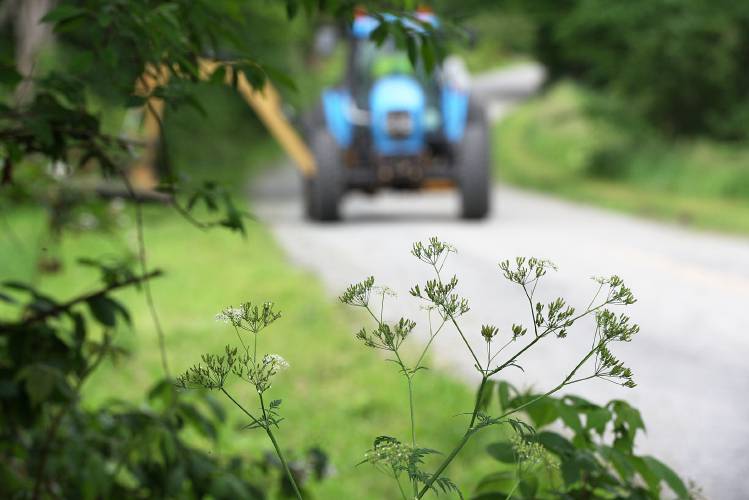
In what has become known as “chervil season,” the titular invasive weed takes over roadsides, meadows and pastures like a professional. Wild chervil grows about 3 feet tall and blossoms in small white petals, usually from May to June. It resembles the docile Queen Anne’s lace, but the hostile weed can out-compete native vegetation and has become particularly problematic in hayfields over the past two decades or so.
It took Ryan Haac, of Sharon, almost six years of persistent chervil eradication to feel like he has a handle on the plant’s takeover of his homestead. He finally has some pasture back and can hay areas that were once totally overrun by wild chervil.
“I forget every year how much effort I put into it,” Haac said. “It’s a crazy time.”
Wild chervil doesn’t make much easy. Sap from the plant can produce a rash, its seeds are almost magnetic and can travel far just on a boot sole, and its sprawling, tough root system is difficult to dig out.
Haac divided his property into plots — “We’ll call them chervil zones,” he said — and dug out the section closest to his house and his garden with a potato fork.
“There’s a curve of up to three years where there’s no visible progress, but on the third year is when I found that you really start to turn the corner,” he said. “They’re biennial plants, so the ones that are flowering germinated the year before. There’s a nasty delay.”
When Haac opens the ground with his potato fork, he leaves other seeds, like alfalfa, rye grass and red clover, in the chervil’s place.
“I think that’s important for all invasives,” he said. “If you just pull it out, something’s gonna replace it. You really have to get out ahead of it in more ways than one.”
Chervil should be mowed early in its growing season, before the white flowers turn into seeds. When they do, even mowing the plant with a bush hog feeds into chervil’s game: The seeds can spread by latching onto the equipment brought in to cause their demise.
Mike Bald, owner of Got Weeds?, a company that tackles invasive plants without chemicals, warned against the contagious potency of chervil seeds. They can be spread by anyone that doesn’t clean their equipment or even by a car or a bike that drives by chervil gone to seed on a roadside, Bald said.
“I have boots that are for certain locations only because I don’t want to be the one spreading stuff around from Brattleboro to Burlington,” he said. “Seeds will be underneath your hat at the end of the day, even if you never took off your hat. I mean, I can’t explain that.”
On Tuesday, Bald was at a property in Brownsville where he manages weeds. He had applied what he calls “the wave effect” on the site’s chervil infestation.
“I sweep through and get the most developed plant and then keep moving and get the ones that are furthest along,” he said.
Bald pulled around 100 chervil plants at the property when he was getting started. “But I think I pulled 15 earlier this spring, and today I found only one more,” he said.
“So chervil is definitely on its way out here. At least until someone brings in more.”
