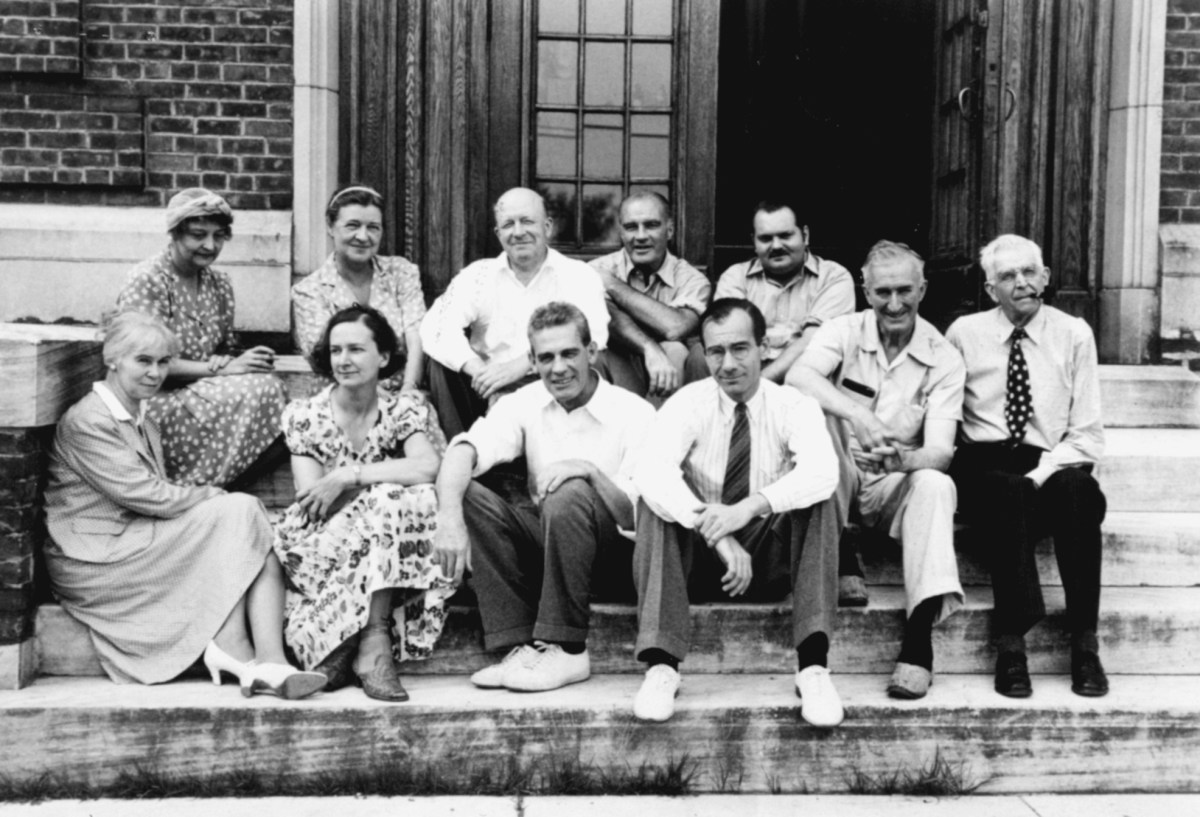
The crowd formed early. While artists were still hanging paintings at the Equinox Pavilion in Manchester, people pleaded for the doors to be opened: “We drove 30 miles to see the pictures,” said one person. “We came over Peru Mountain, and we have to get back before dinner,” the Manchester Journal quoted another saying.
“So they were allowed to come,” the newspaper reported, “and stepped over unhung pictures, (and) were stepped on by artists in shirt sleeves. But they saw the pictures.”
This was in August 1927. The Southern Vermont Artists, as they would become known, had been hosting summertime exhibits of their work for several years. The shows developed quite a following, attracting both out-of-state vacationers and people who might never have been outside Vermont.
Word spread of the quality of the art being displayed, and the annual show soon outgrew the Pavilion, moving to the gymnasium at the adjacent Burr & Burton Seminary.
“It has grown from very modest beginnings to a status of real importance,” New York Times art critic Edward Alden Jewell informed readers in September 1935. Jewell had appreciated the egalitarian character of previous shows, where visitors encountered, hanging side by side, works by prominent New York artists summering in the Dorset and Manchester area and by virtual unknowns from Vermont.
Jewell was happy to report that, at the 1935 exhibit, “the democratic, warmly welcoming note is still sounded.”
Today, Lyman Orton appreciates both the artistry and the democratic spirit of those early 20th century art shows. That’s why he is making possible a similar exhibition this summer and fall.
“For the Love of Vermont: The Lyman Orton Collection,” which runs from July to early November, is being jointly presented by the Southern Vermont Art Center in Manchester and the Bennington Museum. It is appropriate that two leading local institutions are sharing the show, but it is also a necessity: Neither has enough room on its own to host the show, which will present roughly 210 paintings, prints and drawings.

Orton is best known as proprietor, along with his three sons, of the Vermont Country Store, a national mail-order company with two stores in Vermont. But he is also a major collector of Vermont artwork; his collection of 20th century Vermont art is considered the largest of its kind in private hands.
Orton focuses particularly on art created between roughly 1920 and 1960, which he considers the “golden age” of Vermont art.
Much of the artwork depicts scenes from southern Vermont, because that’s where so many artists gravitated to during this period.
“Lyman has a good explanation of why it was this end of Vermont,” says Anita Rafael, who wrote the companion book to the exhibition with Orton. “It’s because it was the prettiest, quickest, cheapest place you could get to in one short train ride from New York City.”
Orton finds no irony in the fact that many of the artists in his Vermont collection weren’t from Vermont. Where they were born or where they lived for much of the year is irrelevant to him. What matters is that they came to Vermont and fell in love with the place.

“Once a few artists started, they invited their friends, ‘come on up!’ and so they made a life of it here,” he says.
Rafael can picture the scene. “I can just imagine, especially the early years, the ’20s, with the Dorset Painters, they all knew each other,” she says. “They would paint all day and then at the end of the day they would go over to (Wallace) Fahnestock’s barn and hang up all their paintings and have cocktails and criticize each other’s work.”
The landscape and the community kept drawing them back. “It wasn’t like they dropped in for a week or two or a summer or so,” says Orton. Some became so enamored with the state that they decided never to leave. “Twenty-two of them are buried in the Dorset cemetery,” he notes.
Art on every available wall
Orton gave me a preview of the show last month, which involved visiting his company’s expansive headquarters in Manchester, where pieces from his collection, hundreds of them, hang on seemingly every available wall. Even offices that don’t have a window are guaranteed an interesting view.
Orton seems to know many of the scenes as intimately as the artists did. They combine to create a portrait of his life lived here. He grew up in Weston in the 1940s and ’50s, across the street from the country store his parents ran alongside their catalog business, which he later took over.
Walking among his collection, he almost inhabits the scenes. He’ll point out the church in one canvas — it’s where his parents were married — or mention that a building in a painting has since been torn down, or that in another work the artist, just to help the composition, added a steeple in the background to catch the eye.
Orton loves Vermont because of its natural beauty and tightknit communities. His ancestors arrived just as the state was being founded, but he doesn’t care how long someone has lived here. “It doesn’t matter if you’re first generation or seventh generation or anything else. If you’re here, you’re a Vermonter.”

In addition to the landscape paintings of the Manchester and Dorset areas, Orton’s vast and varied collection includes views of Lake Champlain, Mount Mansfield and other locations around the state. Some of the paintings capture glimpses of everyday life — people standing outside a general store, bidding at a farmhouse auction, enjoying the rides at a country fair.
Two paintings hanging next to each other at the headquarters illustrate the collection’s range of daily-life images. One, “Bromley Mountain” by Mead Schaeffer, is an idyllic scene of skiers dressed in sweaters and hats trekking past trees laden with snow, like something out of an old Vermont Life magazine (which Orton’s father, Vrest, helped found). The painting, in fact, served as a cover for the Saturday Evening Post in 1946.
The other painting, titled “The Trophy,” is a small, undated watercolor by Paul Sample (an artist in residence at Dartmouth, who lived in Vermont) showing hunters hanging a recently shot deer from a tree to cool and age the meat.
Across from these pieces is a striking painting by one of the most famous artists in the collection, Rockwell Kent, who lived for a time in Arlington. “Puritan Church/Mother and Chicks” offers a view of the Sunderland Union Church and surrounding graveyard illuminated by a sunbeam bursting from a dark sky. (The mother and chicks in the title refers to the relationship of the large church and small graves that gather round it.)
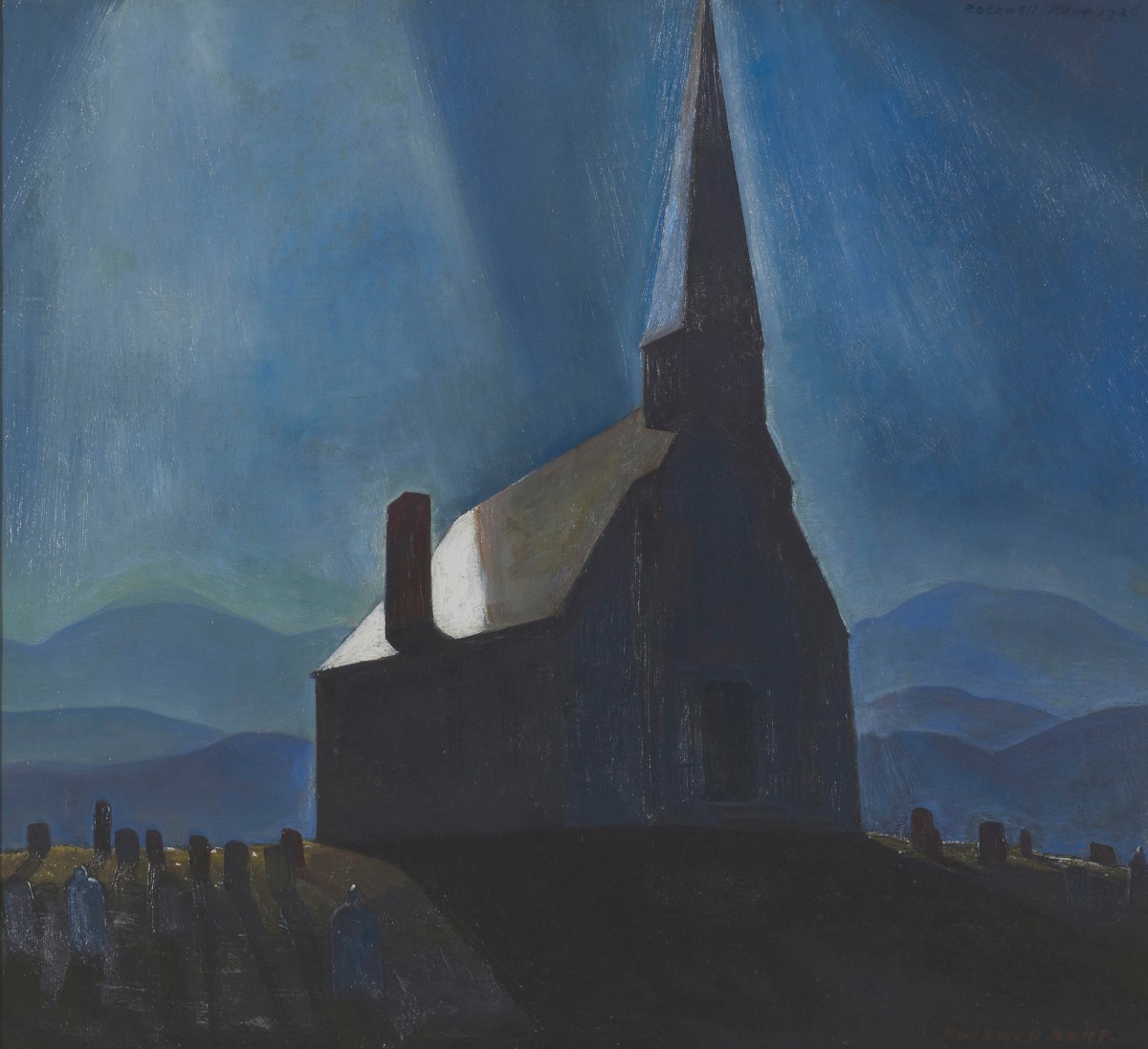
Orton learned that the painting was for sale at a San Francisco gallery (Kent’s ex-wife had taken Puritan Church to California when she moved there). The dealer asked an “eye-popping” price, Orton says, so he bided his time and purchased the painting when the price fell.
The collection also contains many paintings by lesser-known, local artists.
John Lillie grew up on a farm in Dorset and worked as a stonemason, builder, carpenter, farmer and, eventually, an artist. Having never taken a lesson in color mixing or drawing, he had a straightforward approach to painting: “Just giving facts in my own simple language as they were revealed to me,” he once wrote, “not caring what people said(,) as these were my stories and I must stick to facts at any cost.”
Arthur Jones had a background similar to Lillie: He was born into a Dorset farming family and did a variety of odd jobs before turning to painting. Jones, who died in 2020, felt lucky to have been born where and when he was. “If I had been born anywhere else, this all would have been fatal. This era was the place to paint,” he once said.
His father understood that he didn’t want to go into farming and encouraged his son’s artistic efforts. So too did the more-famous, out-of-state artists who flocked to Dorset. Today, paintings by Jones, Lillie and other homegrown Vermont artists hang beside works by the likes of Rockwell Kent and Luigi Lucioni.
‘Repatriating’
Orton gets help tracking down paintings from Donnel Barnum, curator of his collection, as well as others in the art world, including Jamie Franklin, curator of the Bennington Museum.
But during his early days as a collector — just as he was realizing he had become a “collector” — Orton received invaluable assistance from Barbara Melhado, an art appraiser and antique dealer, who used her connections to locate important Vermont paintings.
Orton and Melhado noticed that many paintings at auctions were being bought as mementoes by people who lived out of state. They worried that this “art highway” would denude the state of its cultural heritage. So they worked to bring back as many important paintings from out of state as possible. Melhado has since passed away, but Orton is still on this mission, which he calls “repatriating.”
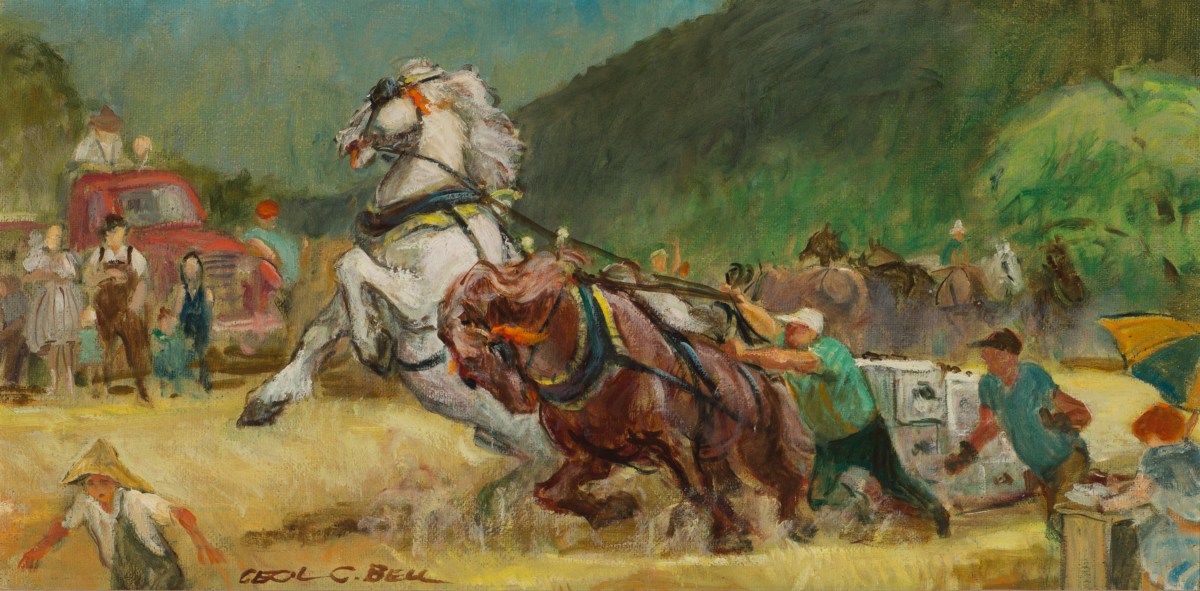
Another example of a repatriated painting is “Good Boys” by Cecil Crosley Bell. Orton stumbled upon the painting, the dramatic spectacle of a horse-pulling contest at a Vermont county fair, while visiting a gallery in Carmel, California. Orton, who knew that Bell summered and painted in Vermont for three decades, bought the painting on the spot and returned it to Vermont, where it joins two other Bell paintings of county fairs in the collection.
Orton wants to make sure the show is accessible and interesting to the general public, not just art aficionados. To that end, exhibition labels will focus on the stories behind the paintings and the artists themselves, rather than on arcane details about brush technique or art history, as organizers of art exhibits often do.

Orton recounts how, while most out-of-state painters visited in the summer, two of them came mostly in the winter. Aldro Hibbard and Emile Gruppe painted mostly in Rockport, Massachusetts, during the summer, but when the weather turned cold, he says, “they were up here hitching rides on logging trucks or on the back of the farmers’ tractor going into the sugarbush.”
Instead of relying on reference photos to paint winter scenes in the warmth of their studios, they would set their easels in the snow and get to work. “I don’t know how they did that,” Orton says, “but, boy, they learned how to capture snow and how to capture what’s going on back in those woods in the sugaring season and the logging season.”
Hoping for the backstory
Orton hopes the exhibit will attract some Vermonters who can help tell the stories behind some of his paintings. Maybe someone will come forward to share their father’s or grandfather’s stories about transporting artists into the hills.
Another story he’d like to hear involves the painting “Family Restaurant” by Kyra Markham. The artwork depicts diners and servers at a home-based eatery in the town of Halifax in the late 1940s or ’50s.

The faces on the people are distinct enough that Orton believes Markham was capturing likenesses of local people. He would love to learn their names.
Although Orton has been generous in loaning paintings to museums, this is the first time so much of his collection can be seen in one place, or, well, in two places. Orton naturally hopes the show will draw a strong crowd, like the shows in the 1920s and ’30s did.
“For the Love of Vermont” is the realization of the vision Orton had when he started hunting down and repatriating art decades ago. “I want to keep this art in the state for everyone’s benefit,” he explains. “This collection tells our story of our Vermont life.”
About the exhibit
“For the Love of Vermont: The Lyman Orton Collection” will be hosted jointly at two venues.
The Bennington Museum will exhibit about 60 artworks from July 1 to Nov. 5. The opening reception, which is free, will be at 3:30 p.m. on July 15 and will feature a panel discussion about how Orton built his collection.
The Southern Vermont Arts Center in Manchester will show approximately 150 artworks. Its portion of the exhibition opens with a free reception at 4 p.m. on July 22, and will feature a panel discussion about how the collection was formed. The SVAC part of the exhibition will close on Nov. 5.
Lyman Orton will present public slide talks about his paintings on June 28 at 5 p.m. at the Manchester Community Library and on June 29 at 6 p.m. at the Wardsboro Public Library. Both talks are free and will last about an hour.
Information about the exhibition and the companion book is available at www.fortheloveof vermont.com.