


Proponents of an airport expansion plan in Franklin County, set to bring more business traffic and economic growth to the region, have the unlikeliest of foes: a population of grasshopper sparrows that nest in the otherwise largely inhospitable fields on the airport property.
The grasshopper sparrow is one of the rarest birds in the state, and is categorized as a threatened species in Vermont. Its population at the Franklin County State Airport in Highgate is among the last of its kind in the state, according to Rosalind Renfrew, wildlife diversity program manager at the Vermont Fish & Wildlife Department.
“There’s a lot to this, because the grasshopper sparrow — this is what’s left of their population in Vermont,” she said.
Across North America, grassland bird populations are declining faster than any other category of bird due, in part, to the development of their grassy habitat or its conversion from grass to other agricultural uses. Vermont is no exception.
On the other hand, an expansion at the state-owned airport is expected to economically bolster Franklin County. It would add 1,000 feet to the airport runway, which is already being widened this summer, allowing more types of aircraft to land there. The new, longer runway would allow for new charter flights and cargo planes to fly into Highgate, but not jets or aircrafts that, for example, the Burlington International Airport can accommodate.
“We’ve been working on developing this airport as a space to bring jobs to Franklin County, into an area of Franklin County which typically doesn’t have a lot of jobs beyond agriculture,” said Cliff Coy, the airport manager.
In an interview, Coy ticked through the progress that airport and regional officials have made in a years-long effort to make the expansion a foundation for commercial and industrial growth in the area. Utilities such as Vermont Gas and Comcast are involved and ready to serve new developments.
Residents already approved a $3.5 million bond to bring new water and sewer infrastructure to the airport and surrounding area, making it easier for new businesses to set up shop. One long-term vision for the airport, which would require more development than what’s currently proposed, could create as many as 1,200 new direct and indirect jobs, according to one estimate.
Other fields farther from the airport could be suitable habitat for the birds, Coy said. He expressed a hope that the birds would move elsewhere with the help of a mitigation plan.
Safety of the people using the airport should be the first priority, he said, overriding everything from stormwater plans to endangered species habitat.
“The (Federal Aviation Administration) is very clear,” he said. “Animals and airplanes do not mix at all. Because, if you hit a bird at 130 miles an hour, it kills you, and everybody on board.”
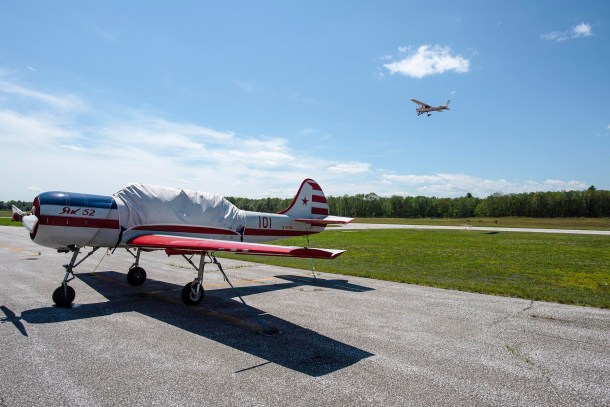
Renfrew, with Vermont Fish & Wildlife, said it’s unusual for wildlife to adapt to the environment close to airports. Airport officials usually keep the surrounding area barren to avoid plane-wildlife conflicts.
But the grasshopper sparrow is an exception.
“What grasshopper sparrows like is sort of the opposite of what you might find at a farm, or what a farmer might desire,” she said. “They need well-drained, impoverished soils that result in a plant community that has a lot of bare ground.”
Grasshopper sparrows aren’t good flyers, so they need space on the ground to walk and forage.
It creates a challenging situation in which the species “is completely reliant on these sites that are really intended for industrial use,” she said.
“The intent of those areas has nothing to do with wildlife conservation, right? And yet the species is wholly dependent on them,” she said. “It’s challenging, and it’s far from ideal.”
In the past, Coy said, the airport has managed the species by mowing the grass closest to the airport to a level that’s unappealing for the birds, keeping them away from dangerous areas.
But because of the species’ status as threatened, the airport needs a Threatened and Endangered Species Taking Permit to move forward with the expansion.
The Agency of Natural Resources has issued a draft permit, and in the coming weeks, the state’s Endangered Species Committee will meet to make a recommendation about how to mitigate the projects’ impact on the birds. Then, the secretary of the Agency of Natural Resources, Julie Moore, would issue a final decision.
David Mears, executive director of Audubon Vermont and vice president of the National Audubon Society, doesn’t question whether the expansion should take place, but rather how to mitigate the negative impacts on the bird population. He said the issue isn’t “black or white, economics versus birds. The two things are related.”
Because a plan has not yet been finalized, the organization doesn’t have a position yet on the project, but Mears believes that, if the expansion impinges on the grasshopper sparrow’s habitat, airport officials need to find a credible way to provide alternative habitat.
Meanwhile, Coy said he’s worried about a looming deadline to use federal funding from the Federal Aviation Administration.
“We’re in real danger of losing that extension,” he said, adding that developers are ready to use commercial lots nearby and businesses are ready to move in.
“I’ve got a waiting list of companies and stakeholders to build hangars here,” he said. “All of this is predicated on an airport that’s usable.”
Trini Brassard, assistant director of policy, planning and intermodal development at the Vermont Agency of Transportation, said the Agency of Natural Resources has committed to working with her agency under its deadline.
While some worry about losing the expansion, others worry about losing the bird. With all that’s at stake for Franklin County, what is the significance of a small, elusive sparrow?
Most of Vermont’s modern-day grassland habitat has been created by humans, following a period where Vermont was almost entirely forested. Although the state once had natural grassland habitat, scientists don’t have clear records to show which grassland birds are originally native to Vermont. Renfrew said she often hears arguments that, because scientists aren’t sure whether the grassland birds that inhabit Vermont today are technically native, the state shouldn’t work to protect the habitats they need.
But the population of grasshopper sparrows in Vermont adds genetic diversity to other populations of the species around the country, she said.
“How far back in time do we want to mimic what we have in this state?” she said. “It seems like we can’t go back to managing for what was here thousands of years ago, or even hundreds of years ago. So what is our baseline right now?”
Mears said that, if humans have contributed to a species’ decline, humans should also work to protect it.
“It’s a human activity on the landscape that has driven these birds to become quite so scarce and rare,” Mears said. “And so we have a responsibility to make sure we don’t snuff them out.”
Clarification: An earlier version of this story imprecisely described native grassland bird habitat in Vermont.
