


BURLINGTON — In the center of the ring, Tiara James had her opponent Taylor One Shot pinned to the ground, her legs kicking in the air and body squirming to escape the hold.
The crowd hollered and cheered as the referee scrambled to the ground and began to count, “ONE! TWO!” — punctuating each number with the slap of his palm on the mat. Just before the third count, Taylor One Shot gave a sudden and forceful roll, freeing herself.
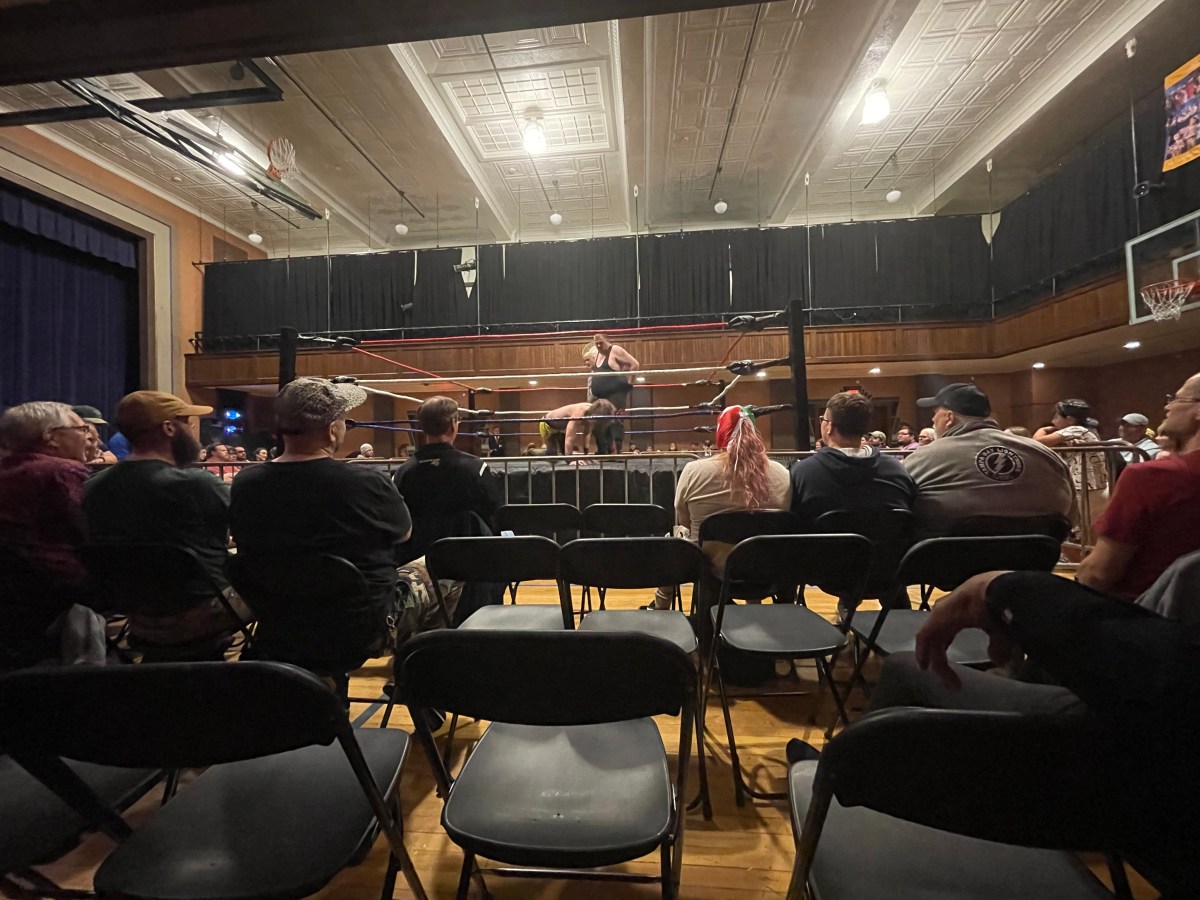
It was Saturday night in the main room of Burlington’s Old North End Community Center. The space, which doubles as a basketball court and a theater, had been transformed into a wrestling arena under the eye of Shane Alden, veteran wrestler and the owner of World of Hurt Wrestling.
The action looked markedly different from wrestling matches of the past, with a women’s match that featured Tiara James, a Black wrestler from Kentucky, and Taylor One Shot, a trans wrestler from upstate New York. The night’s headliner was Punjabi wrestler Jora Johl.
“They’re just high-level, high-performing athletes and they are diverse,” Alden said. “We’re accepting of all.”
At the height of his professional wrestling career, Alden, who grew up in Bennington, used to don a black leather singlet, paint his forehead a bright blue or red and occasionally slip a milky white zombie lens in one eye. Over the past decade, Alden has transitioned to a more business-oriented role, booking promotions — another word for wrestling shows — under the World of Hurt Wrestling brand.
Earlier that afternoon, Alden’s younger wrestlers, with the help of a few veterans, began lugging corner posts and cables into the gym, slowly constructing the wrestling ring at the center of the room and unfolding rows of chairs on all four sides.
Alden described World of Hurt as “the Ellis Island of wrestling,” a launching pad for up-and-comers as well as a nostalgic site of reunions with retired wrestler partners from his past. He said independent shows like his provide a refreshing contrast to the “very overproduced” shows on television that require scripts and strict time cues.
“The beauty of independent wrestling in front of a live crowd, it’s like making a movie versus theater,” he said. “If the audience responds to something, you can go in that direction. We can take the time to tell a story and get the audience involved in the drama. There’s a freedom to live wrestling.”
Pro wrestlers take on characters complete with spandex costumes, amplified personas and a hero or villain story arc. The match is often interpreted as a theatrical performance of justice.
In pro wrestling, matches pit a “face” or “babyface,” the hero, against the “heel,” the villain who antagonizes their opponent and the crowd. The audience cheers for the face, groaning when they get body slammed. When the heel gets pushed against the ropes, the crowd roars, relishing in their pain. From revenge plots to the triumph of an underdog, pro wrestling purports to mimic life’s comedies and tragedies.
“It’s society writ large in the most simple way possible,” said the event’s ring announcer, Max Vocal. (The moniker is play on his real name, Matt Vogel.)
“Like, I don’t like you because you said something, you don’t like me because I said something. We’re gonna have this physical battle in the ring to hash it out, but it’s scripted. It’s a way to release energy and tension from your life in the ring,” he said in an interview. “And it’s just, like, fun to boo. How often do you get to boo in real life?”
But in an industry — and a society — that for decades resisted giving the same platform and mainstream opportunities to women, LGBTQ+ and non-white wrestlers, these athletes are developing new storylines. They are putting forward a new face to wrestling, and dealing with old stereotypes, as they navigate their careers.
‘$12 for a front-row seat’
Several of Alden’s old friends remember the heyday of wrestling in Burlington.
Pat Lacour, who on Saturday was hawking vintage wrestling posters, and piles of action figures and playing cards, recalled seeing Andre the Giant, then known as Giant Jean Ferre, and other Montreal-based wrestlers at Burlington’s now-defunct Memorial Auditorium in the 1970s and ’80s.
Gary Hathaway, who grew up in Colchester and served as Saturday’s event promoter, got his start in the industry then, tagging along as a teen with venerated Burlington promoter Ira Blow, who booked the shows. Tickets to see Giant Jean Ferre were “$12 for a front-row seat,” he remembered.
Hathaway recalled that before the rupture that came with campier, televised shows and the broader industry shift to acknowledging professional wrestling as entertainment, there was “kayfabe.” The term refers to the strict and constant maintenance of the illusion — that wrestlers are their personas, matches are spontaneous as opposed to pre-planned, and blows and stunts are unrestrained — as reality.
In the kayfabe era, the appearance of feuds between faces and heels were kept up even after the wrestlers stepped out of the ring.
Hathaway remembered, “The babyfaces traveled with the babyfaces and the heels traveled with the heels. The guys didn’t mix and mingle. You stayed completely away from each other. You had separate dressing rooms. It was different. I was taking pictures and writing for a magazine (and) I wasn’t allowed in the dressing room.”
After the 1990s, Hathway said, World Wrestling Entertainment stopped coming to Burlington because there wasn’t a venue large enough. His hope is to revive wrestling in Burlington’s cultural consciousness to the stature it once had.
‘More seen’
The culture of wrestling has transformed radically, according to Vocal, who also produces a wrestling podcast.
“Wrestling has gotten more mainstream and moved far away from the Attitude Era of chauvinism, racism, sexism, and just blatant things that were commonplace in that time in society,” said Vocal. “World of Hurt, despite the name, is a family-friendly environment.”
The Attitude Era is what people call WWE wrestling in the late 1990s to early 2000s. The industry then was defined by more graphic depictions of violence, the use of profanity and the hypersexualization of women wrestlers.
That was when Alden got his start in the industry, a time when the scene was generally dismissive of women wrestlers. “Women were like eye candy in wrestling,” Alden said. “They came out in skimpy outfits. Maybe they really didn’t know how to wrestle. It was kind of a joke.”
A women’s match was a chance for people to go out and buy popcorn, Alden said. “Now the women wrestlers, most of them wrestle as good or better than the guys. Tonight, the girls will have one of the best matches on the card.”

In the dressing room before the match began, Tiara James was rifling through her suitcase to pick out what to wear.
Though she’s only in her second year of pro wrestling, James has had a meteoric rise, going on television multiple times and booking fights with several big companies, including WWE.
While women’s pro wrestling has “definitely become more seen in the industry,” James noted that, “on a lot of big shows, there’s only one women’s match. So I feel like as far as we’ve come, there’s still more to go.”
James wouldn’t reveal her age. “I don’t tell anyone. I’m not 30, not 21. I never had age anxiety until I started wrestling. (In wrestling,) you die when you’re 30,” she said. “As a woman, you just think I’m gonna do so many things before 30 because then the pressure is on to have kids, to get married. That’s really anxiety that I’ve never dealt with before.”
She hopes that might be changing though, pointing to Mercedes Martinez, who was recently signed by All Elite Wrestling at the age of 40.
Mid-sentence James stopped, pulling out a pair of rhinestone-studded fishnet tights with a large hole. “This is the biggest expense in wrestling!” she said with a laugh, before returning to her costume search.
As a Black woman, “I don’t think I have to act different,” she said. “I mean, sometimes you don’t want to come off aggressive. But it’s never been the first thing in my head. I just feel like I’m here. I have a job to do. I can do it just as good as anybody else.”
James sees smaller, local shows like Saturday’s, where wrestlers can interact with fans more intimately during the fight and take pictures with them after, as key to her success.
“In the long run, these are the people (who are) going to be the ones that push you to the bigger platforms. You can do all the big shows you want, but if you don’t have the small towns behind you, which is what fuels WWE, you don’t have it,” she said.
‘Hero’ or ‘villain’
Vocal, suited in a tuxedo, strutted around the ring. In a deep, rolling baritone, he bellowed into the microphone, “And now introducing our headliner for tonight, hailing from the land of warriors, Punjab, India, weighing in at a ripped and jacked 229 pounds, the Punjabi Lion, Jora Jooooooohl!”
Johl walked in, all smiles in his role as the babyface, stopping to high-five kids in the audience. He stepped into the ring, eying his competitor, Johnny Pierce, who was taller and stockier in build.
Minutes into the fight, Johl had flipped Pierce flat onto his back. Then, in a move that elicited excited cheers and the errant wince, Johl jumped into the air and landed his upper body directly onto Pierce’s torso.
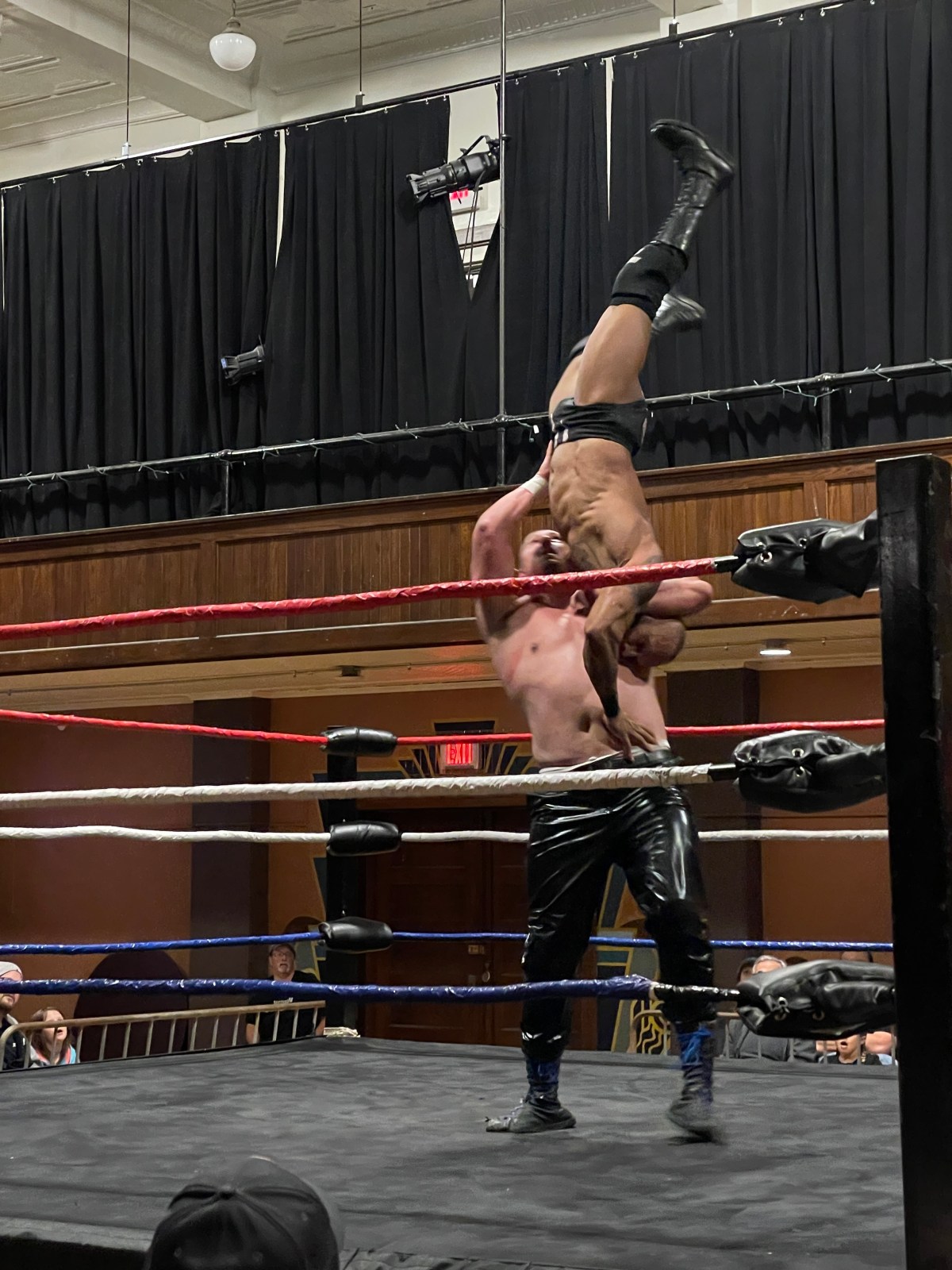
Johl, whose real name is Harpreet Singh, is from Punjab, India. Currently, Johl is with All Elite Wrestling, a Florida-based professional wrestling promotion and does indy shows on the side. He rebranded himself as Jora Johl, a common Punjabi name, shedding his former ring name of Punjabi Lion.
The decision came out of a desire to represent his origins on his own terms. “I didn’t want to do a typical gimmick,” he said. “I want to represent my people but (without) dressing a certain type of way or or making my look a certain type.”
His choice reflects a broader industry shift that acknowledges how depictions of villainy in pro wrestling casting and costumes have, in the past, collided with xenophobic, often racist portrayals.
Johl grew up watching wrestling. “Guys from our culture or maybe (the) Middle East, they would dress up a certain type of way and they were portrayed as villains,” he said. “(They) only dressed up that way so that they (could) get the markets. I always thought, why (can’t) they be just a really good athlete who’s one of us?”
‘Room to grow’
For diehard fans, it is the artistry, the athleticism of the stunts and following the storylines that matters. For casual fans, though, the suspense often lies in deciphering whether or not it really hurts.
At times, it’s clear: the blows barely connecting, the sound too quiet. Other times, as the two wrestlers’ bodies collide onto the mat with a deafening slap, it’s hard not to wince or groan.
But sometimes, the pain is real in other ways.
Taylor Kelly, a 34-year old wrestler from Troy, New York, was filling in for James’ usual sparring partner last weekend, playing villain to James’ hero.
The night before, at the World of Hurt event in Bennington, where just under 500 people attended, Kelly had brought out a baby pink and blue transgender pride flag, hoisting it above her head as she stood on top of the ropes. It was only her third or fourth match. She said she was heckled with a transphobic comment.
“Somebody in the crowd said, ‘Dude, you’re a man’ or ‘That’s a man.’ I’m the bad-guy character, so I was able to flip them off and just move on,” Kelly said. “Yeah. Sucks. First time it happened to me.”
Interactions like that have increased Kelly’s desire to undergo facial feminization surgery. “I wanted to do that beforehand,” she said. “But now, being in wrestling even more, you’re exposed.”
Kelly is grateful for the bookings she has gotten, but she said the industry as a whole could do more. “There’s still things that could be definitely made better: more matches, more opportunities, more representation. Try to include people more. I don’t know the perfect answer. But yeah, (we’ve) still got room to grow.”
That night, stepping into the ring with Tiara James, Kelly again carried the pride flag above her head. Many in the crowd cheered. The heel had become the hero.


