


This story by Corey McDonald first appeared in The Other Paper on June 15.
After a public hearing this month, the South Burlington City Council approved land use regulations that will require the installation of solar photovoltaic systems in new commercial buildings and some new residential buildings.
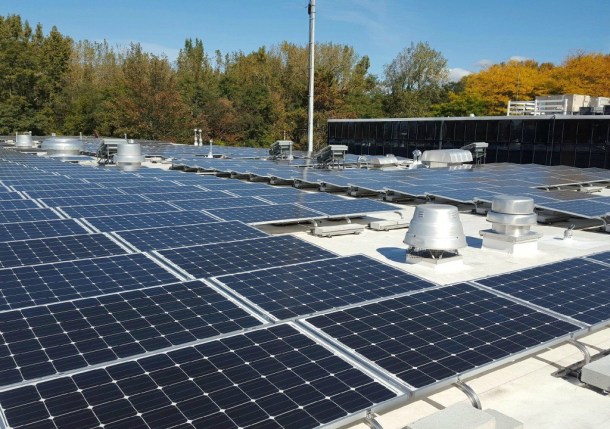
The regulations, passed at the council’s June 5 meeting, take effect immediately and follow an amendment passed in February 2022 that mandated new buildings keep 40 percent of their roof “solar-ready,” or have a section of their roof designated and reserved for the future installation of a solar-energy system. The new rules now mandate that any commercial building or residential building with four or more stories be required to use that roof space to generate some of the building’s energy through solar.
“We should be very proud of ourselves in this city,” city councilor Andrew Chalnick said. “There’s only a handful of jurisdictions nationwide that have this requirement and it makes so much sense, so really, kudos to the city for being forward on this issue.”
The regulations have been in the works since 2019, originating from the city’s energy committee and its Climate Action Task Force — which has worked over the last several years to generate provisions to combat climate change on the municipal level — before making its way through the planning commission and council.
The regulations would apply to any building that is seeking a zoning permit after the effective date of the “solar-ready” amendments passed last year, according to Paul Connor, the city’s planning and zoning director.
“Under this standard, those buildings would now be required to include the installation of a solar PV system on that solar ready zone,” Connor said.
Steve Crowley, a resident of South Burlington and energy chair for the Vermont chapter of the Sierra Club, lauded the adoption of the regulations, but added that “if anything, I feel like it’s not enough.”
“About 5 percent is the small, tiny, minuscule bit of in-state solar that’s required, and it’s not nearly enough and we’re not nearly on the right path yet,” he said. “So, the more that we can do here at the local level the better.”
The amendment follows similar regulations the city has approved as part of its Climate Action Plan, a roadmap to guide the city in reducing its carbon emissions through provisions on transportation and infrastructure.
Officially passed in October, the plan recommends reducing South Burlington’s 2019 greenhouse gas emissions by 60 percent by 2030 by addressing the city’s biggest contributors — transportation, commercial and industrial building energy usage, and residential energy usage.
By 2050, the city hopes to reduce emissions by 80 percent below 1990 levels.
An ordinance approved in November requires new buildings permitted on or after Feb. 15 to use renewable energy sources for their primary heating and domestic water heating systems.
Another move by the city — a charter change that would have allowed it to regulate thermal energy systems in existing residential and commercial buildings — was voted down 3-2 earlier this year. That charter change would have mimicked language passed by neighboring Burlington voters in 2021 that was signed into law by Gov. Phil Scott in April.
Two of the three no votes on the charter change — Thomas Chittenden and Matt Cota — are no longer on the council. Councilor Tim Barritt also voted no.
