


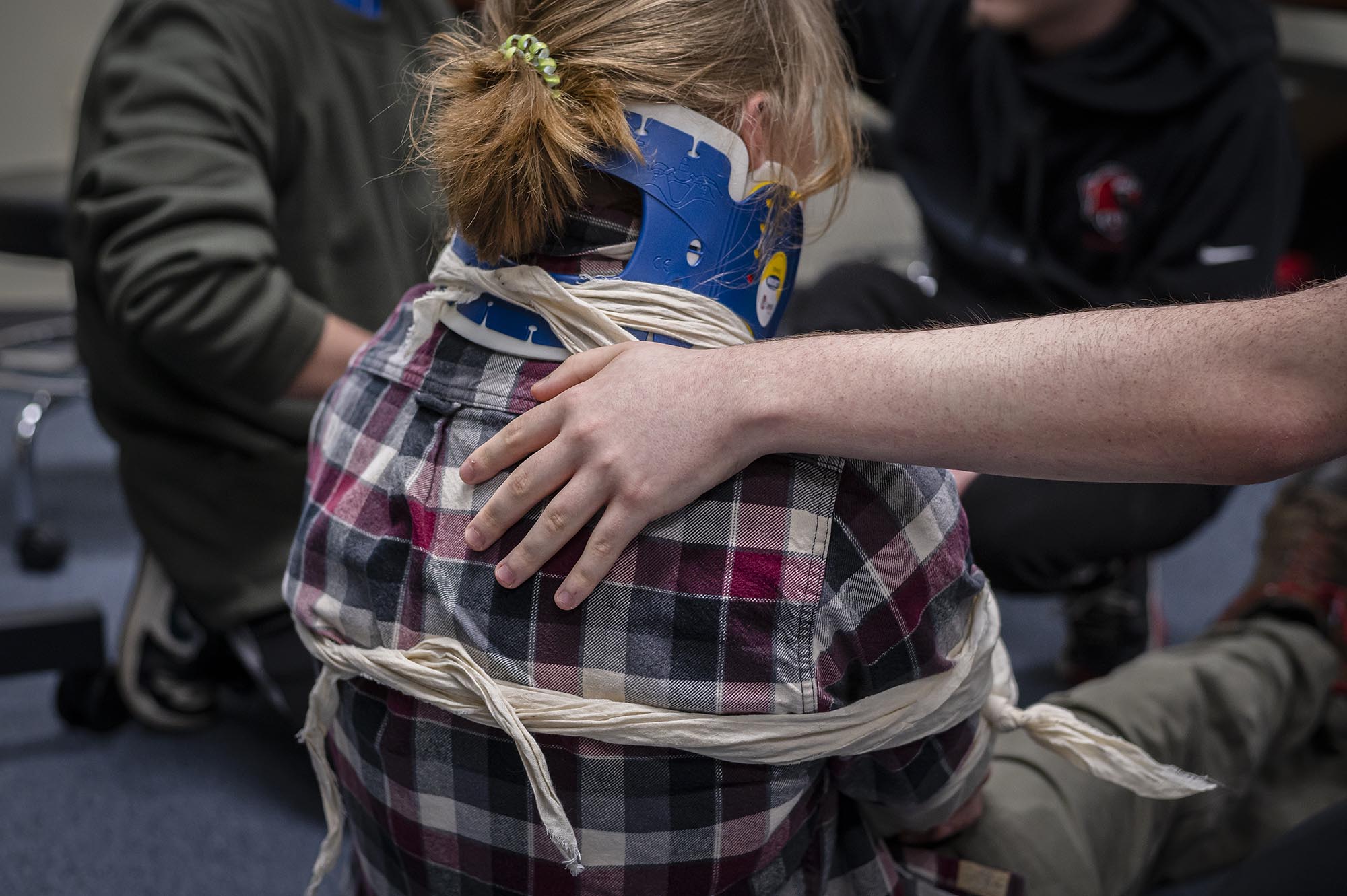
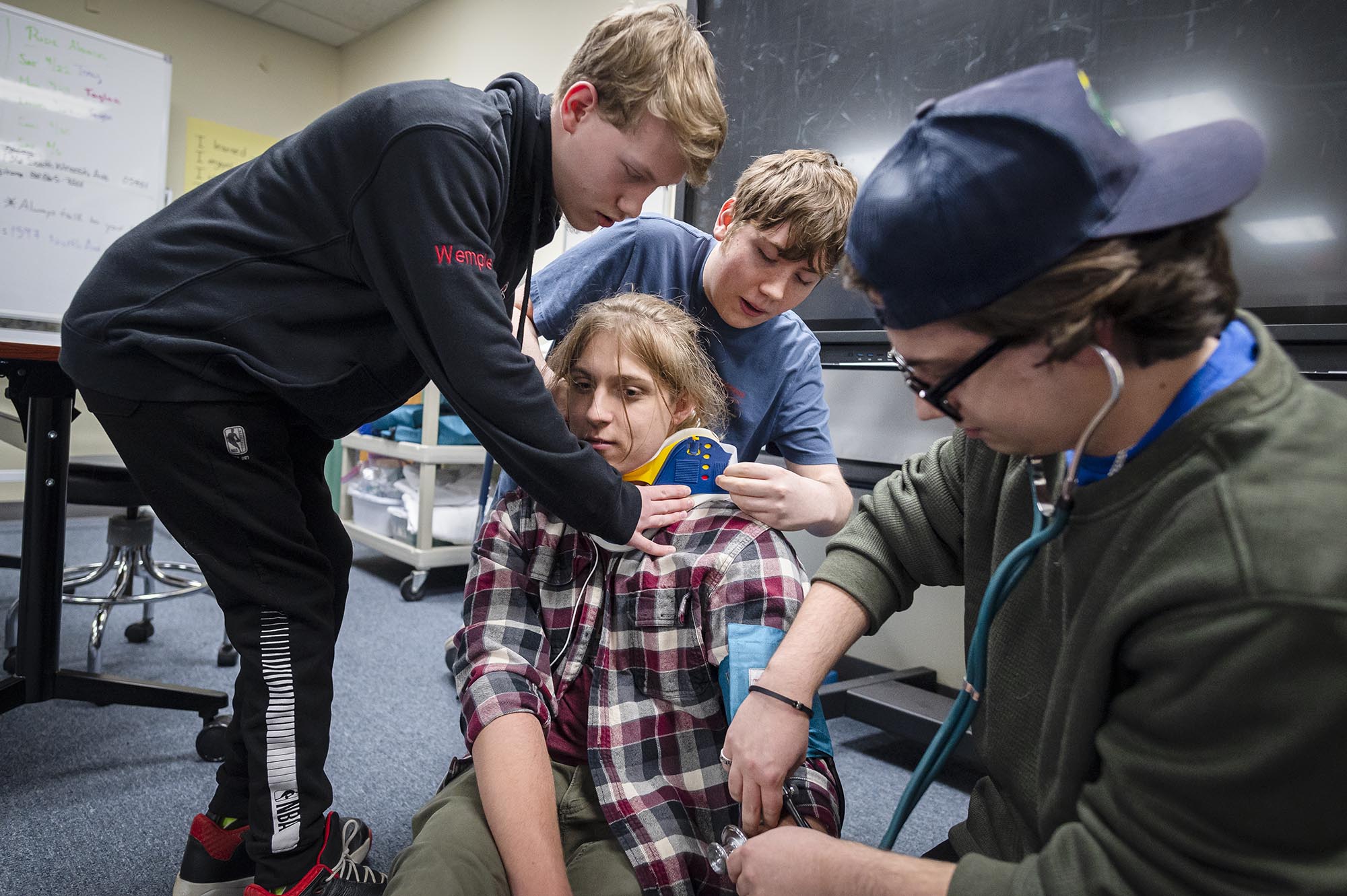
On the ground floor below a Paint and Sip studio, across the street from the temporary digs of Burlington High School in the old Macy’s store, students at Burlington Technical Center’s Health Science Academy are getting a jump on their college degree.
In addition to courses that can earn them 17 college credits, students can enroll in a certification program for phlebotomy (technicians who collect blood samples) and an EMT certification program. The students spend half a day at the academy, and the rest of the time at their high school.
The college credits include all the prerequisites for the practical nursing program at Vermont Technical College. Fourteen of those credits could be transferred to any other nursing program in Vermont.
“So basically, you’re reducing your education by about a semester” by attending classes at the academy, said Mary Anne Sheahan, director of the Vermont Talent Pipeline, a project of the Vermont Business Roundtable in collaboration with state government, area economic development agencies and private industry.
Students at Burlington Technical Center come from nine major schools. Add in private schools and alternative programs across the Champlain Valley, and 15 to 17 schools send students to the academy, said Jason Reed, director of Burlington Technical Center.
This year, the Health Science Academy program had 38 applicants for 23 seats.
Nearly all of the students — 97% — go on to college, according to health academy instructor Stacey Ladd. Over the last five years, 25% to 50% have gone to nursing school.

But there are other ways besides this direct route to get into the nursing profession.
A diagram on the Vermont Talent Pipeline website illustrates the various paths to nursing in Vermont.
The state’s four nursing programs — at the University of Vermont, Norwich University, Vermont Technical College and Castleton University, the latter two of which are merging into Vermont State University in July — are graduating only 300 to 400 nurses a year, Sheahan said.
Megan Foster, workforce development coordinator at Central Vermont Medical Center, recruits nurses from those programs for the hospital.
“There’s just not enough nurses,” said Foster said
Deb Snell, president of the Vermont Federation of Nurses and Health Professionals, said there are currently 300 openings for nurses at University of Vermont Medical Center alone.
The University of Vermont Health Network has had to rely on traveling nurses and medical support staff to fill nursing gaps, and staffing agencies have raised the rates they charge to fill those gaps, raising the network’s costs by $95 million in Vermont alone last year. (The network also has three hospitals in New York.)
Vermont’s most promising jobs
Nursing is one of Vermont’s most promising jobs, according to the McClure Foundation and the Vermont Department of Labor — defined by them as jobs that pay more than the median Vermont wage of $22.50 an hour and are expected to have at least 500 openings or more over the next decade.
The nonprofit Advance Vermont posts Vermont’s most promising jobs on its website, where people can find out about 500 careers in Vermont and can see what training they need to land a job in one of those careers.
To draw attention to the opportunities, the organizations are spotlighting the four occupations with the greatest number of projected openings through 2030: bookkeepers, carpenters, nurses and teachers.
VTDigger’s Promising Jobs series is taking up the torch to look more closely at how people are getting into those four careers. Today, we look at nursing. We’ve previously covered teaching, carpentry and bookkeeping.
The nursing profession is a good fit for people who “like to observe, learn, analyze and solve problems,” according to a brochure from the McClure Foundation.
The survey projected 4,460 job openings for registered nurses between 2020 and 2030. Registered nurses in Vermont make a median salary of $75,379.
Those numbers are backed up by the Vermont Talent Pipeline’s own survey, which forecast 6,244 openings for nurse practitioners, clinical nurse educators, registered nurses, licensed practical nurses, medical assistants, psychiatric technicians and licensed nurse assistants between 2021 and 2023, with 2,609 openings forecast for registered nurses.

Many paths to nursing
At Central Vermont Medical Center, which is part of the UVM Health Network, Foster works with local tech centers to get students interested in entry-level positions.
Once the health network hires people for support positions, they will pay for them to go to nursing school, she said.
Also, for nursing students whose families make less than $150,000 a year, the Vermont Student Assistance Corp. currently covers full tuition at Vermont state colleges, including Vermont Tech and Castleton.
The University of Vermont, Norwich University and Castleton University have four-year programs leading to a bachelor of science in nursing.
Vermont Technical College is different. It has a one-year practical nurse program and a two-year associate’s degree registered nursing program.
The program may be shorter, but is still rigorous.“It’s a challenging program,” said Johannah Driscoll, a nursing student at Vermont Technical College.
Statewide, because of a shortage of nursing teachers, about half the qualified applicants do not get into the traditional nursing programs, Sheahan said.
So Sheahan has worked with hospitals to develop apprenticeships.
A one-year apprenticeship gives health care assistants — such as licensed medical assistants or certified nursing assistants (jobs that require only a high school degree) — the education needed to qualify as a practical nurse. A two-year program qualifies them for an associate’s degree as a registered nurse.
Four hospitals are participating in the program this year: University of Vermont Medical Center, Northwestern Medical Center, Southwestern Vermont Medical Center and Central Vermont Medical Center. Mount Ascutney and Porter Medical Center are joining next year.
Sheahan said the goal of the apprenticeships is to grow the number of registered nurses completing their degree to approximately 600.

Advice to young people
Driscoll warns students to make sure that nursing is really something they want to do.
“It’s a lot of work and it’s really tiring and it takes a lot of commitment,” she said.
Ultimately, Driscoll believes that nursing is a good career choice because it offers so many opportunities.
Foster recommends that, if high school students are thinking about nursing, they should shadow nurses if they can.
She said what nursing leaders look for in new employees is an ability to multitask and to prioritize as they take care of people.
“Somebody who has been a member of a waitstaff at a restaurant made a really good candidate for their unit because they were able to do customer service,” Foster said. “They were taking care of people. They were juggling multiple tasks. They’re prioritizing.”
Snell said critical thinking skills and being observant are essential.
“Walk into the room and (the patient) is not as talkative as they were,” she said. “They’re a little more somnolent-looking. Picking up on those clues and being able to process what happened in those last couple of hours that could have brought that change?”
She describes the work as almost like detective work.
“No two days are the same,” said Snell. “You never know what you’re going to walk into.”
