

Updated at 8:32 p.m.
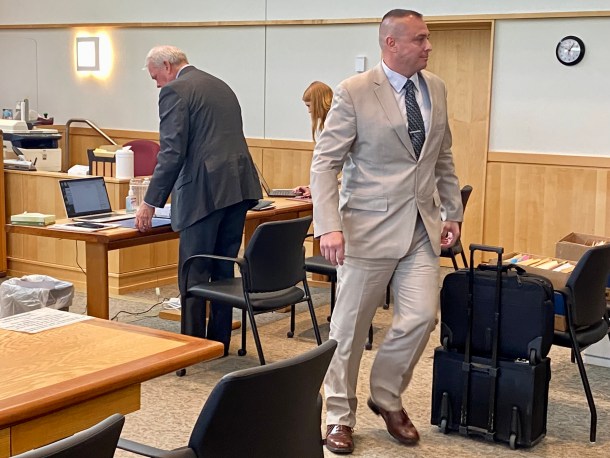
BENNINGTON — A judge threw out an assault case against a Vermont state trooper just as his trial was scheduled to start Tuesday morning, after finding that prosecutors did not produce important evidence until Friday afternoon.
The precipitous end to the yearslong prosecution launched an unusual blame game later Tuesday between the Vermont Attorney General’s Office and the Department of Public Safety — both of which suggested the other had erred in the leadup to the trial.
Robert Zink, 41, of Arlington, was scheduled for a two-day trial on a misdemeanor charge of simple assault. He was accused of using excessive force against Christopher Campbell of Shaftsbury, who was suspected of drunken driving in February 2021.
According to court records, Zink repeatedly struck the handcuffed man on his leg and head while Campbell was resisting arrest and being combative. A state police detective who investigated Zink said the two other troopers at the scene believed Zink had used excessive force. He was placed on unpaid leave in April 2021.
On Friday, defense attorney David Sleigh filed an emergency request to dismiss Zink’s case, hours after receiving from the Attorney General’s Office three reports related to evidence he’d been seeking since the spring of 2021.
Sleigh said the prosecution’s “tardy disclosure” of the documents — including one that was heavily redacted — was “extremely prejudicial” to his client’s ability to prepare for a fair trial.
The recently disclosed documents were “use of force” reports created by three other members of the Vermont State Police, who had also interacted with Campbell during or after his arrest on Feb. 23, 2021. The reports, which Sleigh said prosecutors had earlier repeatedly told him did not exist, were “exculpatory” evidence and “critical” to the defense’s trial preparations, the defense attorney said.
The prosecutor, Assistant Attorney General Paul Barkus, told the court he believed Vermont State Police hadn’t found the reports when requested earlier because they were considered protected internal affairs documents and likely accessible only to certain supervisory personnel.
Barkus said Vermont State Police provided the reports to him on Friday afternoon, two days after he asked them to double-check their files. This was prompted, he said, by reading a case document in which a trooper referred to making a use-of-force report in the Campbell case.
Barkus acknowledged prosecutors’ delay in producing the reports but argued that didn’t justify dismissing Zink’s charge. He said the state didn’t commit a willful violation and that the reports largely contained information that troopers had provided in earlier interviews.
Judge Kerry Ann McDonald-Cady, of Bennington County Superior Court, dismissed Zink’s case with prejudice, meaning he cannot be recharged.
McDonald-Cady emphasized that prosecutors had a basic responsibility to provide the use-of-force reports to the defense, possibly as early as a year prior.
“They existed. It was a matter of finding where they were,” she said from the bench shortly before 10 a.m. Tuesday, the scheduled start time of Zink’s trial, as jurors waited to be brought into the courtroom.
At the very least, McDonald-Cady said, the judge should be able to see the unredacted report to see how it could impact the case.
“The discovery violation is one that is so primary here to the principle of due process … of having a fair trial,” she said.
The judge said Zink had been preparing for trial for more than two years, while not being able to earn a salary in his profession. She said it was not fair for Zink to have to restart the evidence-gathering, then wait for a new jury trial to be scheduled months down the road when he had already undergone years of financial and career setbacks.
McDonald-Cady underscored that she didn’t find bad faith in the prosecutors’ actions, since the Attorney General’s Office had repeatedly asked state police for the use-of-force reports.
Zink, who has been suspended from work since February 2021, didn’t have an audible reaction when the judge dismissed his criminal case. But he briefly closed his eyes when McDonald-Cady announced her ruling.
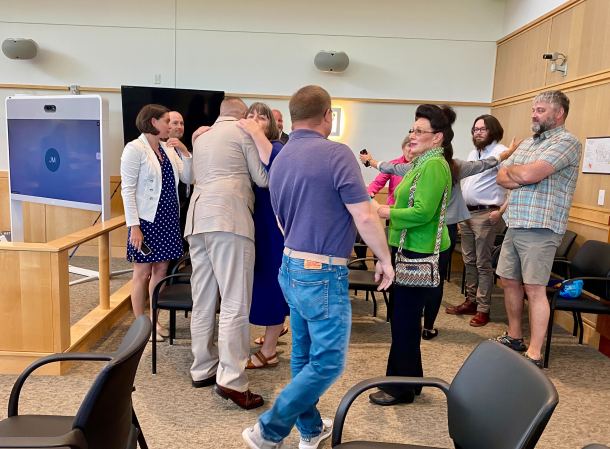
During a court recess, Zink went over to the gallery and hugged his supporters. The roughly 20 people present in the courtroom included several current and former state police officers.
Zink declined to comment after the hearing, referring questions to his attorney. Sleigh said Zink hopes to rejoin the Vermont State Police. His last assignment was with the Shaftsbury barracks.
“He wants to be a Vermont state trooper, always has,” Sleigh said. Zink joined the law enforcement agency in 2008 after graduating from the Vermont Police Academy.
Vermont Attorney General Charity Clark expressed disappointment at the outcome of Zink’s prosecution, underscoring state police’s delayed disclosure of the use-of-force reports.
“It is troubling that discovery documents — which were requested more than once by the Attorney General’s Office, and their existence denied by Vermont State Police — were ultimately produced by Vermont State Police days before trial,” she told VTDigger in a statement.
“My office will be working with Vermont State Police to determine how and why they failed to timely produce discovery documents in this case and how this situation can be prevented in the future to ensure that justice may be served,” she said.
Vermont State Police, through spokesperson Adam Silverman, rebutted Clark’s statement that the agency ever denied the existence of the use-of-force reports. He said state police made the Attorney General’s Office aware of these reports as far back as June 2021 but acknowledged that state police incorrectly described the reports as confidential, internal affairs materials.
“However, it falls squarely upon the prosecution to determine what materials are discoverable in a case, and to disclose to defense counsel the existence of any potentially relevant information,” Silverman said in an email.
He said it was unfortunate that Clark was blaming state police for the discovery violation before either office had thoroughly investigated the matter.
Silverman said that, about a couple of hours after Zink’s case was dismissed, Clark and Public Safety Commissioner Jennifer Morrison agreed to conduct parallel inquiries into the situation and discuss their findings later this week. The Department of Public Safety oversees the Vermont State Police.
“The dismissal of this case over discovery issues prior to trial ultimately serves no one and leaves the central issue unresolved,” Silverman said. “Trooper Zink believed he would have been exonerated by a jury, but now we will never know.”
Campbell, meanwhile, was charged with multiple offenses after his arrest, including drunken driving and assault on a police officer. He later pleaded guilty to driving under the influence.
In January 2022, Campbell filed a $25 million federal lawsuit against Vermont State Police, Zink and the two other troopers who arrested him. The civil case is still pending in the U.S. District Court for Vermont, though Vermont State Police has been dismissed as a defendant.
