

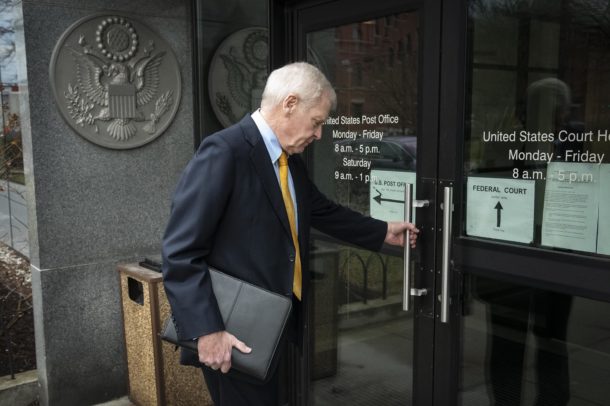
Updated at 3:59 p.m.
A federal judge has sided with prosecutors in ruling that Bill Stenger missed his chance to challenge a $250,000 restitution order in the largest fraud case in state history.
Less than a day after the judge’s decision came down, Stenger’s lawyers filed a notice in the case appealing the ruling to the U.S. 2nd Circuit Court of Appeals in New York City.
“It’s disappointing,” David Williams, one of Stenger’s attorneys, said Tuesday of Crawford’s ruling. Williams said he wanted more time to review the ruling before commenting further.
The U.S. Attorney’s Office, which prosecuted the case, declined comment Tuesday on the ruling, through a spokesperson.
Stenger, in a recent filing, argued he had newly revealed communications between state and federal regulators about financial irregularities in the federal EB-5 visa program that showed the state knew more than it had let on. His lawyers contended that state officials knew the fraud was taking place when it allowed more foreign investors to put money into projects headed by Stenger, who was Jay Peak’s president at the time, and Ariel Quiros, the resort’s owner.
The two men later pleaded guilty to federal crimes stemming from AnC Bio Vermont, one in a series of projects they led. Money came from foreign investors seeking green cards, or permanent U.S. residency, provided their investments met job-creating requirements.
Prosecutors have argued that the revelation of the communications was not new, and that the correspondence had in fact been provided to Stenger’s attorneys during the discovery process in the criminal case against him. He was indicted in May 2019.
Stenger’s attorneys wrote in their court filing they had only recently discovered the material while going through more than 6 million pages of discovery material. As a result of the new information, they sought to strike the $250,000 restitution order leveled against Stenger at sentencing last year.
Judge Geoffrey Crawford, in a ruling issued late Monday afternoon, dismissed Stenger’s argument and agreed with prosecutors that the $250,000 restitution order should stand.
“The defendant has failed to meet his burden of demonstrating extraordinary circumstances leading to a fundamental error in the prior criminal proceedings,” Crawford wrote.
“The information on which he relies to justify the timing of his motion more than a year after the sentencing hearing has been in his attorneys’ possession for more than three years,” the judge wrote. “The issues which he seeks to raise were also raised at the sentencing hearing itself.”
As a result, Crawford wrote, he denied Stenger’s request.
Stenger, in a plea deal with prosecutors, was sentenced to serve 18 months in federal prison in addition to being ordered to pay $250,000 in restitution. He ended up in prison for nine months and is currently serving the second half of his sentence on home confinement.
He had pleaded guilty to a federal charge of submitting a false statement to the government regarding the status and job-creating ability of the AnC Bio Vermont project, a $110 million biomedical center proposed for Newport.
Despite raising more than $80 million from over 160 foreign investors, the project never got off the ground, with federal regulators terming it “nearly a complete fraud.”
Each EB-5 investor put at least $500,000 into the project.
Quiros, Stenger’s business partner, was sentenced to five years in prison, while William Kelly, a key advisor to Quiros in the project, was sentenced to 18 months.
Prosecutors had sought much more in restitution during Stenger’s sentencing hearing, calling on the judge to make Stenger pay $1.66 million. Crawford eventually set the figure at $250,000.
The judge, in setting that restitution, stated the sum was an amount that was not impossible to pay and took into consideration age and health. Stenger is 74 years old.
In his ruling Monday, Crawford wrote that Stenger did not show that there were “extraordinary circumstances” that warranted changing the $250,000 restitution order.
“At the sentencing hearing, Mr. Stenger sought to demonstrate to the court that he was the unwitting victim of Mr. Quiros and the state regulators,” Crawford wrote.
“The court disagreed with his position and included a restitution obligation in the final judgment, creating an opportunity for him to seek relief on appeal,” the judge added. “He chose not to appeal – effectively conceding that there was no error in the sentence or at least none that he was prepared to pursue.”
