


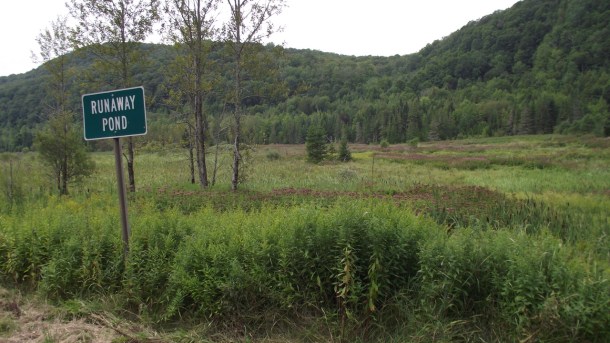

Drive north on Route 16 out of Hardwick into the tiny town of Glover and you will pass through a graceful, slender valley. If you stop to read the roadside marker, you will learn a startling fact.
Two centuries earlier, the spot where you are standing was 70 feet underwater. Though there is little evidence of it today, this valley once contained Long Pond. That is until one day in 1810 when a grievous hydro-engineering blunder gave Long Pond a new name: Runaway Pond.
That error put this town on the map, by almost wiping it off it.
In the early 19th century, water was the greatest force humans had harnessed. People set up factories and mills along rivers and streams to tap into that power for production. One of those people was an ambitious man named Aaron Wilson (or Willson — the spelling varies in historical accounts), who moved his family from Keene, New Hampshire, to Glover in 1808 to build a gristmill and a sawmill on the Barton River.
Wilson’s dream began to crumble only two years later when dry weather reduced the river to a thin stream. It was then that Wilson had what must have seemed like a good idea at the time. If Mud Pond, which fed the Barton River, wasn’t providing enough water, why not redirect Long Pond so it flowed into Mud Pond? Then his mills would have plenty of water.
He ended up getting more water than he bargained for.
On June 6, 1810, Wilson rounded up 60 men and boys to dig a small canal to coax Long Pond to flow north instead of following its southerly drainage. After a morning’s work, the men had dug a ditch about 100 feet long, 5 to 6 feet wide and 4 to 8 feet deep, depending on which account you read. When they had reached a few feet from the north end of Long Pond, they broke for lunch.
They should never have picked their tools back up. But they did, and started to dig out the last feet of hardpan and the curiously sandy soil they had noticed all morning. The sand had made their work light, but they apparently hadn’t thought much more about it.
As the last shovels of dirt were removed, Long Pond became free to flow north, down a steep hill into Mud Pond, down the Barton River and onward into Lake Memphremagog. At first, the water rushed into the canal they had been dug, but soon the flow slackened and no more water poured into the ditch. Witnesses — survivors, really — described a moment of eerie calm. They must have stared at each other, wondering, “Where is all the water going?”
They soon found out. The water was eating into the soft sand, causing the canal to yawn wider. The earth beneath them began to moan. Then it roared. Trees fell. Half-acre chunks of land, timber still intact, toppled over the eroding bank.
The men ran for safety. One fell into quicksand up to his neck, but saved himself by grabbing onto a tree’s roots and pulling himself free. Another was saved by a friend, plucked by his hair from the churning, sandy slurry.
Over the next hour and a half, Long Pond ran away. The pond’s 2 billion gallons shot through what had grown into a 200-foot gap. The flood hit Mud Pond below and took all of that pond’s water with it. Picking up boulders and trees as it crashed forward, the flood’s leading edge presented a 40-foot wall of water.
People downstream in Barton heard the growl and thought it was an earthquake accompanied by thunder. But one witness on a hillside saw what was happening: “The forest from Glover was coming down upon Barton.”
Fearing that someone might be working in Wilson’s mill — often the person is identified as Wilson’s wife — a man tried to race the torrent through the woods. Toppled trees formed momentary dams, slowing the floodwaters and making the race a fairer contest.
Wayne Alexander, a 20th-century historian who was probably the leading expert on the incident, believed the runner was a young man named Spencer Chamberlain, a tall, wiry man known for his speed. His heroic run is remembered annually on Glover Day, when the town holds a 5.5-mile road race named after what onlookers allegedly yelled as he ran. It’s called the Run, Chamberlain, Run.
The water obliterated the gristmill. It also destroyed two sawmills, five bridges, and a blacksmith’s shop, allegedly leaving an anvil lodged in a tree. The flood carried away a horse and numerous sheep.
As it flowed, the flood discarded thousands of trees and boulders covered by mounds of dirt in surrounding fields. When the waters reached Lake Memphremagog about six hours later, they purportedly raised the lake’s level a foot and sent panicked fish swimming up its tributaries.
“Such unaccountable havoc, perhaps never was made in so short a time, and for such a distance, by an event so singular,” reported the Vermont Journal of Windsor. In its next issue, having had a week to digest the news, the Journal wrote: “Perhaps the history of America does not record a more extraordinary event.”
Thanks to luck, or to the fact that Glover was sparsely settled in 1810, or to Chamberlain’s speed, no one died in the flood.
The aftermath of Aaron Wilson’s little project, however, is still felt in Glover. Homeowners in some parts of town have reportedly had trouble digging foundations. Once they reach a depth of about 5 feet, they hit a layer of downed cedar trees — evidence of Long Pond’s sudden demise.
