


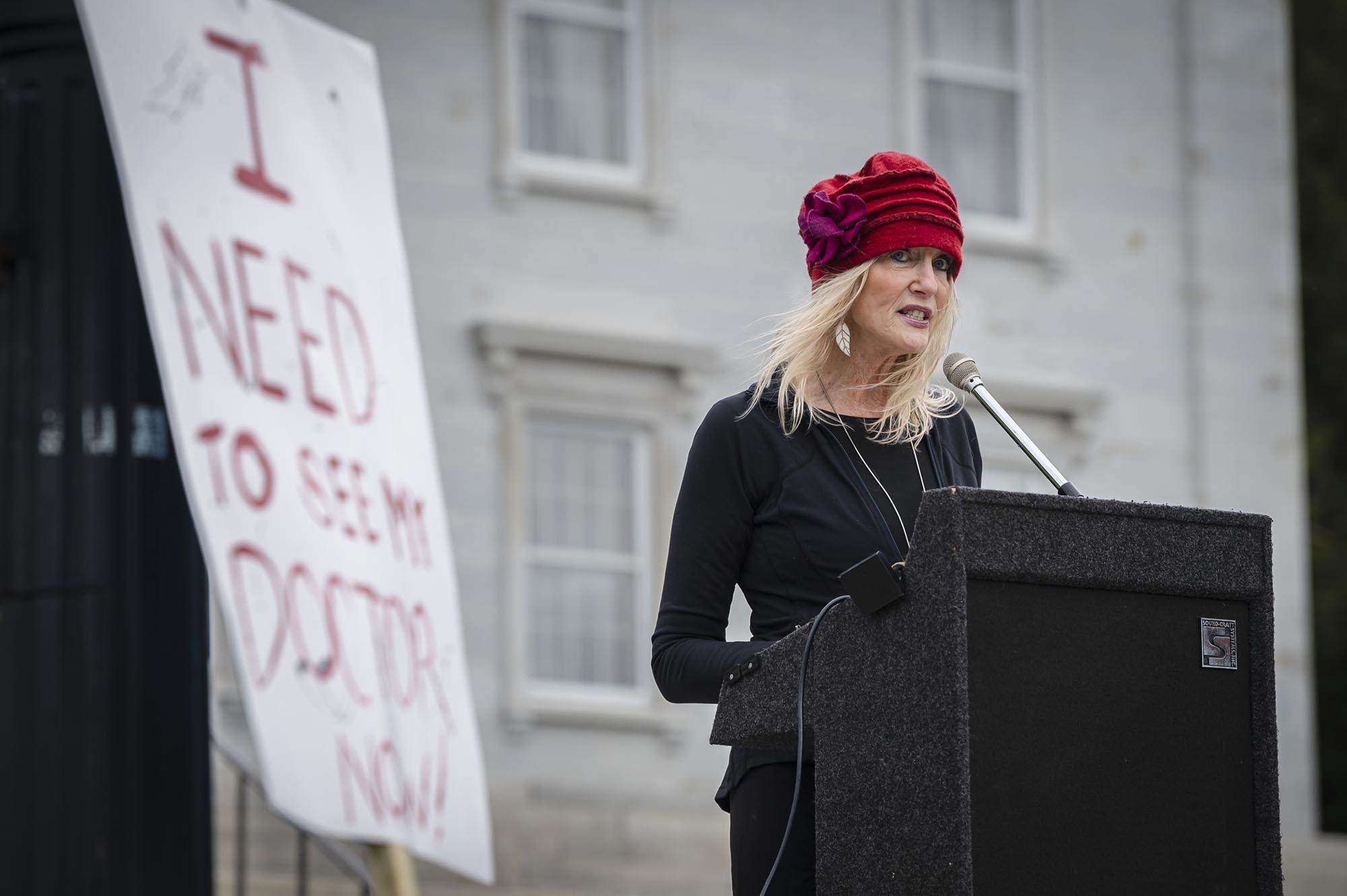
MONTPELIER — About two dozen people gathered in front of the Statehouse on Thursday to demand better health care for incarcerated people in Vermont.
The rally, led by organizers with Vermont Just Justice, a nonprofit and blog advocating for criminal justice reform, was spurred by the death of David Mitchell, 46, who died April 17 at Southern State Correctional Facility in Springfield after complaining he couldn’t breathe.
“We hear all politicians say, ‘We have to look out for the most vulnerable,’” Will Hunter, an advocate who provides housing for recently incarcerated people, said to the crowd. “I think it’s safe to say, somebody with an oxygen tank, in a prison, who’s had his liberty taken away, is pretty far up on the list of the most vulnerable, and we didn’t do a very good job taking care of David Mitchell.”
Five witnesses who were incarcerated near Mitchell at the time of his death told VTDigger Mitchell begged for help before and after he was briefly seen by medical staff on the morning of his death. All five also said a corrections officer told Mitchell he would be sent to segregation if he didn’t stop complaining about his trouble breathing.
Four said he used an oxygen tank. Corrections Commissioner Nick Deml previously told VTDigger that Mitchell, who was the 12th person to die at the Springfield prison since January 2022, had a “robust medical history.”
On Thursday, Haley Sommer, a corrections department spokesperson, said no one had been placed on leave as a result of Mitchell’s death, and there is no indication of misconduct. Investigations by the state police, Department of Corrections and Defender General’s Office are ongoing, she said.
Mitchell’s cause of death was chronic obstructive pulmonary disease — often shortened to COPD — according to his death certificate, dated last week. His manner of death was listed as natural. An autopsy is still pending at the Chief Medical Examiner’s Office in Burlington.
At Thursday’s rally in front of the golden dome, criminal justice reform advocates waved homemade signs and decried Mitchell’s death, questioning the care he received.
They also criticized the health care provided in Vermont’s prisons.
“Our incarcerated folks are easy targets,” Leslie Thorsen, a registered nurse and advocate, told the crowd. She noted the state plans to spend more than $33 million on a new health services contract with Wellpath LLC. “Take the profit out of prison health care, and prevent another death sentence.”
In an email to an organizer, which VTDigger verified with the corrections department, Deml wrote that about 1,000 of the 1,300 people in the corrections department’s custody suffer from a chronic illness — a 47% increase since 2015. The average person in the department’s custody is prescribed 5.5 medications, and 70% of people are prescribed psychotropic medication (those that affect mood or behavior), he said.
In 2022, requests for medical attention rose 18% year over year, according to Deml. Medical visits rose 27% in that same time.
At the rally, however, Thorsen called the department’s use of those statistics “victim blaming.”
Several incarcerated people who spoke to VTDigger about Mitchell’s death have also shared their own stories about health services in Vermont’s prisons.
In a video interview from prison on Thursday, John White, 35, who first told VTDigger his account of David Mitchell’s death, said he struggled to receive adequate health care while housed at the Springfield prison.
White entered Springfield with endocarditis — a heart infection that causes heart inflammation — and was placed in the infirmary as he received antibiotics, he said.
“I was supposed to have weekly televisits with UVM (Medical Center),” White said, but he never did.
He was told he was scheduled to see a pulmonologist and cardiologist, but according to White, he never received that care, either.
Months later, he said he developed shortness of breath.

In the days after Mitchell’s death, White was transferred to Northwest State Correctional Facility in St. Albans. Since the move, White said he’s received significantly better health services, with more prompt responses to his requests for physical and mental health care.
At the Thursday rally in Montpelier, people concerned with health care in Vermont’s prisons gathered to show their support for those who had recently died while incarcerated.
Among them was Lt. Gov. David Zuckerman.
“I think it’s important that folks who are incarcerated still have some basic rights,” Zuckerman said in an interview. “If they’re in the custody of the state, basic needs like decent conditions and health care are part of that, and we should certainly highlight if that’s not what we’re doing.”
Perhaps the state could find a different way to house “terminally ailing” and “significantly older” members of the prison population, Zuckerman suggested, to show them more “dignity” at the end of their lives.
Zuckerman said he was “not deeply” aware of the details surrounding Mitchell’s death, but he hoped corrections would take seriously any patterns of possible issues in its facilities.
“I don’t know the conditions in Springfield per se, but if we are seeing more frequent health challenges,” he said, “then I would hope the Department of Corrections would look into that.”

