


This story by Aaron Calvin was first published by the News & Citizen on April 27.
For over a hundred years, there has been a Wilcox on Cady Hill in Cambridge, and, with relatively little interruption, there’s almost always been a Wilcox delivering mail for the Cambridge Post Office.
Richard Wilcox worked as a mail carrier in Cambridge, a career from which he retired at the end of March. He worked the same routes as his grandfather, Clyde, and the same routes as his father, Reg, and now, the same routes where Richard’s son, Richie, delivers.
For over a century, four generations of Wilcox men have stuffed the mailboxes in Cambridge.
Each member of the Wilcox dynasty saw his fair share of challenges and changes, but the part of the job that always kept Richard going, through rain and sleet and snow, has been shared across generations.
“I want to thank the people I delivered to for the joy they gave me,” Wilcox said, reflecting in the kitchen of his home one Sunday following his early April retirement. “The smiles, the laughter, the conversation. The people were great.”
The people kept Wilcox on his route every day, despite some of the unwelcome changes brought by the appointment of Postmaster General Louis DeJoy under President Donald Trump that were exacerbated by the surge in package delivery following the coronavirus pandemic.
Now that he’s retired, Wilcox has some choice words for the postal service’s management structure and the way it has driven its remaining employees ever harder to keep up with the endless surge of boxes in all shapes and sizes.
In the six months preceding his retirement, Wilcox never had a non-Sunday off, and his son, Richie, who started on the job last August, still hasn’t a day off other than Sunday.
“I feel the customer service has gone down to some extent, that’s just my opinion. Some people would say, ‘Well, you’re just bitter.’ No, I’d probably do it all over again, but things are so different now,” Wilcox said.
Blood and ink
From the top of Cady Hill, Richard Wilcox still has the same view that his grandfather enjoyed, looking out over Pleasant Valley to Sterling Ridge.
Clyde Wilcox managed a working farm with 15 Jerseys that required milking morning and night. In 1919, he became a mail carrier, working in a horse-drawn carriage — or sleigh through the long winters — until the 1930s when motorized vehicles came on the scene.
Young Reg Wilcox would regularly ride along to help his father, running mail up the long dirt hills that the car couldn’t reach. When Clyde fell ill, Reg took up the mail mantle, and took up the job fulltime as World War II ended.
A 1983 Burlington Free-Press article commemorating Reg Wilcox’s nearly 40-year career as a mail carrier remarked that he always worked late around the holidays to ensure packages and letters reached their destination in time. He knew everyone’s name along his route and had personal relationships with the people in the houses he delivered to.
His son, Richard, tried to do the same.
“They want you to just use a number, write down the numbers,” Richard said. “I’ve always preached name recognition. I mean, there’s a lot of names that I had to remember, but I was younger.”
He always took a package to the house if he could. He always had a treat in his pocket to calm an irate dog. He was always in his baby blue Subaru, which he inherited from his dad. He was on his third Subaru when he retired.
Customers gave Reg Wilcox Christmas gifts every holiday season and sent him home with vegetables from the garden in the summer. They did the same for Richard.
Wilcox, 69, took a more circuitous route to the postal service than his father and grandfather. He spent four years in Vietnam with the U.S. Air Force before returning to Vermont with his high school sweetheart, Theresa, whom he had married before heading overseas. After working for General Electric for 25 years, the plant shut down. So, in 2002, he took up the family occupation, starting part-time as a delivery carrier.
He stuck it out for 21 years, enjoying the relationship he built with the Cambridge-Fletcher-Fairfax community across his 54-mile route comprised of over 500 mailboxes.
Package weight
As complaints about lagging or absent postal service have plagued nearby towns like Stowe and Jericho, Cambridge has largely been absent from the conversation.
This may in part lie in the seasoned veterans that occupied its staff. But just a month before Wilcox left the postal service, so did Bonnie Hitchcock, who had worked as a postal clerk at the Cambridge Post Office since the 1970s.
Broadly, Wilcox sees a labor shortage as the primary driver of patchy delivery service reported by some post offices over the past few years.
“There’s no help,” he said. “They’re almost bare bones for help, and nobody’s hiring.”
This assessment is corroborated by other reports from troubled towns, the results of DeJoy’s austerity approach to overseeing the post office, which he has claimed will help rescue the service from unprofitability. From Wilcox’s point of view, though, they’re not lacking in expensive overhead and management. They’re missing carriers, a job that he believes requires a commitment to the community being served beyond just the base incentives.
“In my mind, this job, it’s got to be in your heart,” he said.
Responsible for an ongoing drain in the workforce is the increased demands the job makes of its frontline workers. When the coronavirus pandemic hit in 2020 and the first lockdowns began, more people turned to home delivery, a surge that has not let up.
As a result, Wilcox said carriers became more beholden to the tracking tools commonplace with delivery behemoths like Amazon that keep postal carriers to an exacting schedule, and policies that push postal workers to leave a package next to a mailbox rather than ensuring it makes it to the front door.
Theresa Wilcox grew so concerned about issues facing the post office and her husband, she wrote a letter to Sen. Bernie Sanders.
In response, Sanders called mail delay “unacceptable” and blamed the problems squarely on Dejoy. “These delays, service issues, and the mistreatment of postal workers are unacceptable,” Sanders wrote.
Though Sanders last year helped to pass a law that is supposed to fix some of the postal service’s problems, his call for DeJoy’s dismissal by the Postal Board of Governors has gone unheeded.
Next generation
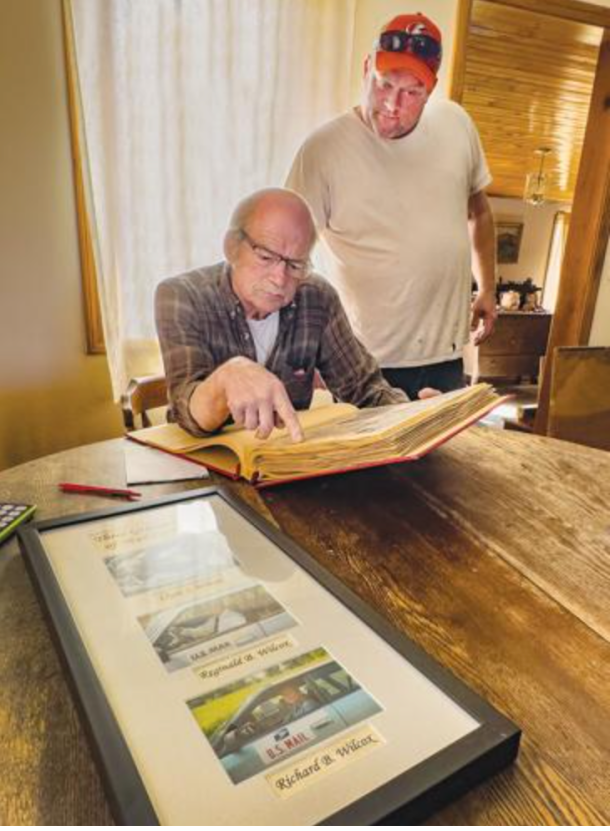
In a long frame in the Wilcox household, pictures of Clyde, Reg and Richard Wilcox are set together in descending order. Richie Wilcox may end up framed with his forefathers one day, too.
Richie, 42, has worked a range of labor-focused jobs, including sugaring in Pleasant Valley. Despite its challenges, postal carrying offers solid union work. But it can be the kind of job that makes you dread Monday morning.
“Monday’s always hard because we got two days’ worth of mail,” Richie Wilcox said. “We’re not open on Sunday, so they save it all for Monday.”
Instead of driving his own car, as Richard did, Richie pilots a Mercedes delivery van owned by the postal service, which got stuck in the snow and had electrical problems all winter.
Still, it may be better than a horse-drawn sleigh, which, according to Richard, his grandfather Clyde warmed by a rock that had been on the woodstove through the night, keeping his legs warm as he delivered the mail through those winters long past.
