


The news shot through the North Country faster than whitewater in rapids: The age of the major log drives on the Connecticut River was coming to an end.
But there would be one last hurrah. The Connecticut River Lumber Company announced that it would end the tradition with the largest log drive the river had ever seen, which was saying something. The Connecticut River was already the nation’s oldest log-driving route and the longest, and it regularly carried some of the largest drives in terms of the sheer volume of logs conveyed.
During the winter of 1914-15, the company hired 2,000 men to cut trees and prepare the way for that final drive. The 1915 drive choked the river with hundreds of thousands of 20-foot-long sections of trees. Period photos show the logs filling some of the river’s widest parts from bank to bank.
When the leading edge of the drive reached Bellows Falls, its back end was in Barnet, 80 miles upstream.
Shepherding these logs to mills in Massachusetts would be 500 of the toughest men the region had ever known. The rivermen of the North Country were the cowboys of the East. Like cowboys, they transported goods to market.
The job description might sound mundane, but a mystique developed around both types of work. Whether it was herding cows or logs, both involved strength and courage, and an acceptance of danger. Both types of men were known as hardworking and hard-drinking and quick to brawl. They often traveled in packs, spent virtually all their time outdoors, had their meals prepared for them by a traveling chuck wagon, and were the inspiration for folk ballads.
Despite Hollywood’s depiction of cowboy life, however, the riverman’s was probably more dangerous. Indeed, the press found it newsworthy when rivermen weren’t killed during annual log drives.
Rivermen spent their autumns and winters as lumberjacks, felling trees and braving the considerable dangers of that profession. But come spring, when the river ice broke up and the massive piles of waiting logs could be moved downstream, they became rivermen, an elite group selected for their agility, strength and fearlessness.
A false step could mean death
For all the dangers of logging, driving logs downriver was even more perilous.
To drive their massive lumber herds downriver, rivermen spent much of their time walking across vast, floating fields of slippery logs. A false step could mean death, whether by drowning in the frigid water or being crushed between giant logs as they sped downstream.
Death was common enough that rivermen developed traditions for commemorating their dead. When a riverman was killed, he would be buried there on the riverbank, sometimes with an empty pork barrel serving as a makeshift coffin, and his boots would be hung from the nearest tree.
Along particularly dangerous stretches of the Connecticut, a succession of hanging boots once lined the shore.
Rivermen had to be particularly alert when they entered a stretch of the Connecticut known as the Fifteen-Mile Falls, which culminated in Mulliken’s Pitch, the river’s most treacherous rapids. Mulliken’s Pitch was finally tamed in 1928 when construction started on the Comerford Dam near Barnet.
During the project, workers unearthed a half-dozen pork barrels bearing rivermen’s remains.
To outsiders, it can be hard to understand that the danger of navigating these fierce rapids actually drew many men to the job, in much the same way that mountain climbers are attracted to the danger posed by a sheer rock face. Rivermen embraced the risks, which allowed them to test their skill and courage.
Boots and poles
The riverman’s only forms of protection were his calk boots, whose soles were studded with inch-long spikes, and his peavey, a wooden-handled tool with a metal spike and claw at the end. The calk boots helped rivermen maintain their footing on the slippery logs. In rough water, rivermen held their peaveys horizontally as a sort of balance pole.

A peavey — named for its inventor, Maine blacksmith Joseph Peavey — also helped rivermen do their most important, and probably most dangerous, job: breaking up logjams. A variation of a peavey, but with a blunt end in place of a spike, was called a cant hook or cant dog. These tools provided rivermen leverage they needed to roll logs, while keeping their hands and feet at a safer distance. The tools were invaluable.
Whenever lumber baron George Van Dyke saw one of his men fall in the river, he would supposedly yell, “To hell with the man! Save the cant dog!” He probably wasn’t entirely joking.
Rivermen employed a variety of tricks during the drive. One involved jumping onto one end of a log, which would naturally cause the other end to rise up into the air. The riverman would then run up the rising log until it had righted itself.
And to steer the log gently, a skilled riverman could deftly roll the log to the side with his feet, like you might have seen in a log-rolling contest.
Big trees were for the Royal Navy
People began driving logs on the Connecticut as early as the mid-1700s. The most coveted logs then were extremely long, straight sections of white pine, often measuring more than 100 feet in length and 3 feet in diameter. These were destined for England, where they were needed as masts for the Royal Navy.
In fact, it was illegal for colonists to cut white pines with a diameter of 24 inches or more for their own use, since those were reserved for the king’s use.
The Crown’s monopoly on the largest trees was a major complaint of residents of northern New England in the years leading up to the Revolution. Defying the cutting ban could land you in serious trouble.
In 1769, a court in Windsor found a logger guilty of cutting 16 large pines. He claimed he merely cut the trees to clear a meadow. It didn’t help his case that he had signed a contract to ship the logs down the Connecticut and sell them. He was fined 800 pounds and jailed for several months.
The British surveyor general and four deputies traveled through the Northern Forest, marking the bark of particularly fine “mast pines” with the king’s “broad arrow” symbol.
Legend has it that some trees marked for the king’s use are still growing in Vermont today. Since white pines can live more than 400 years, it is at least theoretically possible.
In the 1800s, lumberjacks fashioned logs into rafts that were shipped downriver. The rafts had the advantage of being able to hold other goods for market on top of them. The disadvantage was that they had to be broken down into pieces no wider than 7 feet to fit through canals along the river, and then reassembled below the canal.
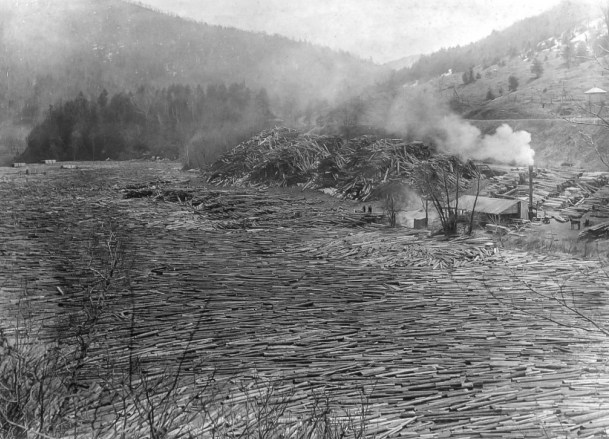
Lumberjacks conducted their first so-called long log drive in the late 1860s. For half a century, these log drives were regular summer occurrences. Connecticut Valley residents would hear the drive’s approach from miles away, like distant thunder, as the logs collided with each other.
The drive’s arrival meant that mills had to open their dams and therefore lose their power source, halting work to let the logs pass. The mill closures threw laborers out of work for days or even weeks.
Communities made the best of it, though, turning out to watch the spectacle of the brave rivermen plying their trade.
In the end, the long log drives on the Connecticut River were victims of their own success. The drives allowed the lumber industry to move an unsustainable volume of trees downriver. By 1915, the forests of northern New England were greatly depleted, so it did not make economic sense to continue the long log drives.
For a little over a decade, lumber companies continued to drive pulpwood in 4-foot lengths downriver. But these drives required less skill and courage from the rivermen. The drama and mystique of the fabled long log drives was a thing of the past.
Note: If you want to learn more about New England’s log drives, there is no better source than Robert E. Pike, whose books including “Tall Trees, Tough Men,” and “Spiked Boots.”
Correction: When the leading edge of the 1915 log drive reached Bellows Falls, its back end was in Barnet, 80 miles upstream. The original version of this column mixed up the geography.
